

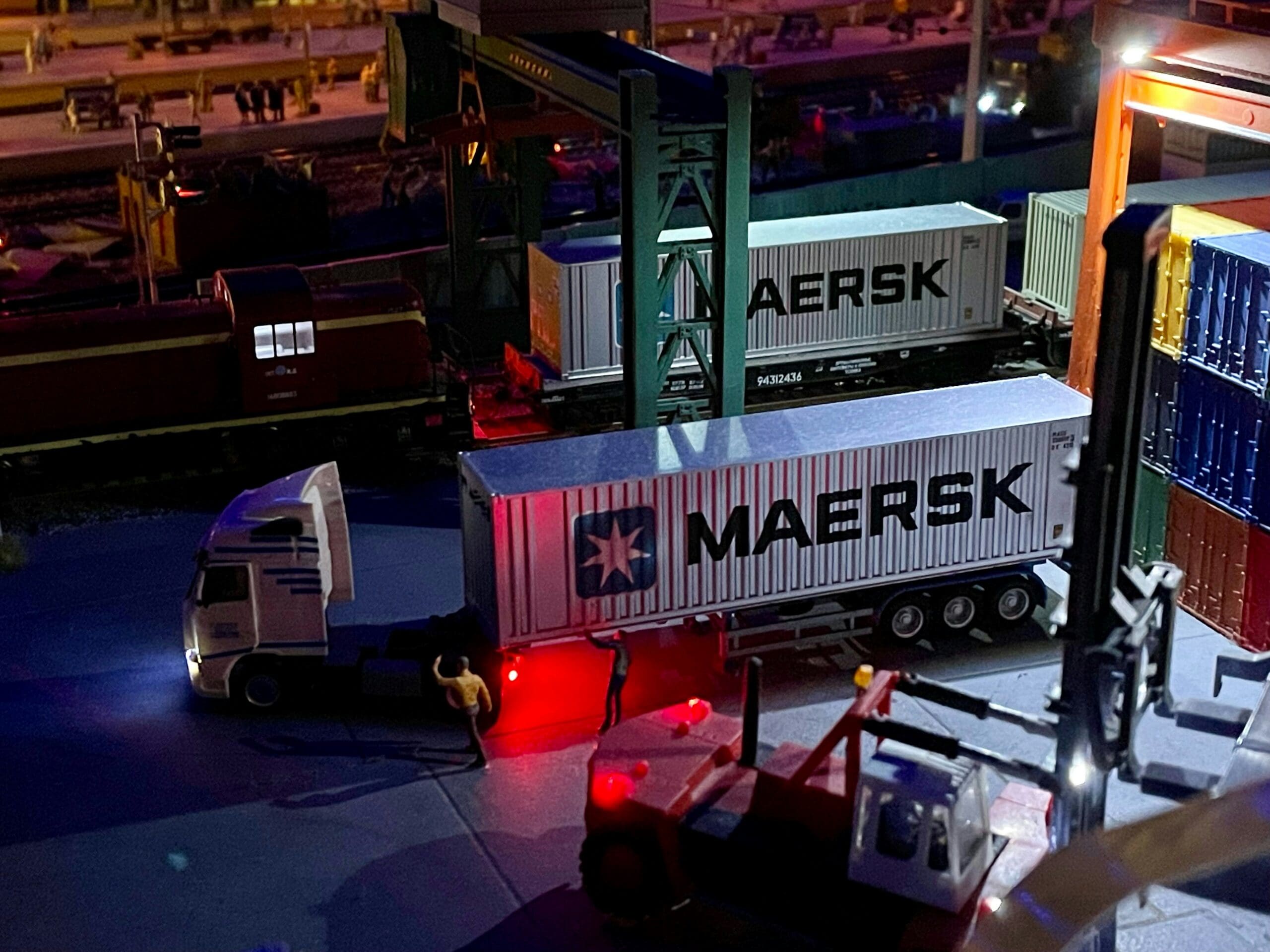
Maersk has built one of the broadest logistics platforms in the market. The next phase is making that platform operate as a coordinated system when conditions are not stable.
Maersk’s direction is now clear.
The company is no longer positioning itself as only a container shipping line. It is trying to manage more of the customer’s logistics flow: ocean shipping, terminals, inland transport, warehousing, customs, air freight, and supply chain services. That shift reflects a simple reality. Ocean freight is essential but volatile. Integrated logistics offers a way to participate in more of the customer’s operating model and smooth that volatility over time.
The foundation is in place. In 2025, Maersk reported $54.0 billion in revenue, with improving performance in its Logistics & Services segment and strong results in terminals. Ocean volumes grew, reinforcing the scale advantage that still anchors the business.
That matters because Maersk is not moving away from ocean. It is building around it.
Ocean provides reach, asset control, and customer access. Terminals extend that control into physical nodes. Logistics services bring Maersk closer to how customers actually run their supply chains. Taken together, this is one of the more credible attempts in the market to connect infrastructure with customer operations.
But assembling the pieces is the easier part.
The harder part is making them behave like one system.
Ocean shipping runs on fixed schedules and asset utilization. Warehousing is driven by customer-specific demand patterns. Inland logistics responds to exceptions. Air freight operates on urgency and cost trade-offs. Customs brokerage depends on documentation and local compliance processes.
These are not naturally aligned activities.
That is why disruption is the real test.
When vessels reroute around Africa instead of transiting the Suez Canal, transit times extend, schedules drift, and inventory plans start to break down. At that point, the customer does not need better visibility alone. The customer needs to know what the delay means across the rest of the network.
Does inventory arrive too late for production? Does labor need to be rescheduled? Should stock be reallocated regionally? Is air freight justified for part of the flow? Are customer commitments at risk?
This is where the integrated model either creates value or falls short.
Maersk is increasingly in a position to answer those questions because it participates in more of the flow. That is the strategic advantage. But participation is not the same as coordination.
The next phase of this strategy is not about adding more services. It is about linking decisions across services. Can the ocean delay inform warehouse actions? Can inland capacity adjust in time? Can the customer see one operating picture instead of several?
That is where integrated logistics becomes real.
There is also a commercial dimension. The goal is not just revenue expansion. It is revenue quality. Ocean shipping will always carry exposure to rates and capacity cycles. The integrated model should create more durable customer relationships, increase switching costs, and give Maersk more ways to stay relevant when conditions change.
That is the longer-term prize.
Maersk’s strategy is gaining traction because the structure is now credible. The company has the assets, the network, and the customer access. What matters next is consistency.
Integrated logistics will not be won by offering more services. It will be won by coordinating them when the network does not behave as planned.
That is where Maersk is heading. And that is where the real advantage sits.
Research & Analysis
A practical framework for A2A coordination, MCP, and graph-enhanced reasoning in modern supply chain systems.
AI is moving beyond isolated copilots and into coordinated, operational decision systems. This ARC Advisory Group white paper explains how A2A, MCP, retrieval architectures, and graph-enhanced reasoning are beginning to reshape supply chain execution, visibility, and resilience.
Free download • 10-minute read
Independent ARC research for supply chain leaders and technology decision-makers.