

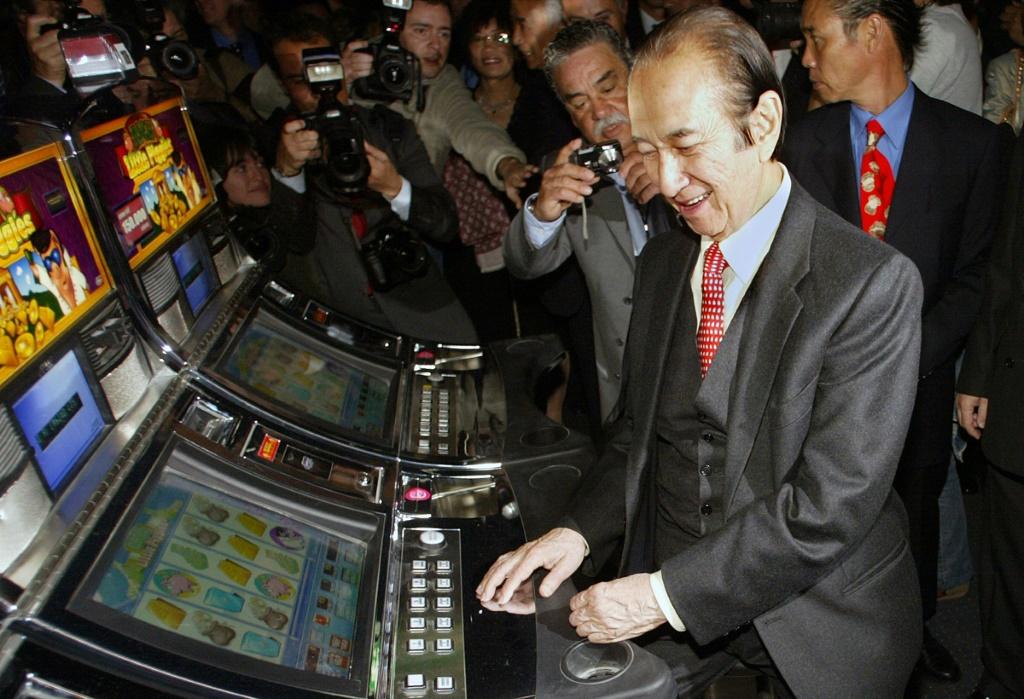
Stanley Ho, the Hong Kong-born tycoon who made billions transforming neighbouring Macau from a sleepy Portuguese outpost into the world's biggest gambling hub, died on Tuesday at the age of 98, his family said.
Known as the "godfather" of Macau's casinos, Ho was instrumental in turning the semi-autonomous city on China's southern coastline into a gambling boomtown.
He fathered at least 17 children and speculation about how his vast fortune would be divided among his offspring has long occupied Hong Kong's tabloid media alongside public family feuds.
Family members said Ho passed away shortly after 1.00 pm local time in hospital.
"My father will live in our family members' hearts forever, and the hearts of all the people who benefited from him and were encouraged by him," daughter Pansy told reporters.
China's state-run CCTV described Ho as a "patriotic entrepreneur".
Ho monopolised the gaming industry until 2002, when the government introduced foreign investors sparking a boom which saw casino takings contribute around 80 percent of Macau's annual revenue and overtake Las Vegas.
His Sociedade de Jogos de Macao Holdings (SJM) empire remains a major player in Macau, the only place in China where casinos are allowed.
The company took a hit alongside its competitors after China's President Xi Jinping launched a high-profile corruption crackdown in 2014, triggering a dramatic decline in high-rollers to Macau.
Gaming revenues bounced back until earlier this year when the coronavirus pandemic emptied casino floors and hammered the industry.
Most operators, however, including SJM, have ample cash reserves built up from the boom years to weather a prolonged downturn.
While many of Hong Kong's tycoons have rags to riches backstories, Ho initially had a gilded start to life.
He was the great-nephew of one of Asia's first tycoons, Robert Hotung, an influential Eurasian businessman and philanthropist who was among Hong Kong's wealthiest individuals at the turn of the 20th century.
But Ho's family fortunes collapsed during the depression years, and when World War II came he fled to Macau virtually destitute.
The war allowed him to make his first fortune -- smuggling luxury goods into China from Macau -- before securing the only gaming licence in the then-Portuguese colony in 1962.
Ho said he had never wagered a bet, even while his casinos continued to rake in billions in revenues annually. He also added to his wealth through a property and shipping empire.
A flamboyant entrepreneur, philanthropist and keen ballroom dancer, Ho first married in 1942 but subsequently had three other partners with whom he had children.
Local media said it was unclear whether or not he had married all the women he called his "wives".
Bloomberg estimates his family empire is worth $14.9 billion and a spat between rival factions in 2011 became front page news before it ended with an agreement.
Like many of Hong Kong's magnates, Ho was reluctant to retire and only officially stepped down from SJM in 2018 at the age of 96, handing over the reins to his daughter Daisy and Angela Leong, his fourth "wife".
One of his sons, Lawrence, runs rival casino and hotel operator Melco International in Macau.
In 2015 his nephew Alan Ho spent 14 months in jail on charges linked to a prostitution racket that was uncovered at the company's flagship Hotel Lisboa.
Ho had been keeping a low profile after a serious fall in 2009 at the age of 87 which left him requiring brain surgery.
Pansy Ho runs conglomerate Shun Tak, which includes ferry services between Macau, Hong Kong and mainland China and is a major property developer in Macau.
Pansy was named Hong Kong's richest woman by Bloomberg in 2018.
Earlier this year Ho's youngest son, 25-year-old Mario, shelled out HK$500 million (US$64.4 million) on a house at one of Hong Kong's most prestigious addresses, the South China Morning Post reported.
Hong Kong boasts one of the highest concentrations of billionaires in the world, but the city is also shot through with inequality, fuelled by a lack of housing, sky-high rents and low wages for blue-collar jobs.
Copyright AFP. All rights reserved.