

TRUMP Coin Faces SEC Fraud Probe Call After 98% Crash

Democratic senators Elizabeth Warren and Richard Blumenthal have asked the SEC to investigate whether the TRUMP meme coin facilitated fraud or improper enrichment after its value collapsed 98% from its peak.
Summary
- Warren and Blumenthal urged the SEC to investigate possible fraud involving the TRUMP token.
- Nearly 989,000 wallets lost a combined $3.81 billion, according to Nansen data.
- TRUMP trades near $1.47, down about 98% from its all-time high above $73.
- The request adds pressure to the CLARITY Act’s unresolved ethics negotiations.
Senators ask SEC to investigate TRUMP coin
Warren and Blumenthal sent a letter to SEC Chair Paul Atkins asking the agency to determine whether the president-linked token involved illegal fraudulent activity or allowed insiders to obtain improper gains.
“We are concerned that President Trump’s memecoin scheme may constitute an illegal scam,” the lawmakers wrote, according to CNN reporting cited by multiple outlets.
The senators reportedly asked the SEC to examine whether the project operated as a “soft rug pull.” The term describes a situation in which insiders or developers gradually withdraw support or extract value instead of abandoning a project in one sudden move.
Their letter does not establish that fraud occurred. The SEC would need to determine whether federal securities laws apply to the token and whether its promotion, distribution, or trading involved any legal violations.
TRUMP coin investors lost $3.81 billion
The lawmakers cited the scale of investor losses surrounding the Solana-based token, which launched shortly before Trump returned to the White House in January 2025.
Data from blockchain analytics firm Nansen showed that 988,905 of the 1.48 million wallets that purchased TRUMP were carrying losses by the end of June. Their combined losses reached approximately $3.81 billion.
Trump reported earning about $636 million from the meme coin, while his wider crypto-related income exceeded $1.4 billion in 2025, according to financial disclosures reported by US media. Those figures have intensified questions about whether a sitting president should benefit from digital assets while shaping federal crypto policy.
TRUMP traded near $1.47 on Aug. 4, with a market capitalization of approximately $366 million and daily volume near $159 million, according to CoinMarketCap. Its price has fallen roughly 98% from an all-time high of $73.43, although the token was slightly higher over the previous 24 hours.
CLARITY Act ethics dispute remains unresolved
The SEC request comes as senators remain divided over an ethics provision in the CLARITY Act, a broader bill intended to establish US rules for digital asset markets.
As crypto.news reported on Aug. 4, the White House had not responded to a bipartisan counterproposal from Republican Sen. Thom Tillis and Democratic Sen. Ruben Gallego. The compromise would allow state attorneys general to sue the Department of Justice if it failed to enforce restrictions on crypto activity involving federal officials.
Democrats opposed an earlier version that left enforcement solely with the DOJ. Warren has argued that passing the bill without stronger safeguards could expand conflicts of interest tied to Trump’s crypto businesses.
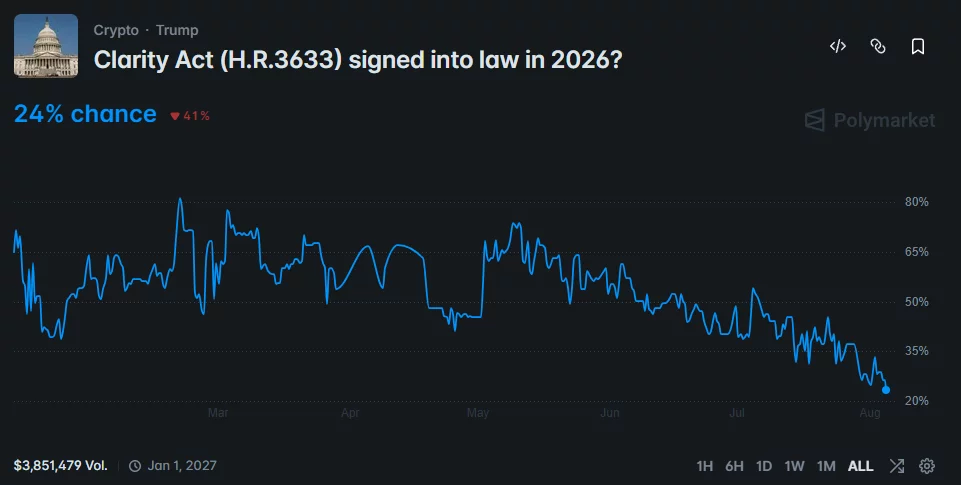
The delay pushed Polymarket’s estimated chance of the legislation becoming law in 2026 to an all-time low of 24%. The measure must still pass the Senate and resolve any differences with the House before reaching Trump’s desk.
Senate faces wider fight over developer protections
The ethics dispute is not the only issue slowing the CLARITY Act. The Blockchain Association sent an eight-page letter to Senate leaders on Aug. 3 disputing claims from the National Sheriffs’ Association that the latest draft creates broad exemptions from anti-money laundering rules.
The trade group argued that Section 10604 protects developers who create neutral software without controlling customer assets or transactions. It said intermediaries that exercise control would remain subject to the Bank Secrecy Act, sanctions and anti-money laundering requirements. The Blockchain Association’s response also rejected the view that earning revenue alone makes a developer a financial institution.
The Senate ended Monday without taking action on the bill, leaving it without a publicly announced vote as lawmakers approach the August recess. Warren and Blumenthal’s request could now place the TRUMP coin and presidential crypto conflicts more firmly at the center of those negotiations.
Bitcoin Suisse Turns Regulation Into Growth
For much of crypto’s short history, growth was measured in trading volumes, token prices and the number of customers w... Read more
Circle Wins Landmark US Banking Licence
Circle Internet Group has finally secured the regulatory prize it has been chasing for more than a year, with the Office... Read more
Crypto Treasuries Chase A New Kind Of Capital
There is a peculiar irony at the heart of the crypto treasury movement. Companies that staked their futures on digital a... Read more
What Strategy's Bitcoin Sale Really Tells Us
There is a moment in every bull run when the narrative starts to fray. Not with a crash, not with a scandal, but with so... Read more
The Clock Is Ticking On UK Stablecoins
The world is not waiting for Britain to make up its mind. While the United States and the European Union have spent the ... Read more
From Cypherpunk To Citadel
How Crypto Moved from the Wild West to the Mainstream Financial SystemA long-form analysis of Bitcoin's journey from fri... Read more