

Banks Turn To AI Agents As Compliance Rules Demand More Proof
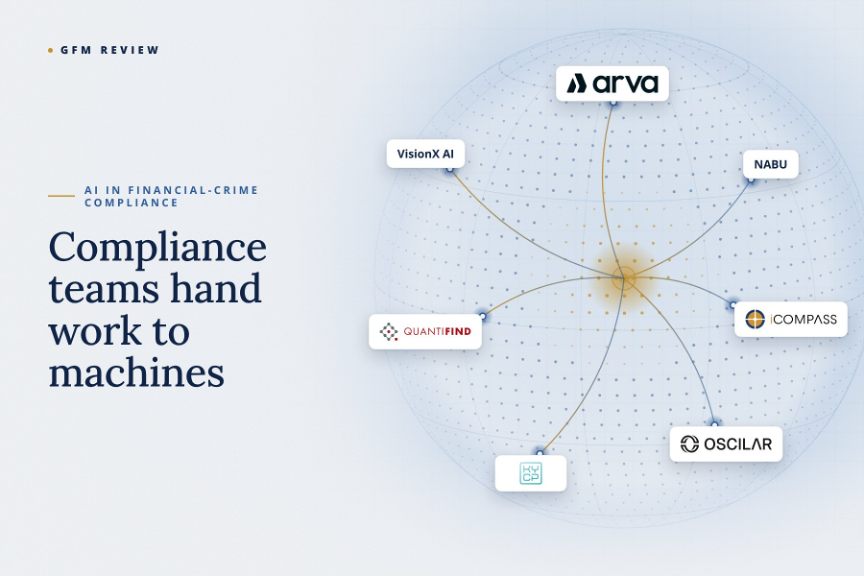
Specialist vendors are moving AI from alert triage into screening, investigations and onboarding. New rules in Singapore and the EU mean banks will have to show how those systems are governed.
Financial-crime compliance is one of banking's largest cost centres, and much of it still consists of people clearing alerts that turn out to be nothing. A group of specialist AI vendors now argues that software agents can take over a large share of that review work, from sanctions screening to customer onboarding. In November alone, several raised money, launched products or published data built on that claim. The harder question is not whether the tools clear alerts faster, but whether they can be governed in a way that supervisors will accept.
What changed in November
Arva AI, which operates from London and New York, announced a $20 million Series A on 17 November, led by Arthur Ventures with Gradient and Y Combinator. Founded in 2024, it builds agents for screening reviews, transaction monitoring investigations and onboarding, names Wise among its customers and says on its website that it processes more than one million reviews a month. On the same day, Ghent-based NABU, founded in 2025, said it had raised EUR 1.1 million from business angels, including former CCV owner Enny van de Velden, to take its customer due diligence agents into the Netherlands and Luxembourg. It claims it can automate up to 90 per cent of those tasks, with final decisions left to staff.
Singapore's VisionX AI, part of Alpha Ladder Group, unveiled AEGIS, a proprietary graph model designed to trace financial-crime networks across bank accounts and crypto wallets, with an investigation platform, TraceX, built on it. Palo Alto-based Oscilar, which combines fraud, AML, credit and onboarding decisions on one platform, said on 18 November that it ranked 32nd on Deloitte's 2026 Technology Fast 500 for North America, citing revenue growth of 2,513 per cent between 2022 and 2025. It says it serves more than 100 financial institutions.
The size of the prize explains the activity. LexisNexis Risk Solutions put the global cost of financial-crime compliance at $206.1 billion in 2023, and 72 per cent of the institutions it surveyed were already using analytics and AI in that work. In October, the incumbent processor FIS opened its AML Investigations Agent, built with Anthropic, to every US bank, including those that do not use its core systems.
The false-positive problem
The commercial case rests on a familiar weakness. Screening systems err on the side of caution and flag far more than they should. A survey of 242 sanctions screening leaders, commissioned by Quantifind and conducted by Propeller Insights in October, found that 82 per cent report false-positive rates of 70 per cent or higher, and 88 per cent are considering replacing or adding to their screening technology within two years. Respondents were overwhelmingly US-focused, with 96 per cent naming the US as their primary jurisdiction, so the results say more about American institutions than global ones.
The same survey found that 94 per cent would be comfortable with AI closing first-level alerts without human review, now or within a year, provided a complete audit trail is kept. Only 69 per cent thought their regulator would accept that today. That gap is the market in miniature: buyers want automation, but they need evidence that it will survive an examination.
Vendor claims should be read in that light. FIS expects its agent to cut first-level review time by more than 90 per cent, but that is a projection, and the efficiency figures from Arva AI and NABU are their own.
Regulators raise the governance bar
Supervisors are not resisting AI, but they are making institutions answer for it. The Monetary Authority of Singapore issued Guidelines on AI Risk Management on 7 October 2026, covering all financial institutions. They call for board oversight, inventories of AI systems and controls proportionate to risk, and they state that institutions remain accountable for AI supplied by third parties. The guidelines take effect on 7 October 2027, with some sections applying from October 2028.
That accountability rule is the opening for iCOMPASS. The Singapore regtech company, known for its ULTRA compliance operating system, launched KY-AI on 18 November to help institutions register, test and monitor internal, third-party and autonomous AI systems. "We believe organisations should know their AI just as they know their customers," said Raymond Moh, its chief executive.
In Europe, the Anti-Money Laundering Regulation will apply directly across the EU from 10 July 2027, creating a single rulebook, while the new Anti-Money Laundering Authority is still finalising technical standards. KYCP, whose client lifecycle software serves firms in more than 25 jurisdictions, released version 2.1.7 of its platform on 16 November and is presenting its configurable rules as a way to adapt to the new regime. In the US, a FinCEN proposal published in April would allow the agency to weigh whether an institution uses innovative compliance tools, including AI, when it assesses a programme.
Fewer fines, not lower stakes
Enforcement data complicate the case for urgent spending. Fenergo calculates that global AML, KYC, sanctions and due diligence penalties fell 18 per cent to $3.8 billion in 2025, after $4.6 billion in 2024 and $6.6 billion in 2023, a total swollen by a single $4.3 billion penalty against Binance. US fines fell by 61 per cent, while penalties in Europe, the Middle East and Africa rose by 767 per cent. "That drop is more about capacity and priorities than any softening of expectations," said Rory Doyle, head of financial crime policy at Fenergo.

Global AML and related penalties, US$ billion. Source: Fenergo enforcement analyses, 10 January 2024 and 13 January 2026.
Enforcement is shifting in geography rather than shrinking, and a lighter year for US fines does not reduce the alerts banks must clear.
What remains uncertain
The central uncertainty is accountability. If an agent closes an alert that later proves to involve a sanctioned party, the MAS framework leaves no doubt that the institution, not its supplier, answers for it. Explainability matters for the same reason: a model that cannot show why it cleared a case gives an examiner little to test. MAS has also said it intends to consult in 2027 on further guidance for agentic AI, so the rules for autonomous systems are unsettled.
Market structure is a second question. NICE Actimize says it serves more than 1,000 organisations in over 70 countries, and processors such as FIS can add agents to existing contracts. Younger firms must show they can plug into those systems and pass the due diligence of banks that are themselves under scrutiny.
What to watch
The next tests arrive in 2027. The EU single rulebook applies from 10 July and the MAS guidelines take effect on 7 October. Until then, the evidence that matters is not funding rounds but disclosed deployments: banks stating, and supervisors accepting, that AI has closed alerts without a human reviewer, with an audit trail to show for it.
Brazilian And Mexican Credit Fintechs Turn To Bank Debt To Grow
BBVA Spark has committed more than US$100 million to two Mexican fintech lenders this month, while Brazilian venture fun... Read more
Gulf Regulators Widen Fintech Licensing As Venture Funding Swings Sharply
Fintech supplied most of the Middle East's start-up capital in the third quarter, then regional funding almost vanished ... Read more
HSBC Swings The Axe At UK Wealth In An AI Push
HSBC is preparing deep job cuts across its UK wealth management arm. It plans to cut about half of its management and sp... Read more
Kraken's Owner Buys A Bank: The Lines Are Blurring
Payward, the parent company of the crypto exchange Kraken, has agreed to buy a European bank. It would be the first digi... Read more
Revoluts Australian Banking Licence Game Changer
Revolut has spent much of its life insisting that it is more than a bank. In Australia, it has now decided that becoming... Read more