

Brazilian And Mexican Credit Fintechs Turn To Bank Debt To Grow
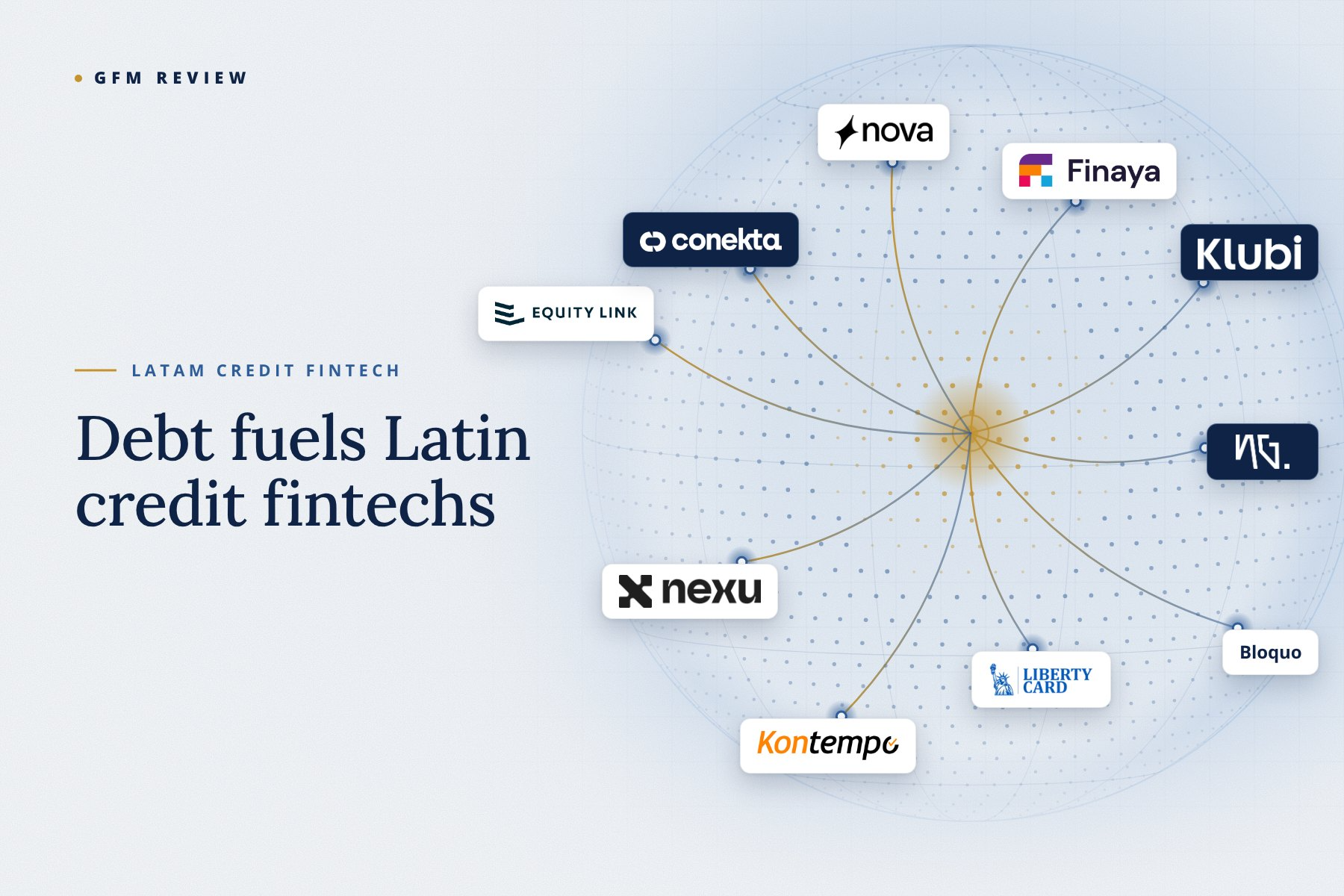
BBVA Spark has committed more than US$100 million to two Mexican fintech lenders this month, while Brazilian venture funding had its weakest month in more than a year in October. For credit-led fintechs, where the money comes from now matters as much as the product.
Two loans from one bank say more about Latin American fintech this month than most equity rounds. BBVA Spark, the BBVA unit that serves high-growth companies, announced a revolving credit line of MXN 1,013 million, about US$55 million, for Mexican auto lender Nexu on 9 November. Days earlier it provided US$53 million to Equity Link, a factoring and supplier finance company based in Chihuahua. Neither deal involved selling shares.
That matters because credit fintechs depend on the cost and reliability of the money they lend. Equity pays for technology, staff and early losses while a loan book is built; debt funds the loans themselves. A lender that can borrow from a large bank on agreed terms can grow without diluting its owners each time demand rises. The question for investors and regulators in Brazil and Mexico is whether this shift reflects maturing businesses or a scarcity of venture money.
The money is moving, but unevenly
The regional figures point both ways. Latin American start-ups raised US$1.3 billion in the third quarter of 2026, up 26 per cent on a year earlier but down 9 per cent on the second quarter, according to Crunchbase. Mexican start-ups raised US$1.52 billion in the first three quarters, about 40.7 per cent more than Brazil's US$1.08 billion, a reversal of the usual order. Endeavor Catalyst's Igor Piquet told Crunchbase that investors are concentrating on a few Mexican winners while Brazil keeps its breadth.
Brazil then had a poor October. Local start-ups announced 15 rounds worth US$118 million, the weakest month in 13 months according to Sling Hub data reported by Bloomberg Línea, and two deals took more than 80 per cent of the total. One of the two was a receivables fund rather than an equity round.
Equity is still available for firms with a distinctive product. São Paulo's Nova, which lets consumers pay Pix transfers and boletos with the limits on credit cards they already hold, in up to 12 instalments, raised a US$24 million Series A led by Canaan, reported on 11 November. NG.CASH, a digital account for younger Brazilians that reports 10 million clients, raised a US$15 million strategic round led by Blockchain Capital in September to expand payroll loans and Pix Crédito. In Mexico, Kontempo, which lets industrial suppliers offer customers flexible payment terms without running their own credit operation, raised a US$10.5 million Series A co-led by Portage and IGNIA in October, taking its total debt and equity raised above US$40 million.

Funding announced by the featured firms, 23 September to 11 November 2026, in US$ million. Klubi's figure is Techloy's conversion of more than R$20 million. Sources: LatamList, BBVA, Mundo das Fintechs, Bloomberg Línea, Latam Fintech Hub, Techloy.
Bank debt and receivables funds fill the gap
The more telling pattern is in the funding plumbing. Nexu says the new line will finance more than 10,000 auto loans through about 3,000 dealerships, distributors and brands. Equity Link will use its financing to expand in industrial sectors and to develop MONIE, an AI tool for real-time financial management. BBVA Spark has been active across the region, with LatamList also recording facilities for Chile's Galgo in September and Colombia's Bold in October.
In Brazil the equivalent tool is the FIDC, a receivables investment fund that buys loan portfolios from originators. Liberty Card, which originates payroll-deducted loans for public servants, has structured a R$300 million FIDC. It follows a tokenised payroll credit certificate sold to retail investors from R$100 through a CVM-authorised platform using B3's digital asset infrastructure. The company cites Anbima data showing FIDC issuance of R$34.8 billion in the third quarter, up 9.8 per cent on the previous three months.
Interest rates shape these choices. Brazil's central bank held the Selic at 13.75 per cent on 4 November, pausing after five quarter-point cuts since March. Banco de México cut its benchmark rate to 6.25 per cent on 5 November, its lowest level since March 2022, with two of five board members dissenting, and signalled it may hold that level for a prolonged period. Cheaper money in Mexico makes bank credit lines easier to service. In Brazil, high rates support lending margins but raise the bar for credit quality.
Regulation raises the price of entry
Regulators are tightening the frame at the same time. Banco Central do Brasil said about 240 authorised institutions fell short of new capital requirements under Joint Resolution No. 14, including 56 payment institutions, 53 direct credit companies and 29 consortium administrators. Together they need R$584.5 million to comply before the final checkpoint on 1 January 2028. That is 0.03 per cent of the system's regulatory capital, but a real burden for a young lender.
The squeeze touches several models in this group. Klubi, a digital consórcio administrator whose members pool monthly payments and take turns to receive credit, received more than R$20 million from Patria Investimentos in October in a second Series A extension, taking Patria's total above R$60 million since 2021. Bloquo, which supplies stablecoin liquidity for cross-border payments, raised a US$3.7 million seed round co-led by Crescera Capital and Triaxis Capital in November. Crescera also backed Finaya, an embedded finance platform whose clients include Assaí, Crefisa and PicPay, through its Criatec 4 fund.
Mexico is pushing towards digital payments. Conekta announced on 21 September that the CNBV had authorised it as a direct non-bank acquirer, letting it connect to card networks without a sponsoring bank. The Senate approved a Digital Economy Law on 20 October by 72 votes to 34, allowing the Finance Ministry to designate sectors where only digital payments are accepted. Arkangeles, a CNBV-authorised crowdfunding platform where individuals can invest from MXN 5,000, has begun a new phase under chief executive Eloísa Cadenas aimed at SMEs and property projects.
What the funding mix does not prove
A bank credit line reflects a lender's view of a loan book's record, not proof of future returns. Such facilities usually carry eligibility rules and can be repriced if losses rise. None of the announcements reviewed here included default rates, so the quality of the underlying credit cannot be judged from public information. Scale claims, such as Bloquo's US$2 billion in annualised volume or Conekta's more than US$15 billion processed, are company figures.
Pix brings opportunity and competition. It set a daily record of 319.7 million transactions worth R$180.5 billion on 6 November, according to the central bank. Every product built on it competes with banks that use the same rails and already hold the customers.
The next tests are Brazil's six-monthly capital checks and whether Banco de México holds rates as signalled. For the lenders, the evidence that matters is whether bank lines are drawn and renewed on similar terms, and whether loss rates hold as books grow. If debt keeps reaching firms such as Nexu and Equity Link while equity stays selective, the region's credit fintechs will be judged less as start-ups and more as specialist finance companies, on underwriting rather than growth.
Gulf Regulators Widen Fintech Licensing As Venture Funding Swings Sharply
Fintech supplied most of the Middle East's start-up capital in the third quarter, then regional funding almost vanished ... Read more
HSBC Swings The Axe At UK Wealth In An AI Push
HSBC is preparing deep job cuts across its UK wealth management arm. It plans to cut about half of its management and sp... Read more
Kraken's Owner Buys A Bank: The Lines Are Blurring
Payward, the parent company of the crypto exchange Kraken, has agreed to buy a European bank. It would be the first digi... Read more
Revoluts Australian Banking Licence Game Changer
Revolut has spent much of its life insisting that it is more than a bank. In Australia, it has now decided that becoming... Read more
The AI Bank Is Coming, But Who Controls The Risk?
Artificial intelligence is no longer something banks discuss as a distant possibility. It is already working behind the ... Read more