

Wolford Owner Lanvin Says Luxury Is Never Out Of Style
Joann Cheng says luxury firms deliver in times of economic distress
The owner of storied French fashion company Lanvin and hosiery brand Wolford has big ambitions to become the world's first China-based luxury giant.
It might seem like a tall order.
The global economy is slowing, Covid-19 continues to cast a shadow over the important Chinese market and rising prices have eroded the buying power of most shoppers.
But Joann Cheng, chairman and chief executive of Lanvin Group, is undaunted by those challenges.
"Luxury is a very resilient industry", she tells the BBC. "People always want to consume quality stuff."
Ms Cheng, whose company also owns St John Knits and Italian shoemaker Sergio Rossi, says she sees plenty of opportunity to grow, especially in the US and China, which is expected to account for half of the industry's revenue by 2025.
Sights on expansion
The firm wants to open 200 new stores globally by 2025 and is looking for more labels to buy, in a bid to boost revenue to $1bn in two years - and make the company profitable.
This week, the company made its debut on Wall Street, raising a $150m war chest for expansion.
"We feel quite happy and very excited about this moment," Ms Cheng says, noting that she is anticipating a big rebound as China starts to loosen its Covid restrictions.
"We want to want to build this brand strategically at a large scale in the future and then demonstrate to the world that from Asia you have the first luxury group."
But the money brought in by the listing was far less than the $544m the group said it hoped to raise in March.
Shares on the firm's first day of trading on the New York Stock Exchange also closed down 25%, a sign that investors remain sceptical of a turn around in the storied fashion house's fortunes.
Image source, Getty Images
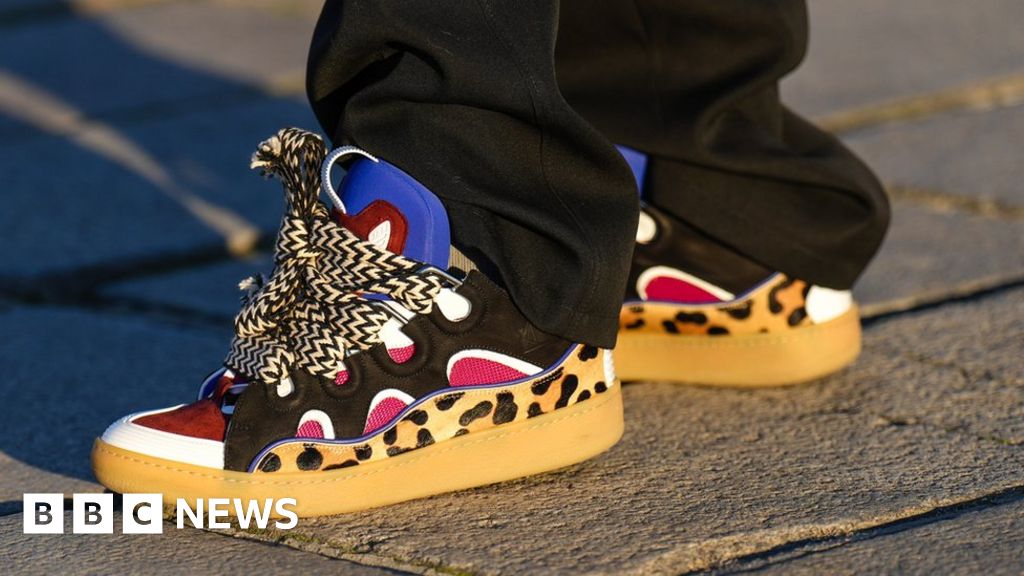
Lanvin has been trying to appeal to younger buyers with offerings like its skate-inspired 'Curb' trainers
But Roxanne Robinson, a New York-based contributing editor at Fashion Network, says there is room for the firm to succeed.
The luxury goods sector grew 22% globally this year, as the rich kept spending despite economic slowdown.
Consultancy Bain forecasts a further 3% to 8% growth in 2023, despite warnings that the wider economy could face a severe downturn.
But Ms Robinson warns Lanvin has work to do to make its namesake brand, founded by French designer Jeanne Lanvin in 1889, "buzzy" again.
"It's going to need that celebrity endorsement," she says. "It's going to need those red carpet appearances. It's going to need influencers that are doing their unboxing or showing up to their shows."
Wooing Gen Z
Since 2015, when fashion designer Alber Elbaz left, Lanvin has endured the fashion equivalent of musical chairs of designers and management, as well as shifting ownership.
Chinese conglomerate Fosun International, owned by billionaire Guo Guangchang, acquired a controlling stake in 2018, becoming the first Chinese company to own a heritage brand at the upper level of French fashion.
This week's listing, via a merger with a special purchase acquisition company (SPAC) created by China's Primavera Capital, made the firm the first major fashion company to list on a US exchange since Ermenegildo Zegna late last year.
Image source, Getty Images
Jeanne Lanvin founded the company in 1889
The company has installed creative director Bruno Sialelli, who is in his 30s, to appeal to the classic luxury customer while also speaking to Gen Z and millennial buyers.
His skate inspired "Curb" trainers have become wardrobe essentials for the likes of rapper Kid Cudi and actor and model Evan Mock.
In the first half of 2022, revenue surged 73% to $215 million.
But the firm still has a long way to go to catch up to competitors like Gucci-owner Kering and LVMH, home to brands like Louis Vuitton and Christian Dior, which currently dominate the market.
Ms Cheng says the firm has time to prove itself and win over sceptics, downplaying the financial significance of the listing as "just one milestone along the road for us to get more exposure".
"We are still young, like five years old and with a relatively small size," she says.
From Chip War To Cloud War: The Next Frontier In Global Tech Competition
The global chip war, characterized by intense competition among nations and corporations for supremacy in semiconductor ... Read more
The High Stakes Of Tech Regulation: Security Risks And Market Dynamics
The influence of tech giants in the global economy continues to grow, raising crucial questions about how to balance sec... Read more
The Tyranny Of Instagram Interiors: Why It's Time To Break Free From Algorithm-Driven Aesthetics
Instagram has become a dominant force in shaping interior design trends, offering a seemingly endless stream of inspirat... Read more
The Data Crunch In AI: Strategies For Sustainability
Exploring solutions to the imminent exhaustion of internet data for AI training.As the artificial intelligence (AI) indu... Read more
Google Abandons Four-Year Effort To Remove Cookies From Chrome Browser
After four years of dedicated effort, Google has decided to abandon its plan to remove third-party cookies from its Chro... Read more
LinkedIn Embraces AI And Gamification To Drive User Engagement And Revenue
In an effort to tackle slowing revenue growth and enhance user engagement, LinkedIn is turning to artificial intelligenc... Read more