

Wifinity Hands Customers Bills For Wi-Fi Services They Didn't Want But Used By Accident After Software 'glitch' Let 'fixed Term' Subs Continue

Members of the British Armed Forces Soldiers have reacted with anger after a British Wi-Fi provider failed to automatically end their time-limited contracts before charging them for consuming data "without subscription".
Ofcom-regulated Wifinity prompted a wave of fury when it told former subscribers on Ministry of Defence bases that they would be receive bills running into the hundreds of pounds for data services that former customers didn't want and hadn't signed up for.
Those bills were then "revised" without explanation down to sums of £10-£30, as seen by The Register, in what one ex-customer told us was a cynical attempt to trick recipients into paying up to avoid further hassles.
A spokesperson for Wifinity told The Register: "Due to technical reasons, some Wifinity customers remained and utilised our network despite their subscription having come to an end. We are sorry for any inconvenience this may have caused, and a full investigation is now under way."
The spokeswoman continued in her statement: "We would like to reassure customers that, in line with Ofcom guidance, we have limited back payments to only those who continued to use the network over the last three months, despite their subscription ending."
One soldier, William, told us he had been on overnight duty at an RAF station and bought a 24 hour subscription to Wifinity: "When I left at 6am I never used it again. I got an email stating that it was intended to end on 24th September however it didn't … they're trying to say I used over 55 hours of internet and 9GB of data was used uncharged."
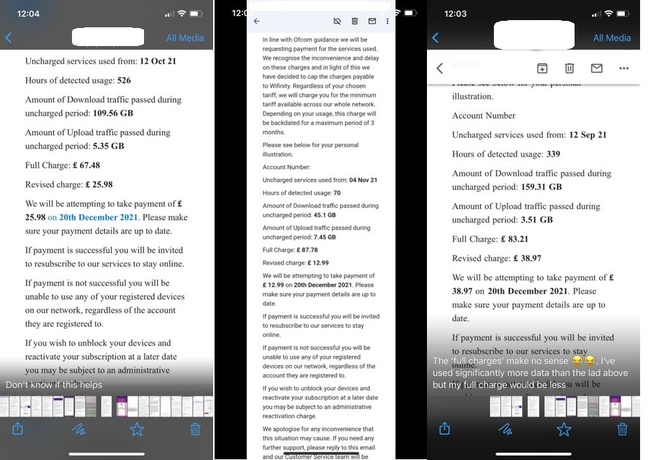
Wifinity bills sent to British soldiers, shown to The Register
Another soldier, Scott, said he thought his devices had connected to his base's business Wi-Fi network only to be unpleasantly surprised when he received a demand for payment. Scott told us he "Only paid for [Wifinity] service at another camp where there was no other option".
Although Wifinity emailed customers citing "Ofcom regulations" that allowed the company to bill them for services they didn't want and hadn't intended to use, it failed to identify the regulation on which it relied.
When El Reg asked, the company cited an unofficial version of the regulator's Ofcom Metering and Billing Direction [PDF], and its section 4.8.4 regarding delayed bills.
The company appeared to admit fault for the extra bills in a Twitter post:
Hi @fillyourboots @moddio. We recently contacted a minority of our subscribers regarding a software glitch that resulted in a billing issue. If you have received this message and you think it is a mistake, please contact us at support@wifinity.co.uk or DM us your details.
— Wifinity (@wifinityuk) December 17, 2021
When El Reg asked why what was first thought to be a billing system cockup was resulting in ex-customers being told to pay up, Wifinity told El Reg: "It is never our intention to financially disadvantage any of our customers and we provide dedicated 24/7 Customer Service support to anyone experiencing financial difficulties. Only customers who have used the service have been charged, and Wifinity has offered this at a substantially reduced rate."
Ofcom wasn't impressed, telling The Register that the regulation cited by Wifinity covers adding chargeable events to scheduled later bills if they were missed off by accident, not generating new ones.
In a statement a spokesman for the connectivity services regulator said: "Under Ofcom rules, the cost of an internet service should be clearly set out when a customer signs up to it, including the length of the contract term and the process for renewing or cancelling the contract at the end of that term.
“Customers who believe they have been incorrectly charged should initially raise a complaint with the company directly, and if that doesn’t resolve the issue, take their case to the ombudsman to settle the dispute”.
Wifinity's (undated) terms and conditions on its website explain that its "fixed term" packages are in fact a monthly recurring subscription:
The four weekly recurring package - not a month - means customers have 13 billing periods during one calendar year.
Alfie Usher, MD of insurance biz Forces Compare and who highlighted Wifinity's demands on his military themed Facebook page "Fill Your Boots", let El Reg know he was unable to comment because he'd lost his internet connection.
- Euro-telcos call on big tech to help pay for their network builds
- Telcos face £100k-a-day fines unless they obey new UK.gov rules on how to deploy Huawei 5G gear in their networks
- It's 2021 and a printf format string in a wireless network's name can break iPhone Wi-Fi
Wifinity's website says it provides paid-for Wi-Fi services at around 100 Ministry of Defence locations around the country. It also says the firm provides business connectivity to the MoD as a Fujitsu subcontractor, and has – somehow – signed the Armed Forces Covenant, "a promise by the nation ensuring that those who serve or who have served in the armed forces, and their families, are treated fairly".
Nothing says "fair" like a "fixed term" subscription that has no fixed end point and which bills you 13 times a year. Merry Christmas! ®
From Chip War To Cloud War: The Next Frontier In Global Tech Competition
The global chip war, characterized by intense competition among nations and corporations for supremacy in semiconductor ... Read more
The High Stakes Of Tech Regulation: Security Risks And Market Dynamics
The influence of tech giants in the global economy continues to grow, raising crucial questions about how to balance sec... Read more
The Tyranny Of Instagram Interiors: Why It's Time To Break Free From Algorithm-Driven Aesthetics
Instagram has become a dominant force in shaping interior design trends, offering a seemingly endless stream of inspirat... Read more
The Data Crunch In AI: Strategies For Sustainability
Exploring solutions to the imminent exhaustion of internet data for AI training.As the artificial intelligence (AI) indu... Read more
Google Abandons Four-Year Effort To Remove Cookies From Chrome Browser
After four years of dedicated effort, Google has decided to abandon its plan to remove third-party cookies from its Chro... Read more
LinkedIn Embraces AI And Gamification To Drive User Engagement And Revenue
In an effort to tackle slowing revenue growth and enhance user engagement, LinkedIn is turning to artificial intelligenc... Read more