

Who Had Money On Samsung And Red Hat Joining Forces On Next-gen Memory Software?
Samsung and Red Hat have pledged to work together on developing software to get the best from emerging memory technologies.
The Korean giant points out that a bunch of storage and memory tech – NVMe SSDs, Compute Express Link, the combination of high-bandwidth memory and processing-in-memory, and data fabrics – all need enabling software if they are to work well with the kind of demanding applications they're promised to, well, enable.
The tech is likely to be used in different tiers, while sharing memory across devices is well and truly on the agenda as part of a renewed push for composable infrastructure.
Hardware vendors don't just fling devices over the fence and wait for an ecosystem to form. They usually engage with key platform and application providers early in the product design process to ensure their wares will work in the real world.
So it's a little surprising that Samsung's announcement of its Red Hat tie-up claims this is the first time the chaebol has teamed with an open-source software outfit with an aim to "foster engagements across the IT marketplace."
The relationship will see Samsung create a loftily monikered Memory Research Cloud in which the two companies "will develop and verify software solutions on diverse server environments."
- TSMC, Samsung plan price hikes for chip designers – reports
- Samsung testing memory with built-in processing for AI-centric servers
- Red Hat Kubernetes security report finds people are the problem
- Samsung unveils hardened SD card that can last 16 years if you treat it right
You, dear reader, might be invited into that cloud to test the best memory hardware configurations to drive your applications to optimal efficiency.
Samsung says its Memory Research Cloud will be "an open collaboration hub" in which customers can test combinations of software and memory hardware.
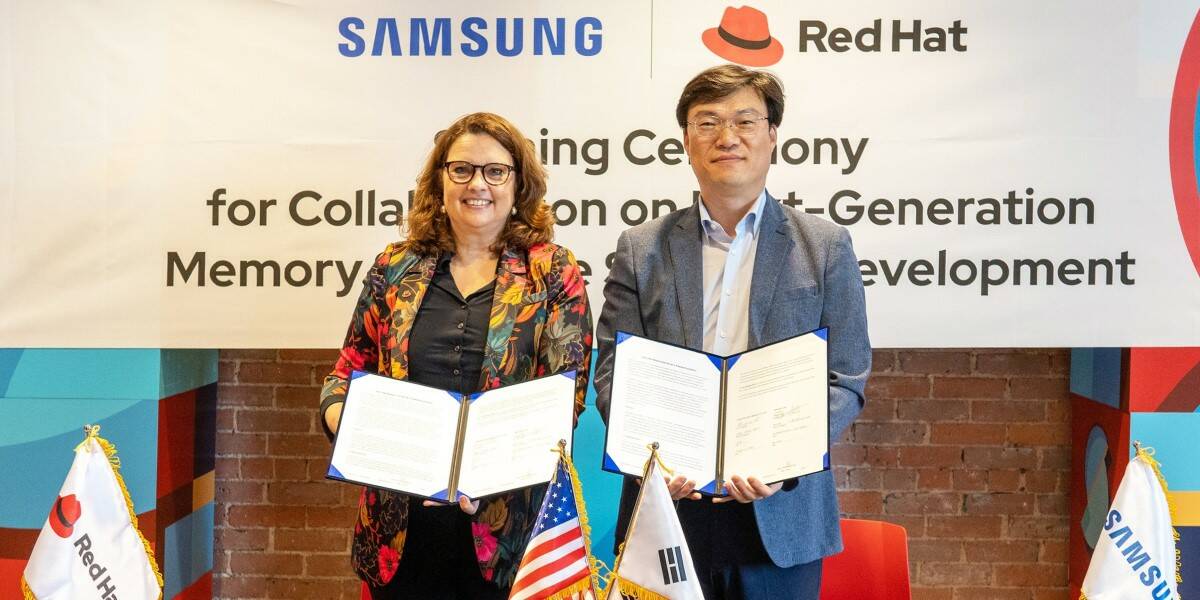
You can see it, too, right? ... From left, Marjet Andriesse, senior veep and Head of Red Hat Asia Pacific, with Yongcheol Bae, executive veep and Head of the Memory Application Engineering Team at Samsung Electronics, holding copies of their storage software pact. Source: Samsung
Samsung says work with IBM's Red Hat will also be shared with other orgs, such as the Linux Foundation, to ensure "full support in Red Hat Enterprise Linux, and with other open source software stacks."
Which sounds a lot like Samsung wants this work to be pushed into the Linux kernel – where it arguably belongs, given Linux's dominance of the world's server fleet. ®
From Chip War To Cloud War: The Next Frontier In Global Tech Competition
The global chip war, characterized by intense competition among nations and corporations for supremacy in semiconductor ... Read more
The High Stakes Of Tech Regulation: Security Risks And Market Dynamics
The influence of tech giants in the global economy continues to grow, raising crucial questions about how to balance sec... Read more
The Tyranny Of Instagram Interiors: Why It's Time To Break Free From Algorithm-Driven Aesthetics
Instagram has become a dominant force in shaping interior design trends, offering a seemingly endless stream of inspirat... Read more
The Data Crunch In AI: Strategies For Sustainability
Exploring solutions to the imminent exhaustion of internet data for AI training.As the artificial intelligence (AI) indu... Read more
Google Abandons Four-Year Effort To Remove Cookies From Chrome Browser
After four years of dedicated effort, Google has decided to abandon its plan to remove third-party cookies from its Chro... Read more
LinkedIn Embraces AI And Gamification To Drive User Engagement And Revenue
In an effort to tackle slowing revenue growth and enhance user engagement, LinkedIn is turning to artificial intelligenc... Read more