

United Airlines To Trial Airport Covid Testing
By Jonathan Josephs
Business reporter, BBC News
- Published
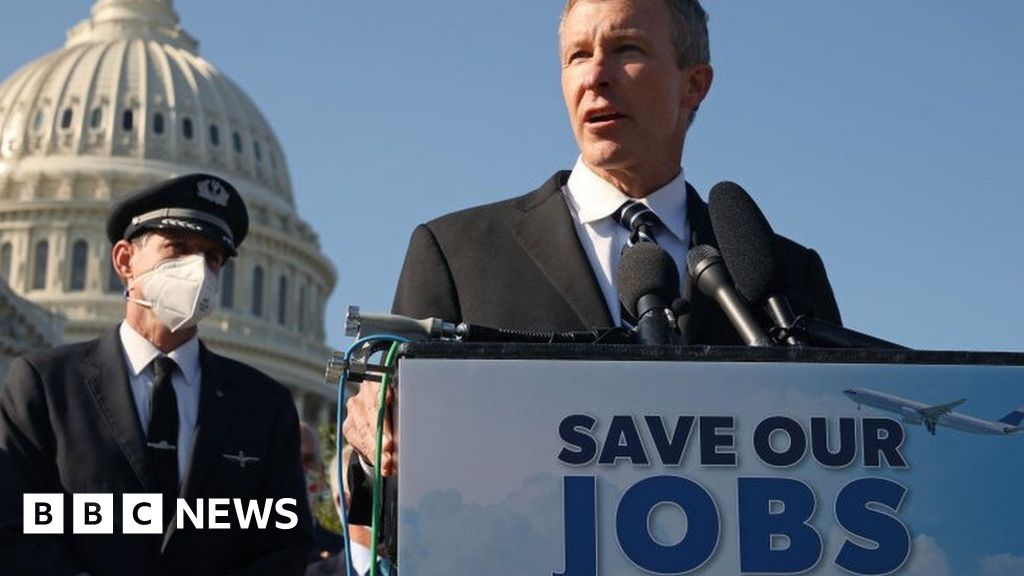
Testing airline passengers for coronavirus is "the key to reopening the world economy" United Airlines' boss Scott Kirby has told the BBC.
The airline is starting Covid-19 tests on some flights from Newark airport, near New York, to London Heathrow.
Mr Kirby said it could provide evidence that will convince governments to drop quarantine requirements for travellers.
He said several countries have told United they are interested in using testing to open up their economies.
But these countries "want to make sure everything works" and have said that "health and safety appropriately comes first", he said.
The International Air Transport Association (IATA) says demand for international flights is down about 90% compared with last year.
According to IATA's director-general, Alexandre de Juniac, governments need to "take firm action" to mitigate the economic impact. "The loss of aviation connectivity will have a dramatic impact on global GDP, threatening $1.8 trillion in economic activity," he said.
United is among the many airlines whose fortunes have declined because of coronavirus. It's currently losing $25m (£19m) a day. That compares with a $4.3bn profit last year.
A US government support programme for airlines expired at the end of September, since when United has furloughed 13,000 staff, with another 9,000 leaving on a voluntary basis.
image copyrightGetty Images
Mr Kirby said he hopes more cuts would not be necessary and that he is "hopeful here in the United States at least that after the election something will be done to support aviation".
That financial difficulty is why the world's fourth biggest airline is trying to take the initiative in showing that testing can help overcome the fears that have led governments to close borders and impose restrictions on passengers.
From 16 November it is launching a four-week trial of what it says are the world's first free Covid-19 tests for transatlantic passengers.
Everyone over the age of 2 will be tested on arrival at the airport and held in an airport lounge for the 15-20 minutes it will take to get the results. Anyone who doesn't want to be tested will be moved to other flights so that the airline can guarantee all those on board have tested negative.
Mr Kirby said he hopes that it will eventually mean that "when you fly into London Heathrow you won't have to quarantine for two weeks". He said that "if the testing regimes can prove sufficient" governments and health authorities will be able to "have confidence that when people fly in on an airplane they're Covid-free, and therefore they can get about their business".
image copyrightGetty Images
The UK government has been relatively slow to embrace airport testing for coronavirus. This week, Heathrow's chief executive John Holland-Kaye said Britain was "falling behind" because of that slowness and it was putting jobs at risk.
'Uniquely safe'
When it comes to the risks of contracting coronavirus during a flight, Mr Kirby told the BBC "its almost impossible to get coronavirus once you're on the airplane" thanks to ventilation systems and other safety measures.
United has worked with the US Department of Defense on a study which claimed the risks were low. Mr Kirby said this research supported his company's decision not to follow rivals such as Delta Airlines and Jet Blue in limiting the number of passengers to 60% or 70% of an aircraft's capacity to improve social distancing.
IATA data shows there have been 44 cases of Covid-19 transmission this year that are thought to be linked to a flight, during a period when 1.2 billion passenger journeys have been made.
Mr Kirby said that as more data emerges, the rest of the aviation industry "is catching up to that fact that aviation and an aircraft really is a uniquely safe environment".
From Chip War To Cloud War: The Next Frontier In Global Tech Competition
The global chip war, characterized by intense competition among nations and corporations for supremacy in semiconductor ... Read more
The High Stakes Of Tech Regulation: Security Risks And Market Dynamics
The influence of tech giants in the global economy continues to grow, raising crucial questions about how to balance sec... Read more
The Tyranny Of Instagram Interiors: Why It's Time To Break Free From Algorithm-Driven Aesthetics
Instagram has become a dominant force in shaping interior design trends, offering a seemingly endless stream of inspirat... Read more
The Data Crunch In AI: Strategies For Sustainability
Exploring solutions to the imminent exhaustion of internet data for AI training.As the artificial intelligence (AI) indu... Read more
Google Abandons Four-Year Effort To Remove Cookies From Chrome Browser
After four years of dedicated effort, Google has decided to abandon its plan to remove third-party cookies from its Chro... Read more
LinkedIn Embraces AI And Gamification To Drive User Engagement And Revenue
In an effort to tackle slowing revenue growth and enhance user engagement, LinkedIn is turning to artificial intelligenc... Read more