

Ukraine War: Russia Denies Causing Global Food Crisis
By Robert Plummer
BBC News
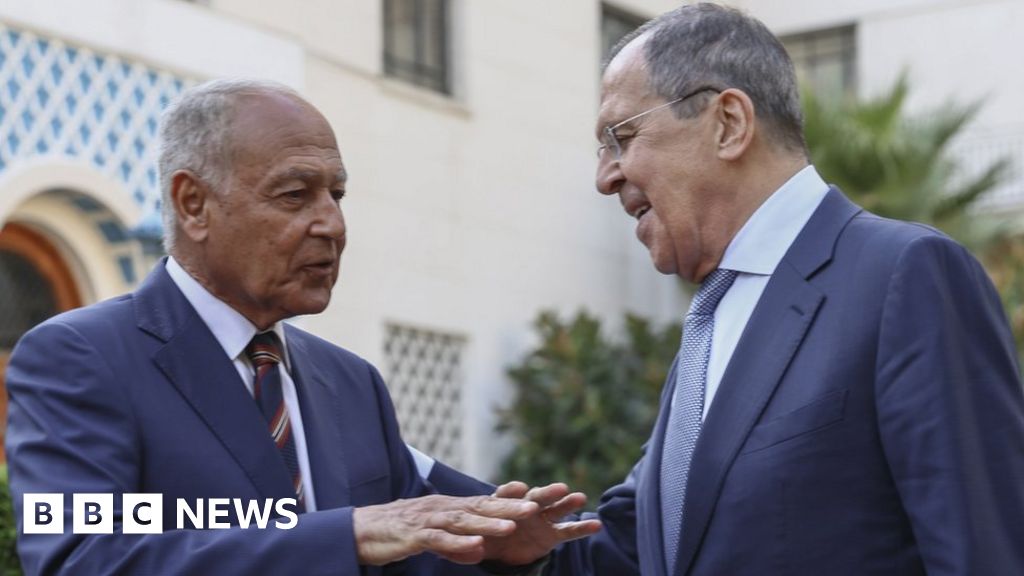
Mr Lavrov spoke with the head of the Arab League
Russia's Foreign Minister, Sergei Lavrov, on a diplomatic offensive in Egypt, has dismissed claims that Moscow caused the global food crisis.
In a speech to Arab League ambassadors in Cairo, he said Western nations were distorting the truth about the impact of sanctions on global food security.
He accused Western nations of trying to impose their dominance over others.
Much of the Arab world and Africa is badly affected by grain shortages caused by Russia's war in Ukraine.
Mr Lavrov will go on to visit three African nations to rally support amid anger over the war.
Mr Lavrov said that Western nations' "aggressiveness" in imposing sanctions on Russia indicated one simple conclusion: "It is not about Ukraine, it is about the future of the world order.
"They say everybody must support a rules-based world order, and the rules are written depending on what specific situation the West wants to resolve in its own favour."
Earlier, Mr Lavrov held talks with his Egyptian counterpart, Sameh Shoukry.
Egypt has significant ties with Russia, which supplies wheat, weapons and - until the invasion of Ukraine began - large numbers of tourists.
After his talks with Mr Shoukry, Mr Lavrov told a joint news conference that the West was prolonging the conflict even though it understood "what and whose end it will be".
It is the first stage for Mr Lavrov of a brief tour of Africa taking in Ethiopia, Uganda and Congo-Brazzaville.
In an article published by local newspapers in the run-up to his tour, Mr Lavrov said his country had always "sincerely supported Africans in their struggle for freedom from the colonial yoke".
He added that Russia appreciated Africans' "balanced position" on the issue of Ukraine.
Ukraine and Russia usually supply more than 40% of Africa's wheat, the African Development Bank says.
Egypt is normally a big consumer of Ukrainian wheat. In 2019, it imported 3.62 million tonnes of it, more than any country.
But in his article, Mr Lavrov rejected the accusation that Russia was "exporting famine" and blamed it on Western propaganda.
He added that Western sanctions imposed on Russia had exacerbated "negative tendencies" in the international food market that stemmed from the coronavirus pandemic.
Taking advantage of a reluctance to take sides
By Will Ross, Africa regional editor, BBC World Service
Sergei Lavrov is trying to convince African countries that they are better off siding with Russia than the West - using phrases like "we'll help you complete the process of decolonisation".
But it is clear across much of the continent that there is a reluctance to take sides over the war in Ukraine. The Cold War had a devastating impact, fuelling conflicts in Africa and halting development.
Right now, of greatest concern is the spiralling cost of food and fuel. More than 40% of Africa's wheat comes from Russia and Ukraine.
Some African leaders will be aware that when people cannot afford to eat, their own positions in power are less secure.
Watch: Sergei Lavrov speaks exclusively to the BBC about the war in Ukraine
From Chip War To Cloud War: The Next Frontier In Global Tech Competition
The global chip war, characterized by intense competition among nations and corporations for supremacy in semiconductor ... Read more
The High Stakes Of Tech Regulation: Security Risks And Market Dynamics
The influence of tech giants in the global economy continues to grow, raising crucial questions about how to balance sec... Read more
The Tyranny Of Instagram Interiors: Why It's Time To Break Free From Algorithm-Driven Aesthetics
Instagram has become a dominant force in shaping interior design trends, offering a seemingly endless stream of inspirat... Read more
The Data Crunch In AI: Strategies For Sustainability
Exploring solutions to the imminent exhaustion of internet data for AI training.As the artificial intelligence (AI) indu... Read more
Google Abandons Four-Year Effort To Remove Cookies From Chrome Browser
After four years of dedicated effort, Google has decided to abandon its plan to remove third-party cookies from its Chro... Read more
LinkedIn Embraces AI And Gamification To Drive User Engagement And Revenue
In an effort to tackle slowing revenue growth and enhance user engagement, LinkedIn is turning to artificial intelligenc... Read more