

UK Eyes New Laws As Cable Sabotage Blurs Line Between War And Peace
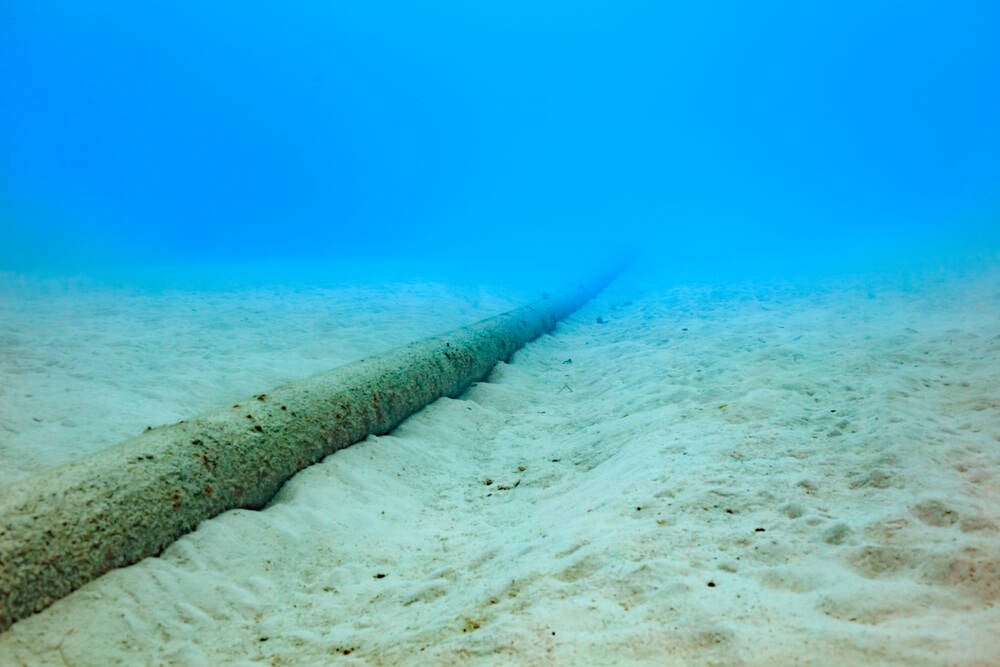
Cyberattacks and undersea cable sabotage are blurring the line between war and peace and exposing holes in UK law, a government minister has warned lawmakers.
Earlier this year, the UK government published a Strategic Defence Review, which proposes a new bill to cover the prospect of state-sponsored cybercrime and subsea cable attacks.
In January, Sweden committed forces to the Baltic Sea following a suspected Russian attack on underwater data cables, one of a number of incidents.
Speaking to the National Security Strategy (Joint Committee) yesterday, Ministry of Defence parliamentary under-secretary Luke Pollard admitted that the Submarine Telegraph Act 1885 – which can impose £1,000 fines – "does seem somewhat out of step with the modern-day risk."
However, he pointed out that forming legislation to mitigate the risk to undersea infrastructure is a balance between a civil and military approach, but this raises the question of how the government might prosecute a perpetrator of undersea cable sabotage.
"We've identified that this is an area that could be looked at again. That's why the Strategic Defence Review talked about creating a defence readiness bill, probably in a later stage, a later session of parliament," he said.
"The legislation that we have inherited may be operational for a peacetime scenario, but they don't necessarily always lead up until crisis into conflict. Between peacetime and conflict, those two good sets of legislation that exist in our system; the build-up between the two perhaps less so."
Pollard pointed to so-called "gray zone threats," hostile activities that sit below the definition of armed conflict.
"It is legitimate to have a question about at what point is someone at war, because on a simple article five of the NATO Treaty basis, if Russia were to roll tanks into the Baltic states, it would be reasonable for the Atlantic council then to take a position that that is an attack on one as an attack on all, [but] where there are cyberattacks and potential threats to undersea infrastructure, the moment where you might move from peace to conflict might be less certain, and because of that, we've identified that as an area where it is prudent to undertake more work, both in terms of how the UK would respond, to how do we update our activities around our reserve forces and other aspects."
Chris Bryant, UK minister of state for data protection and telecoms, told the committee that he was unable to reveal specific plans for legislation owing to Parliamentary protocol.
But he added: "We're in a bit of a double bind because, on the one hand, the 1885 Act the £100 fine provision was upgraded in 1982 to £1,000, and we could, by secondary legislation, [increase it] to £5,000, but that just doesn't seem to meet the needs of the situation," he said.
- Europe is Russian to sanction Putin's pals over 'hybrid' threats
- Sweden seizes cargo ship after another undersea cable hit in suspected sabotage
- NATO's newest member comes out swinging following latest Baltic Sea cable attack
- Submarine cable resilience board announced on same day maybe-cut-by-China Baltic cable repaired
Bryant said the Department for Science, Innovation and Technology and the Ministry of Defence were likely to work together to draft legislation. "That may take longer than just fiddling around with fines."
In January, Swedish authorities seized a cargo ship "suspected of carrying out sabotage" after a cable running between Sweden and Latvia in the Baltic Sea was damaged. The cable runs between the Latvian town of Ventspils and Sweden's Gotland island and belongs to the Latvian State Radio and Television Center (LVRTC).
Similar incidents include damage to the Finnish-Estonian Estlink 2 subsea power line and the C-Lion1 cable and BCS East-West Interlink submarine cable.
According to new analysis, China and Russia are stepping up sabotage operations targeting undersea cables and the UK is unprepared to meet the mounting threat.
In June, the China Strategic Risks Institute (CSRI) looked into 12 incidents in which authorities alleged sabotage between January 2021 and April 2025. The research organization found the vessels had been identified in ten cases, eight of which were linked to China or Russia through flag-state registration or company ownership. ®
From Chip War To Cloud War: The Next Frontier In Global Tech Competition
The global chip war, characterized by intense competition among nations and corporations for supremacy in semiconductor ... Read more
The High Stakes Of Tech Regulation: Security Risks And Market Dynamics
The influence of tech giants in the global economy continues to grow, raising crucial questions about how to balance sec... Read more
The Tyranny Of Instagram Interiors: Why It's Time To Break Free From Algorithm-Driven Aesthetics
Instagram has become a dominant force in shaping interior design trends, offering a seemingly endless stream of inspirat... Read more
The Data Crunch In AI: Strategies For Sustainability
Exploring solutions to the imminent exhaustion of internet data for AI training.As the artificial intelligence (AI) indu... Read more
Google Abandons Four-Year Effort To Remove Cookies From Chrome Browser
After four years of dedicated effort, Google has decided to abandon its plan to remove third-party cookies from its Chro... Read more
LinkedIn Embraces AI And Gamification To Drive User Engagement And Revenue
In an effort to tackle slowing revenue growth and enhance user engagement, LinkedIn is turning to artificial intelligenc... Read more