

UK Energy Plant To Use Liquid Air
By Roger Harrabin
BBC environment analyst
- Published
image copyrightHighview
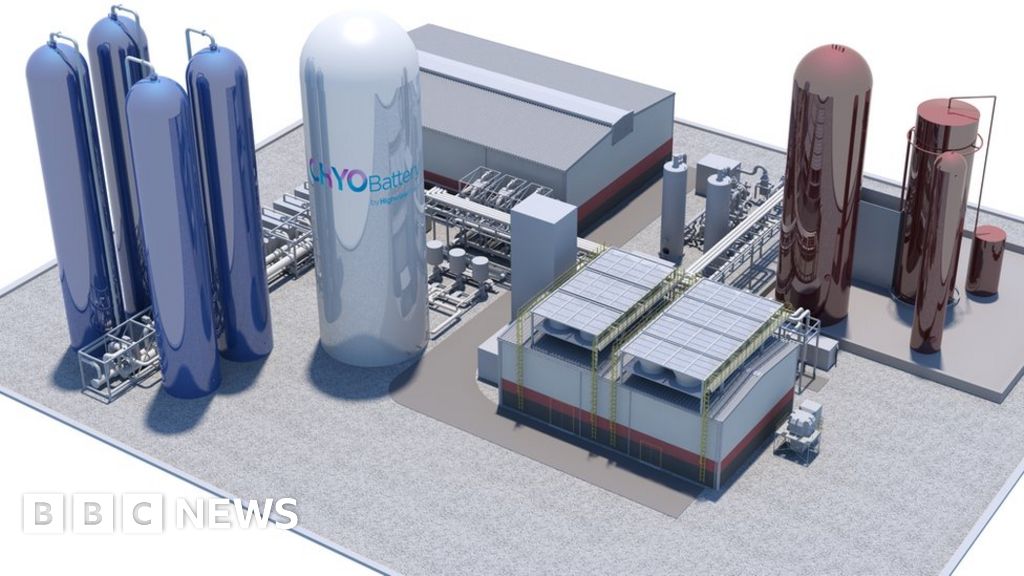
Work is beginning on what is thought to be the world's first major plant to store energy in the form of liquid air.
It will use surplus electricity from wind farms at night to compress air so hard that it becomes a liquid at -196 Celcius.
Then when there is a peak in demand in a day or a month, the liquid air will be warmed so it expands.
The resulting rush of air will drive a turbine to make electricity, which can be sold back to the grid.
The 50MW facility near Manchester will store enough power for roughly 50,000 homes.
The system was devised by Peter Dearman, a self-taught backyard inventor from Hertfordshire, and it has been taken to commercial scale with a £10m grant from the UK government.
"It's very exciting," he told BBC News. "We need many different forms of energy storage - and I'm confident liquid air will be one of them."
image copyrightPA
Mr Dearman said his invention was 60-70% efficient, depending how it is used.
That is less efficient than batteries, but he said the advantage of liquid air is the low cost of the storage tanks - so it can easily be scaled up.
Also, unlike batteries, liquid air storage does not create a demand for rare earth minerals which may become increasingly scarce as the world moves towards power systems based on variable renewable electricity.
"Batteries are really great for short-term storage," Mr Dearman said. "But they are too expensive to do long-term energy storage. That's where liquid air comes in."
Mr Dearman had been developing a car run on similar principles with liquid hydrogen when he saw the potential for applying the technology to electricity storage.
He is now a passive shareholder in Highview, one of the firms building the 50MW plant.
Prof John Loughhead, chief scientific adviser at the government's business and energy department, has previously praised the technology.
Follow Roger on Twitter @rharrabin
From Chip War To Cloud War: The Next Frontier In Global Tech Competition
The global chip war, characterized by intense competition among nations and corporations for supremacy in semiconductor ... Read more
The High Stakes Of Tech Regulation: Security Risks And Market Dynamics
The influence of tech giants in the global economy continues to grow, raising crucial questions about how to balance sec... Read more
The Tyranny Of Instagram Interiors: Why It's Time To Break Free From Algorithm-Driven Aesthetics
Instagram has become a dominant force in shaping interior design trends, offering a seemingly endless stream of inspirat... Read more
The Data Crunch In AI: Strategies For Sustainability
Exploring solutions to the imminent exhaustion of internet data for AI training.As the artificial intelligence (AI) indu... Read more
Google Abandons Four-Year Effort To Remove Cookies From Chrome Browser
After four years of dedicated effort, Google has decided to abandon its plan to remove third-party cookies from its Chro... Read more
LinkedIn Embraces AI And Gamification To Drive User Engagement And Revenue
In an effort to tackle slowing revenue growth and enhance user engagement, LinkedIn is turning to artificial intelligenc... Read more