

Uber CEO Warns Robotaxis Can't Find A Fast Route To Commercial Viability
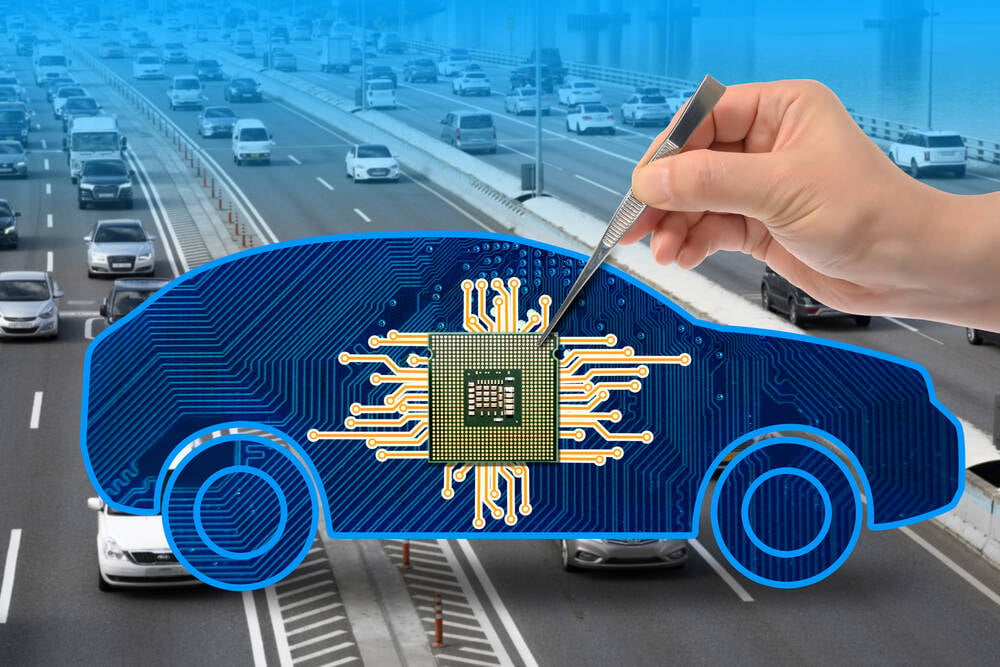
Uber CEO Dara Khosrowshahi is warning that it's not yet possible to commercialize autonomous vehicles due to high costs, seasonal demand fluctuations, and the need to prove "superhuman" safety.
Khosrowshahi took the unusual step of including an update on his company's ambitions for autonomous vehicles (AV) in the prepared remarks [PDF] delivered ahead of the company's Q4 2024 earnings call.
Those remarks opened with the observation that 2024 was a turning point for the AV industry as at least four operators now have fleets of the machines on the road, and many others are likely to join them soon. The CEO estimates AVs represent a trillion-dollar opportunity in the US alone.
However he then turned gloomy, saying: "Even as we see AV technology advancing, we expect AV commercialization will take significantly longer."
Khosrowshahi argued that widespread commercial AV adoption needs five things to all be in place, the first of which is a "consistently superhuman safety record."
"We don't think it's good enough for an autonomous driver to be better than a human. I think we have the chance to be multiple times better than a human," he said, adding that only superhuman safety will convince regulators to allow AVs onto the road.
The CEO also wants consistent regulation across the US, and more jurisdictions to introduce their own AV rules.
He also thinks carmakers need to improve because today's AVs cost $200,000 or more and have higher running costs than human-driven vehicles. Until AVs can run for under $2/hour $2/mile, they can't compete.
Ground operations are another issue of concern. "It is important to note that an average-utilized AV can run as much as 100K miles a year, compared to a typical consumer vehicle at 10-15K miles a year," Khosrowshahi wrote. "This means that AVs need to be charged multiple times a day and serviced monthly. AVs will also require consistent cleaning and available parking." Additionally, someone will need to handle fare disputes, return lost items, rescue stranded vehicles, and handle insurance chores. The CEO reckons Uber can do all that.
Yet one thing he admitted Uber will struggle to do is handle variable demand for AVs.
That's because consumers expect cars they summon to arrive in around four minutes. To meet peak demand, an AV taxi operator would need a fleet of cars that would be underutilized most of the time.
To illustrate the problem, Uber's presentation [PDF] included the graph below, which depicts demand across the week in a single unnamed US city. Each day is broken into four six-hour segments, the first of which starts at midnight.
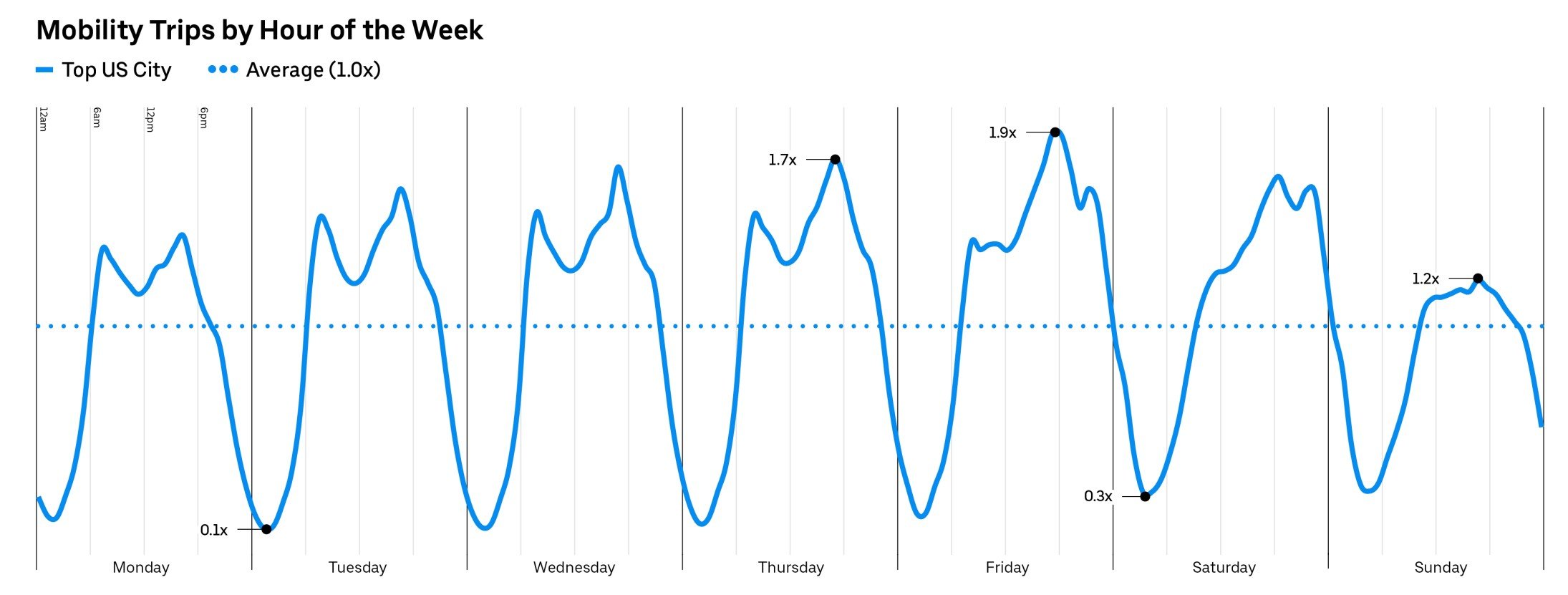
Hourly demand for Uber rides in a single US city across a week – click to enlarge
Uber also offered another graph showing changing demand for rides across the year in two US cities.
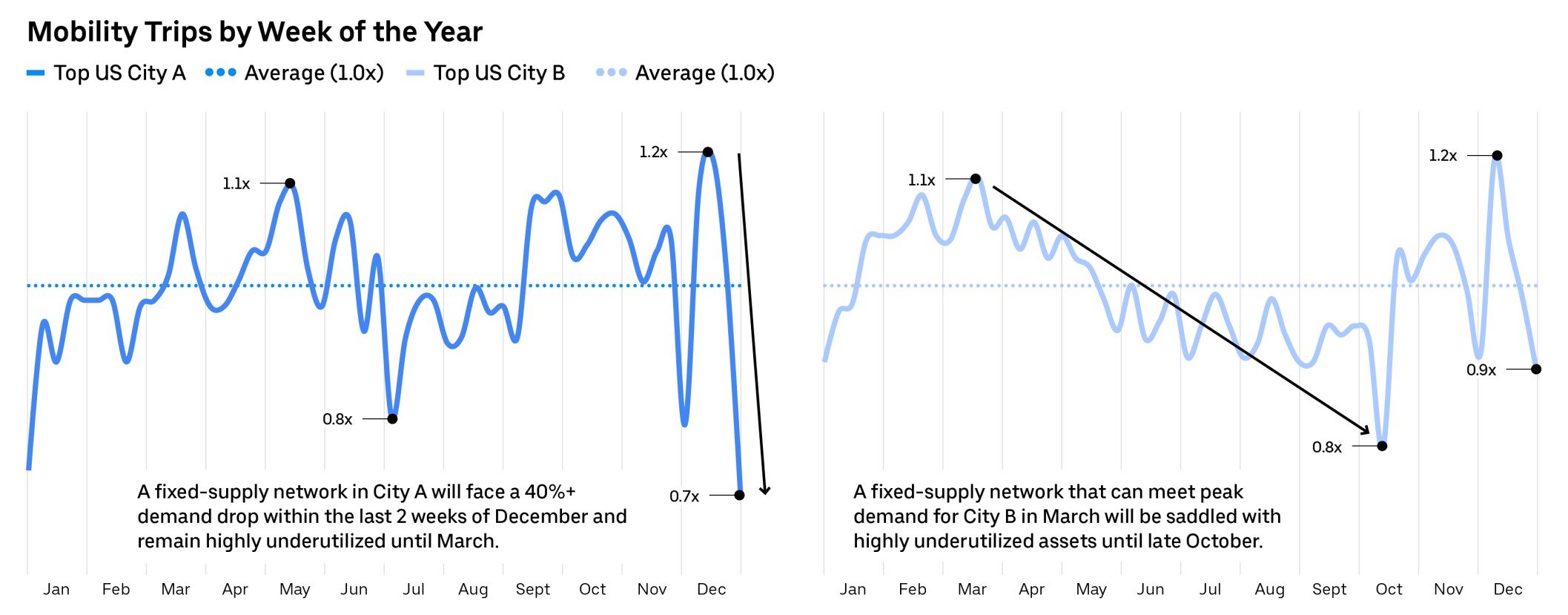
Annual demand for Uber rides in two unnamed US cities – click to enlarge
"Any standalone player with a fixed depreciating asset will need to build against that reality: choosing between running a highly underutilized network (if supply is built for peak demand) or a highly unreliable network at peak periods (if supply is built for anything less than peak)," Khosrowshahi said.
- Cruise robotaxis parked forever, as GM decides it can't compete and wants to cut costs
- What do Uber drivers make of Waymo? 'We are cooked'
- Singapore to increase road capacity by tracking all vehicles with GPS
- China's rideshare champ Didi gives users the option to report stinky cars
"Underutilized vehicles cannot be easily repositioned and will likely sit unused for months, generating additional cost and complexity – against zero revenue," he warned.
The CEO thinks humans can solve this problem because they will "dynamically fulfill demand spikes – and take a break during demand troughs." He therefore suggested that AV operators should partner with Uber to tap its expertise getting humans on the road and avoid acquiring idle assets. Uber drivers the world over will likely find that comforting. They may also like Khosrowshahi's assessment that all five of the matters he identified "must work in concert, or the puzzle falls apart."
In other words, the robot economy doesn't add up – for now – meaning human drivers perhaps have less to worry about than they thought. Another reason to be cheerful is the demise of GM's Cruise robotaxi biz.
Uber bucks
Uber booked $44.2 billion of business in Q4, $22.8 billion of it for rides and $20.1 billion for deliveries, up 18 percent year over year. The company organized 3.1 billion rides across the quarter ended December 31, 2024.
All those rides and deliveries saw $12 billion arrive in Uber's coffers, a 20 percent year-over year increase. Net income was $6.9 billion, but $6.4 billion of that was a "benefit from a tax valuation release." Another $556 million came from "net unrealized gains related to the revaluation of Uber's equity investments."
Full-year gross bookings were $162.8 billion, delivering revenue of $44 billion and net income of $9.85 billion, from 11.273 billion trips. The company boasted 171 million "monthly active platform consumers" across the year.
Uber forecast Q1 2025 bookings growth of 17 to 21 percent, all of it from humans. ®
From Chip War To Cloud War: The Next Frontier In Global Tech Competition
The global chip war, characterized by intense competition among nations and corporations for supremacy in semiconductor ... Read more
The High Stakes Of Tech Regulation: Security Risks And Market Dynamics
The influence of tech giants in the global economy continues to grow, raising crucial questions about how to balance sec... Read more
The Tyranny Of Instagram Interiors: Why It's Time To Break Free From Algorithm-Driven Aesthetics
Instagram has become a dominant force in shaping interior design trends, offering a seemingly endless stream of inspirat... Read more
The Data Crunch In AI: Strategies For Sustainability
Exploring solutions to the imminent exhaustion of internet data for AI training.As the artificial intelligence (AI) indu... Read more
Google Abandons Four-Year Effort To Remove Cookies From Chrome Browser
After four years of dedicated effort, Google has decided to abandon its plan to remove third-party cookies from its Chro... Read more
LinkedIn Embraces AI And Gamification To Drive User Engagement And Revenue
In an effort to tackle slowing revenue growth and enhance user engagement, LinkedIn is turning to artificial intelligenc... Read more