

True Story? Lie Detection Systems Go High-tech
By Natalie Lisbona
Business reporter, Tel Aviv
Image source, Tomer Neuberg
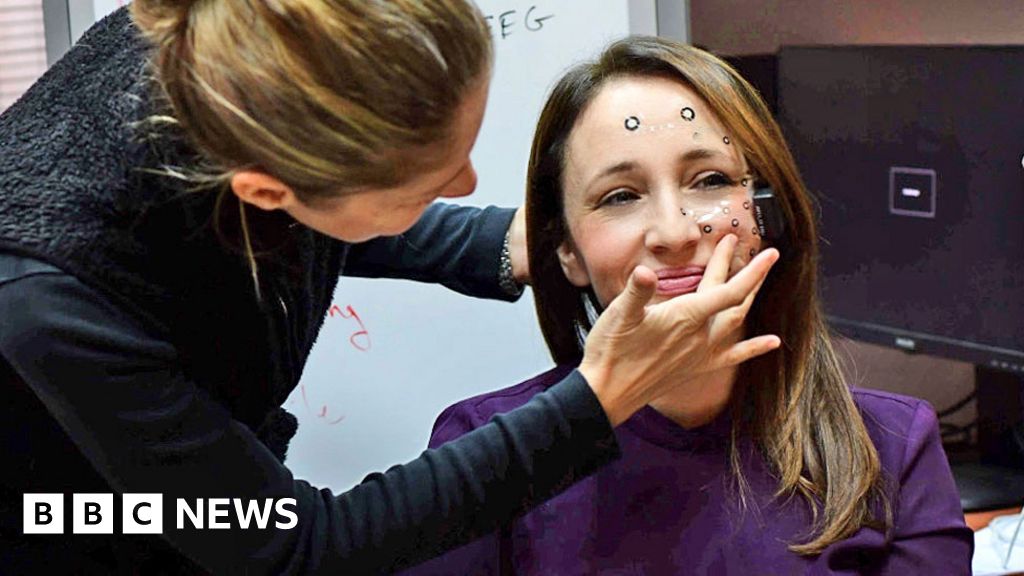
Prof Yael Hanein prepares reporter Natalie Lisbona for her lie detection test
Prof Yael Hanein sticks a number of electrodes to the left side of my face.
"Move your eyes, blink, smile. Now try to relax," she says. "We will see if you are a good or bad liar shortly."
Prof Hanein and colleague Prof Dino Levy lead a team at Israel's Tel Aviv University that have developed a new method of lie detection.
They say they have identified two types of liars - those who involuntarily move their eyebrows when they tell a fib, and those that cannot control a very slight lip movement where their lips meet their cheeks.
Their software and its algorithm can now detect 73% of lies and they intend to improve that as they develop the system. "When you try to conceal a lie, one of the things you try to avoid is any sort of body reaction," she says.
Prof Levy adds: "But it's very, very hard for you to conceal a lie with this technology."
Image source, Getty Images
This is most people's idea of a lie detection machine - the analogue polygraph
Methods of lie detection have probably been around for as long as tall tales have been told. One of the first documented examples comes from 1000BC in China, where a suspect would have to fill his or her mouth with dry rice.
After a period of time the grains would be checked, and if they remained dry then the person was determined to be guilty. The theory was that if the individual had indeed lied he or she would be fearful or nervous, and therefore have a dry mouth.
The early 20th Century saw the invention of the first lie detection machines or polygraphs. The most well-known of these is the "analogue polygraph", which typically has three or four ink-filled needles that dance round on a strip of moving paper.
The suspect has sensors attached to their fingers, arms and body and the machine then measures breathing rate, pulse, blood pressure and perspiration as they answer a series of questions.
Yet there are continuing concerns about the accuracy of these machines and whether it is possible to fool them. So researchers and technology firms around the world are working to develop more high-tech polygraph systems.
Image source, Getty Images
Dr Sebastian Speer says that using MRI scans he can tell if a person is lying by looking at their brain
At Erasmus University in Rotterdam, Netherlands, Dr Sebastian Speer and his team are using an MRI (magnetic resonance imaging) machine to spot if someone is lying or cheating. They do this by looking out for colour changes in brain scans in response to questions.
"Essentially we see [different] areas [of the brain] that are more strongly activated [light up on the scans] when someone decides to cheat or to be honest," says Dr Speer.
One high-tech lie detection system already in use is EyeDetect from Utah-based firm Converus. This focuses on involuntary eye movements to detect lies.
A subject is asked to answer a number of true or false, or yes and no, questions. As they do so, eye tracking software watches and studies their responses. The result is then provided within five minutes, and it claims to be 86-88% accurate.
Image source, EyeDetect
EyeDetect's software is able to work via a laptop camera
Converus (the world is Latin for "with truth") says EyeDetect is now used by more than 600 customers in 50 countries, including over 65 US law enforcement agencies and nearly 100 worldwide.
Chief executive Todd Mickelsen says the test is being utilised by authorities and firms to screen for numerous things: "These could include prior crimes, drug use past or present, unreported disciplinary action, lying on a job application, terrorist ties."
Meanwhile police detectives can use EyeDetect to ask specific questions regarding a crime.
It is important to stress, however, that the legality of lie detectors varies greatly from country to country,
New Tech Economy is a series exploring how technological innovation is set to shape the new emerging economic landscape.
But the results of polygraph tests cannot be used in criminal cases in the UK's three separate legal systems - England and Wales, Scotland and Northern Ireland.
In the US, the rules differ from state to state, with the further complication of US-wide federal law on top.
For instance, California allows lie detection test evidence in state-level criminal court cases if both sides agree, yet in New York state it is not allowed under any circumstances. And US police forces cannot require that a suspect or arrested person undergoes a test.
Meanwhile, The Federal Employee Polygraph Protection Act prevents firms from putting job applications through a test.
Image source, Christopher Burgess
Christopher Burgess cautions that lie detection machines are not fool-proof
Former CIA officer Christopher Burgess cautions that lie detectors should not be been seen as the be-all and end-all for proving the guilt or innocence of criminals - or spies.
"It's one tool used during the interrogation phase of an investigation," he says. "Evidence is how liars, scoundrels, cheats and fabricators are sussed out."
Mr Burgess, who is now a security analyst, adds that the devices are not completely accurate, and says that he himself was once wrongly implicated by a false test result back in the mid 1990s.
As more high-tech lie detection systems enter use, he says there remain "ethical and moral questions".
Back at Tel Aviv University, the researchers hope that the electrodes will eventually be replaced by video cameras and software able to spot a liar from a distance or even via an internet link, based on facial muscle movements.
Image source, Natalie Lisbona
Reporter Natalie Lisbona with electrodes - researchers hope to eventually replace these with video cameras and software
"In the bank, in police interrogations, at the airport or online job interviews, high-resolution cameras trained to identify movements of facial muscles will be able to tell truthful statements from lies," Prof Levy predicts.
After my interrogation I ask if I have passed.
"You're not a very good liar," the two professors jest.
From Chip War To Cloud War: The Next Frontier In Global Tech Competition
The global chip war, characterized by intense competition among nations and corporations for supremacy in semiconductor ... Read more
The High Stakes Of Tech Regulation: Security Risks And Market Dynamics
The influence of tech giants in the global economy continues to grow, raising crucial questions about how to balance sec... Read more
The Tyranny Of Instagram Interiors: Why It's Time To Break Free From Algorithm-Driven Aesthetics
Instagram has become a dominant force in shaping interior design trends, offering a seemingly endless stream of inspirat... Read more
The Data Crunch In AI: Strategies For Sustainability
Exploring solutions to the imminent exhaustion of internet data for AI training.As the artificial intelligence (AI) indu... Read more
Google Abandons Four-Year Effort To Remove Cookies From Chrome Browser
After four years of dedicated effort, Google has decided to abandon its plan to remove third-party cookies from its Chro... Read more
LinkedIn Embraces AI And Gamification To Drive User Engagement And Revenue
In an effort to tackle slowing revenue growth and enhance user engagement, LinkedIn is turning to artificial intelligenc... Read more