

Toyota Battles Tesla, Ford With Own Residential Energy Storage Battery
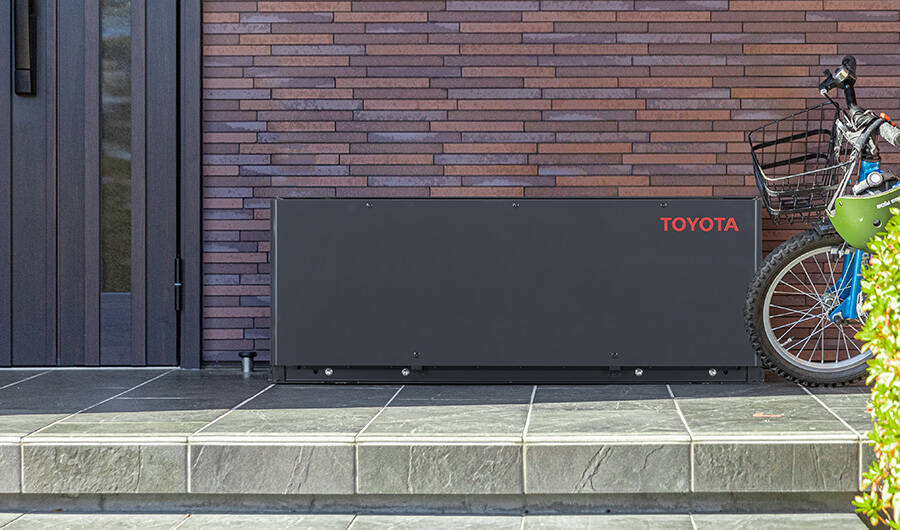
Japanese automaker Toyota has become the latest car company to repurpose its electric vehicle batteries for home energy storage.
The O-Uchi Kyuden System, which is on presale now and will roll out in August in Japan only, mainly consists of a trunk-sized battery and two-way vehicle charger. O-Uchi Kyuden is also able to store power generated by solar panels.
Toyota said the system uses proprietary technology from its vehicle batteries, and can scale electricity based on need, including using Toyota EVs to supply backup power in the event of an outage or other emergency.
Toyota's new product puts it alongside other manufacturers, like Tesla, Ford, and Hyundai, who have built their own home energy batteries out of tech used in their vehicles.
Tesla's Powerwall may be the most noticeable comparison: It too uses a big battery that lives outside and can charge Tesla EVs as well as supply power to a home from the grid or solar panels.
Hyundai Home, which is due to launch this year, offers similar technology, like a backup battery and EV charging, and tries to set itself apart by offering a "concierge" service that customizes solar installations for each customer.
In addition to home energy storage products like those from Hyundai, Tesla, and Toyota, there's also Ford's F-150 Lightning, which is meant to operate as a home power supply in case of emergencies. The Lightning doesn't come with a home battery, and is instead meant to act as its own unit, with a 131kWh battery, far greater than the 8.7kWh of Toyota's or the 13.5kWh of the Powerwall+.
O-Uchi Kyuden has a leg up, though: While Tesla Powerwall can charge an EV, it doesn't do vehicle-to-grid (V2G), while the F-150 Lightning doesn't have a stationary battery – if it leaves, the power goes with it. Toyota's offers both, provided the vehicle connected to it has V2G capabilities, which Toyota's and Hyundai's upcoming vehicles do.
- China 'must seize TSMC' if the US were to impose sanctions
- Vehicle owner data exposed in GM credential-stuffing attack
- Toyota cuts vehicle production over global chip shortage
- EU lawmakers vote to ban sales of combustion engine cars from 2035
- How Schneider Electric is rewiring how we think about modular datacenters
As electrification of vehicles and the power grid continues, concerns over waste won't go away, but will change: Tens of millions of EVs now on the roads will eventually reach end of life, and with them tens of millions of batteries with just enough reduced capacity from repeat charging cycles to make them unusable in new vehicles.
Both Nissan and Volkswagen have launched EV battery recycling programs to address waste, and those programs could end up recycling old EV batteries right into homes as energy storage devices like Toyota's.
The US Department of Energy's American-Made Solar Prize has invited researchers to compete for novel solar technology funding. One entry from Utah State University (USU) proposed technology that could turn retired EV batteries into home energy systems. "With solar energy, you don't have a mileage problem – you just need to provide enough energy storage," said USU researcher Hongjie Wang. ®
From Chip War To Cloud War: The Next Frontier In Global Tech Competition
The global chip war, characterized by intense competition among nations and corporations for supremacy in semiconductor ... Read more
The High Stakes Of Tech Regulation: Security Risks And Market Dynamics
The influence of tech giants in the global economy continues to grow, raising crucial questions about how to balance sec... Read more
The Tyranny Of Instagram Interiors: Why It's Time To Break Free From Algorithm-Driven Aesthetics
Instagram has become a dominant force in shaping interior design trends, offering a seemingly endless stream of inspirat... Read more
The Data Crunch In AI: Strategies For Sustainability
Exploring solutions to the imminent exhaustion of internet data for AI training.As the artificial intelligence (AI) indu... Read more
Google Abandons Four-Year Effort To Remove Cookies From Chrome Browser
After four years of dedicated effort, Google has decided to abandon its plan to remove third-party cookies from its Chro... Read more
LinkedIn Embraces AI And Gamification To Drive User Engagement And Revenue
In an effort to tackle slowing revenue growth and enhance user engagement, LinkedIn is turning to artificial intelligenc... Read more