

The Return Of Gopher: Pre-web Hypertext Service Is Still Around
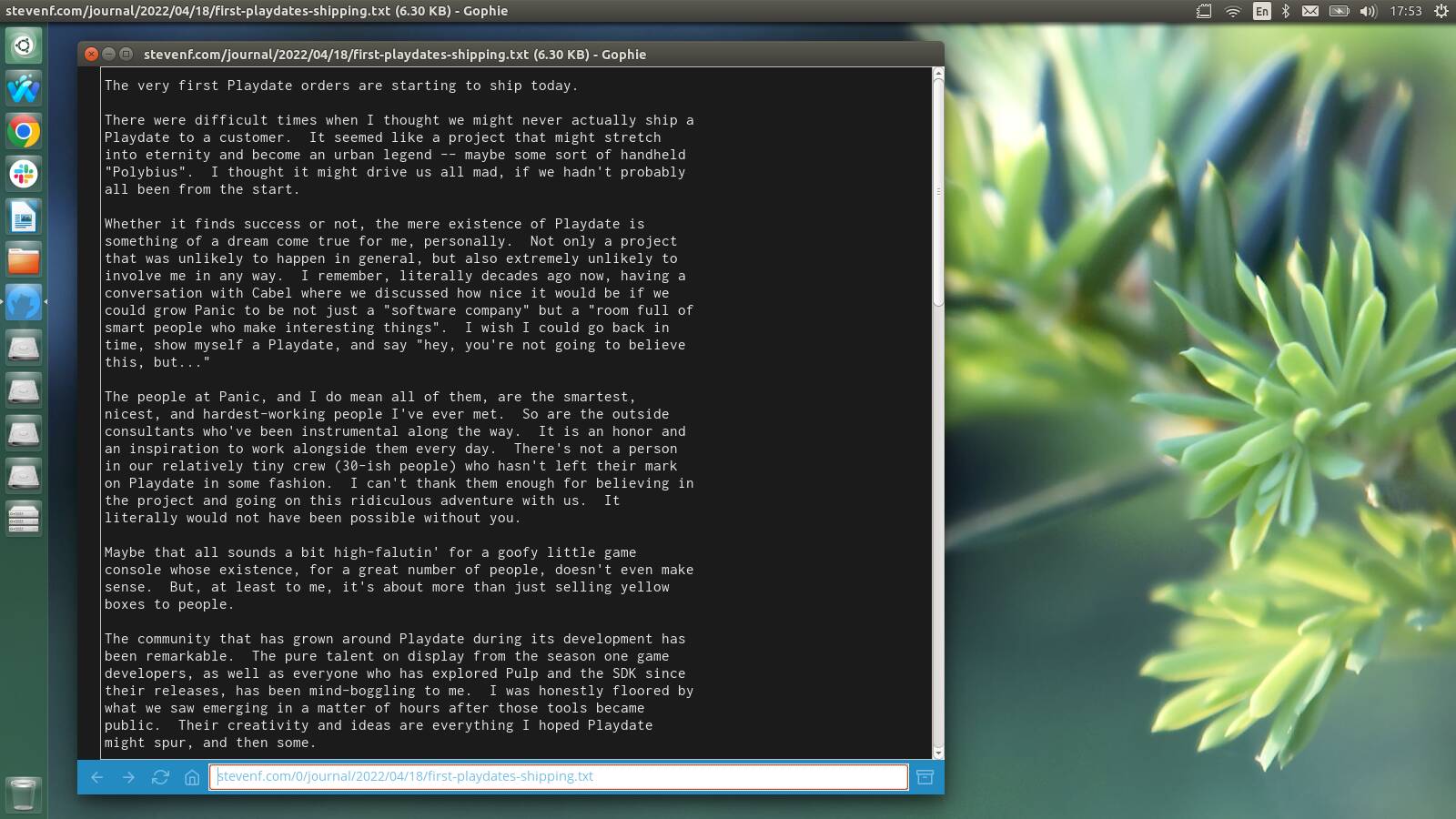
An announcement about a new handheld games console a few days ago caused confusion, because it was online but not on the web. It was published on Gopher.
The Gophie gopher browser running on a recent Linux distro, displaying the Playdate announcement
Gopher is a point-and-click internet protocol that predates Tim Berners-Lee's WorldWideWeb. Although the web has almost totally replaced it, Gopherspace still exists. The snag is that, just as modern web browsers are removing FTP support, they long ago got rid of Gopher support.
But all is not lost. Firefox users can re-enable it with a choice of extensions, including Overbite and Underbite. Chrome users could try Burrow. Rather than full gopher browsers, these direct Gopher links through public Gopher-to-Web proxies.
Saying that, though, there is even a modern dedicated Gopher browser. It's called Gophie, and as it's a Java app, it runs on all the main platforms. Also worth a look is Castor, a modern Rust-based client for Gopher, Gemini and Finger.
Once you have one of these installed, you should be able to view the announcement (gopher link here) about the Playdate console project, as seen on Twitter. (Playdate is an interesting little project in its own right: an open, monochrome-screen handheld games console, with a unique analog input device.)
Gopher's modest revival seems appropriate given the interest in the "small web", concern about web bloat, and increasing interest in lighweight hypertext protocols such as Gemini. In fact, Gemini itself is even documented (gopher link here) in gopher.
Your humble scribe started exploring the internet via JANET in the mid-1980s, and used Gopher, Archie, Veronica (warning: gopher link) and so on when they were new, so it's been enjoyable to read about people discovering it anew.
Gopher is even simpler than Gemini, and it's already there, which is relevant. The underlying file format is a plain text file, called a gophermap, containing tab-separated entries which a gopher browser displays as menu entries.
- Toaster-friendly alternative web protocol Gemini attracts criticism for becoming exclusive clique
- Google talks up its 540-billion-parameter text-generating AI system
- In conversation with Gene Hoffman, co-creator of the internet's first ad blocker
- Hell desk to user: 'I know you're wrong. I wrote the software. And the protocol it runs on'
You can click them with a mouse, or navigate with a keyboard, and although gopher has its own internet protocol (described in RFC 1436 and accessed over port 70), gopher sites can be distributed via file shares or on removable media.
Another type of internet presence in the same vein is the tildeverse, which is a group of communities based around very minimalist, Unix-hosted personal sites such as tilde.club and tilde.town, sometimes described as a "social network accessed via SSH."
The tildeverse has something of the same fun, chaotic feel about it as the early, pre-web internet communities of the 1980s. Your correspondent plans to resurrect his quarter-century-old homepage and join in. ®
From Chip War To Cloud War: The Next Frontier In Global Tech Competition
The global chip war, characterized by intense competition among nations and corporations for supremacy in semiconductor ... Read more
The High Stakes Of Tech Regulation: Security Risks And Market Dynamics
The influence of tech giants in the global economy continues to grow, raising crucial questions about how to balance sec... Read more
The Tyranny Of Instagram Interiors: Why It's Time To Break Free From Algorithm-Driven Aesthetics
Instagram has become a dominant force in shaping interior design trends, offering a seemingly endless stream of inspirat... Read more
The Data Crunch In AI: Strategies For Sustainability
Exploring solutions to the imminent exhaustion of internet data for AI training.As the artificial intelligence (AI) indu... Read more
Google Abandons Four-Year Effort To Remove Cookies From Chrome Browser
After four years of dedicated effort, Google has decided to abandon its plan to remove third-party cookies from its Chro... Read more
LinkedIn Embraces AI And Gamification To Drive User Engagement And Revenue
In an effort to tackle slowing revenue growth and enhance user engagement, LinkedIn is turning to artificial intelligenc... Read more