

The British Twins Who Set Up A Black-founded $1bn 'unicorn'
By Lydia Bernsmeier-Rullow
BBC News
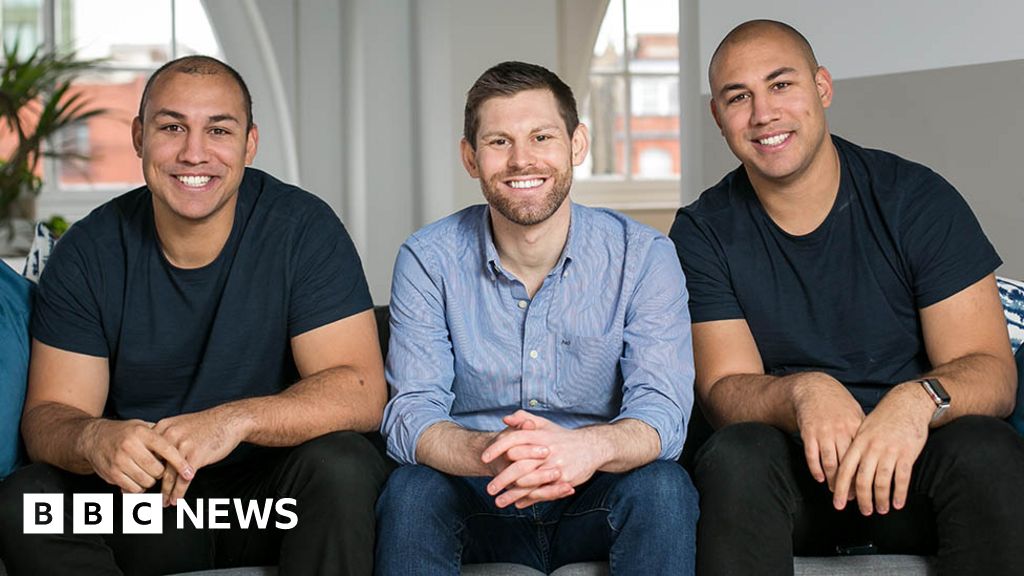
When 29-year-old twins Oliver and Alexander Kent-Braham decided to reinvent one of the most traditional areas of finance - insurance - all they had to go on was an idea and the foyer of a gym for an office.
"We were all members of Virgin Active gym. It had wi-fi, coffee and a location on The Strand!" says Oliver.
That's where Marshmallow insurance was born, with the help of co-founder and chief technology officer (CTO) David Goaté. They had no capital and no clients but they knew they had a strong idea.
Their hunch was right, in September 2021 the company reached unicorn status - meaning it is valued at $1bn (£727m) - making it the UK's second black-founded unicorn firm. Ismail Ahmed's firm, WorldRemit (now Zepz), a digital cross-border payment platform, became the first in August.
Oliver says when they conceived their insurtech firm ("insurtech" means innovating new products and services within the insurance sector) they wanted to turn the industry on its head.
Image source, Marshmallow
The twins had a conversation with a friend who had recently moved to the UK and kept receiving expensive quotes for car insurance led them to their big question: how do you find reasonably priced insurance if you don't have a UK driving licence?
The key was smarter use of technology and data and they are able to specialise in products for "riskier" customers - migrants, young people and those with low credit scores.
"If we were going to start again we would look to raise capital sooner, because before you raise capital you don't have the confidence to take the next step," says Oliver.
"It was literally Tim Holliday (CEO of Marshmallow Insurance), David, Alexander and myself for nine months. Tim joined our company not taking a salary."
Their next step was to raise capital. Not an easy feat.
"Venture capitalists hold the keys to starting new companies. You have to have a mutual acquaintance to even speak to many funders and that needs to change," says Oliver.
Unicorn: What's in a name?
Image source, Getty Images
The most recent government statistics say black-owned businesses are four times more likely to have their business loan applications rejected than white or South Asian business founders.
"The first investor to really believe in us was a guy called Bernard Kantor, who was the founder of Investec bank, and no one really believes in you until one person believes in you," Oliver.
Image source, Getty Images
So how exactly do you create a black unicorn?
The twins have always been driven, being offered a scholarship at the prestigious Reed School on the strength of their skill as sportsmen. That drive has carried them to the top of their field, they say.
"We played a lot of elite-level tennis and what we took from that was persistence. I think that is a skill set needed in businesses; no matter if you're knocked down, you need to get up and try again," says Oliver.
"We'd always had a bit of an entrepreneurial flair. When we were 12, we were selling golf balls fished out of the lake and that sort of stuff.
"It was through our early 20s where we just got really into kind of the tech world and into FinTech especially, the whole space is exciting, and that's where we then started to think we wanted to start our own tech company."
Image source, Getty Images
But despite BAME communities comprising 14% of the UK population, all-ethnic founding teams received just 4% of all venture capital investments between 2009 and 2019.
The latest research from KPMG suggests that, thanks to the UK's Covid vaccination programme and a greater business confidence in the post-Brexit environment, global Venture Capital Investment into UK companies has continued to grow, with £6.7bn being invested in the second quarter of 2021.
Back at Marshmallow, Oliver Kent-Braham has some advice for anyone looking to set-up a business: "To begin with, no one believes in you. Your parents say, 'Oh my god, don't quit your job!' They don't want you to take that risk. So take the risk and be bold in your approach.
"Start small, but go after really big problems."
From Chip War To Cloud War: The Next Frontier In Global Tech Competition
The global chip war, characterized by intense competition among nations and corporations for supremacy in semiconductor ... Read more
The High Stakes Of Tech Regulation: Security Risks And Market Dynamics
The influence of tech giants in the global economy continues to grow, raising crucial questions about how to balance sec... Read more
The Tyranny Of Instagram Interiors: Why It's Time To Break Free From Algorithm-Driven Aesthetics
Instagram has become a dominant force in shaping interior design trends, offering a seemingly endless stream of inspirat... Read more
The Data Crunch In AI: Strategies For Sustainability
Exploring solutions to the imminent exhaustion of internet data for AI training.As the artificial intelligence (AI) indu... Read more
Google Abandons Four-Year Effort To Remove Cookies From Chrome Browser
After four years of dedicated effort, Google has decided to abandon its plan to remove third-party cookies from its Chro... Read more
LinkedIn Embraces AI And Gamification To Drive User Engagement And Revenue
In an effort to tackle slowing revenue growth and enhance user engagement, LinkedIn is turning to artificial intelligenc... Read more