

The Allotment Firms Helping To Trim Long Waiting Lists
By Katherine Latham
Business reporter
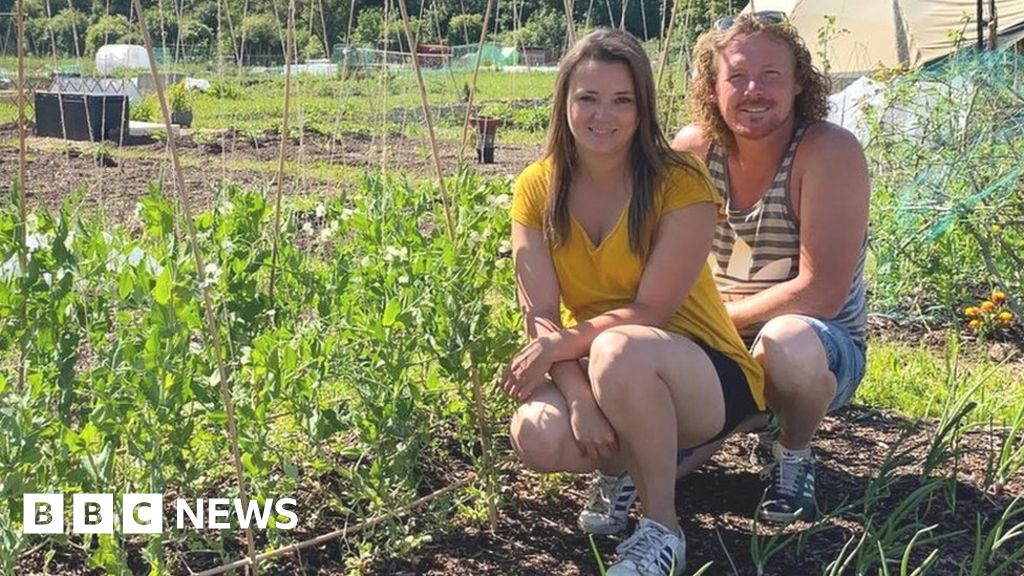
Katie Wales and partner Scott rent their allotment from a private provider rather than the far more typical local authority
Katie Wales says that getting an allotment with her partner Scott "was the best decision we ever made".
"You can't beat the view from our allotment," adds Ms Wales, 38. "It's right next to the river. We bring our boat, and moor nearby."
Demand for allotments across the UK soared during the pandemic. People had more time on their hands to do some gardening, and empty supermarket shelves made many of us more concerned about food supplies.
As a result, 94% of local authorities - who run the vast majority of allotment sites - said that they saw an increase in applications due to Covid-19.
Yet, allotments remain in such short supply that in many cases people are having to wait years - literally - to get their hands on one.
Image source, Getty Images
Demand for allotments soared during the pandemic
This rose to a whopping 17 years in the London Borough of Camden - which has the longest waiting list in the country.
The released data also show that 100,000 people in total were on the waiting list for a council-owned allotment plot, of which there are 330,000 across the UK.
Ms Wales says that she and Scott "just couldn't wait anymore" for a local authority allotment to become available.
So, instead they rented one almost immediately in the Somerset city of Bath, from a new private provider called Roots Allotments. Roots is one of a small but growing number of companies aiming to meet the pent-up demand for allotments.
Image source, Roots Allotments
The first Roots Allotments site is in Bath
Roots' founder Christian Samuel describes the company as a "new age allotment business".
"We launched our first site at Tuckers Meadows, on the edge of Bath in April," he says.
That location, beside the River Avon, is already said to be 97% sold out, and the firm has plans to open five more sites across the South West of England. And that's just the beginning of an ambitious expansion plan.
"People want more than just the nine to five. They want to reconnect with nature," says Mr Samuel. "Our mission is simple. Over the next 10 years, we want to get 250,000 people growing across the globe."
Over in Northern Ireland, Ards Allotments was a private allotments pioneer. Based near the town of Strangford in County Down, it opened back in 2006.
"There is no greater buzz than when you plant a seed in the ground and help it to connect with mother nature," says owner Maurice Patton, a fourth-generation farmer who decided to diversify 16 year ago. "When it matures into a perfect carrot and you take your first bite - it's magic."
Image source, Maurice Patton
Maurice Patton, pictured here with his wife Judith, says he "proud" to see the work of all the allotment holders
Starting out with just 20 plots, Ards now has more than 100, across 40 acres.
"It makes me so proud when I walk round the site and see what an amazing job people have done with their plots - leaning over the fence to have a good natter with their neighbour, while turning food miles into food metres," he says.
"People are re-examining their lifestyles. We can't build plots quickly enough."
Yet, while both Roots and Ards are allowing people to get hold of allotment far more quickly than via a local authority, there is a catch - you have to pay quite a bit more to have one.
At Roots, the price of a 36 sq m "starter patch" is £220 a year, while a 108 sq m plot at Ards will cost you £295 for the first year, and then £220 for each following year. By contrast, 63% of local authority allotments cost below £70 a year, and you typically get a much larger 250 sq m.
Image source, Ards Allotments
Ards Allotments spreads over 40 acres
In Wales, charity Social Farms and Gardens aims to create up to 600 new allotment plots, through their Resilient Green Spaces project, particularly in areas with high levels of food poverty.
Anne-Marie Pope, the charity's development coordinator, thinks in the near future we may increasingly rely upon allotments to fill our fridges.
"Growing your own is core local food security," she says. "It's empowering. You can provide for family, community and yourself.
"If everybody in a street of 10 families planted a packet of seeds, you would have more than enough to swap and share produce."
New Economy is a new series exploring how businesses, trade, economies and working life are changing fast.
Ms Pope adds that the growing demand for allotments stems from a heightened awareness of the need for sustainable food production.
Allotments, she says, also have "a plethora of proven mental benefit. Soil is a natural anti-depressant, and many doctors are prescribing gardening to patients."
In London, waiting lists for local authority allotments have not been helped by sites closing. A total of 41 have shut for good in the city since 2013, according to a 2020 study by Imperial College.
However, for some lucky residents, allotments are being built into new residential developments. At Quintain Living's Canada Gardens building in Wembley there is an area of allotments beds.
One resident, Reschma Jetha, a 32-year-old mother of two, is growing carrots, beans, tomatoes, cabbages, peppers, berries and herbs. "I had never done gardening before," she says. "I wanted to but didn't have the time and thought you needed to have a house with a garden to do it."
Image source, Reschma Jetha
Reschma Jetha, pictured here with her family, is trying gardening for the first time
She and the other gardeners share a greenhouse and shed, and the site's landscape manager is on hand to offer advice.
"When the vegetables are ready, we'll be able to enjoy food we've planted with our own hands," says Ms Jetha. "That's the best part."
Image source, Quintain Living
Quintain Living's Canada Gardens development has an allotment area
Back in Bath, Ms Wales is well on her way to achieving her goal of self-sufficiency. After weeks of hard toil, life has begun to appear from the soil.
"It's been a learning curve, as I'm sure the next few years will be," she says. "We want to develop our skills, to watch our patch grow."
"We always wanted an allotment - to be more sustainable and live the good life. The work has paid off."
From Chip War To Cloud War: The Next Frontier In Global Tech Competition
The global chip war, characterized by intense competition among nations and corporations for supremacy in semiconductor ... Read more
The High Stakes Of Tech Regulation: Security Risks And Market Dynamics
The influence of tech giants in the global economy continues to grow, raising crucial questions about how to balance sec... Read more
The Tyranny Of Instagram Interiors: Why It's Time To Break Free From Algorithm-Driven Aesthetics
Instagram has become a dominant force in shaping interior design trends, offering a seemingly endless stream of inspirat... Read more
The Data Crunch In AI: Strategies For Sustainability
Exploring solutions to the imminent exhaustion of internet data for AI training.As the artificial intelligence (AI) indu... Read more
Google Abandons Four-Year Effort To Remove Cookies From Chrome Browser
After four years of dedicated effort, Google has decided to abandon its plan to remove third-party cookies from its Chro... Read more
LinkedIn Embraces AI And Gamification To Drive User Engagement And Revenue
In an effort to tackle slowing revenue growth and enhance user engagement, LinkedIn is turning to artificial intelligenc... Read more