

Sri Lanka Central Bank Governor Submits Resignation Amid Crisis
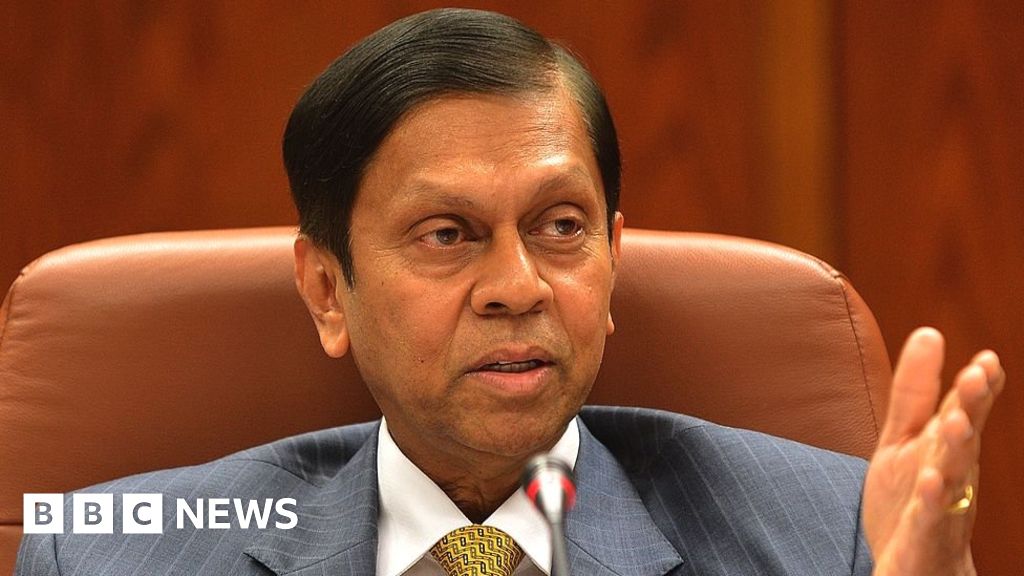
Image source, Getty Images
The governor of Sri Lanka's central bank says he has submitted his resignation as the country faces its worst economic crisis in decades.
Ajith Nivard Cabraal's announcement came after all of the country's cabinet ministers resigned.
Angry protestors have also been calling for the country's prime minister and president to step down.
A severe shortage of foreign currency has left the government unable to pay for essential imports, including fuel.
The island nation of some 22 million people is suffering from its most serious economic crisis since independence from the UK in 1948.
The central bank was due to make an interest rate decision on Tuesday.
A spokesperson for the central bank told the BBC on Monday afternoon that there were currently no plans to postpone the announcement.
Lakshini Fernando, of Asia Securities, said she expects the bank to raise its main interest rate by at least two percentage points as it tries to stabilise the Sri Lankan rupee.
The currency has lost more than 30% of its value against the US dollar since it was devalued last month.
While the market is likely to react positively to Mr Cabraal's resignation, "the key will be who takes over at this juncture," Ms Fernando told the BBC.
"We definitely need more clarity on policy for a stronger momentum," she said.
Demonstrators have been taking to the streets of the capital Colombo as homes and businesses have had their electricity cut for up to 13 hours at a time.
Sri Lankans are also dealing with shortages and soaring inflation, after the country steeply devalued its currency last month ahead of talks with the International Monetary Fund (IMF) over a bailout.
It comes as 26 of Sri Lanka's ministers have submitted letters of resignation - but not Prime Minister Mahinda Rajapaksa or his brother, President Gotabaya Rajapaksa.
Meanwhile, President Rajapaksa's former attorney and the country's ex-justice minister Ali Sabry, was sworn in as the new finance minister on Monday.
Archana Shukla, BBC News correspondent in Sri Lanka
The banners, slogans, protests, dissent - all continued in a day of turmoil in the island nation. Even as the Sri Lankan ruling dispensation struggles to find its feet, the resignation of the central bank has added more to uncertain times.
Ajith Nivard Cabraal's resignation comes right before a crucial monetary policy meeting where the board, chaired by the central bank governor, was to discuss interest rates to deal with rising inflation. Prices of essentials have sky-rocketed and a tinkering of the interest rate is the need of the hour.
Dhananath Fernando, chief operations officer of Colombo-based policy think tank Advocado told me that the political instability in the country will impact the economic situation even more. "With no decision as yet on who takes over as the next governor, we are looking at uncertainty. And the next governor too will have to start from scratch," he said.
Protestors in the capital city, mostly young, shouted slogans calling for the resignation of the president and prime minister, bothers Gotabaya Rajyapaksha and Mahindra Rajpakshya.
The central bank governor and the current ministry of finance, both crucial arms of the economy, were not seeing eye to eye over how to deal with the economic crisis with Mr Cabraal publicly showing his displeasure over the government's decision to seek the IMF's help in coming out of the economic trap.
Priyanga Durusinghe, economics professor at the University of Colombo, told me there is a dire need to increase interest rates, as the banks have already said the rates are unrealistic and they cannot lend at these rates.
With a disrupted monetary policy board, the upcoming discussion with the IMF later this month could have repercussions too.
Mr Cabraal was appointed as the central bank's 16th governor last September.
He was previously the bank's 12th governor for almost a decade, from July 2006 to January 2015.
During his first term in office Mr Cabraal also helped to more than triple the size of the Sri Lankan economy, according to the bank.
With him in charge, the bank said: "Sri Lanka was able to maintain sound and stable macro-economic fundamentals, with inflation being contained at low levels, and financial system stability being achieved in a time of severe global uncertainties and turmoil".
WATCH: Police in Sri Lanka fire tear gas and water cannon at protesters in Kandy
From Chip War To Cloud War: The Next Frontier In Global Tech Competition
The global chip war, characterized by intense competition among nations and corporations for supremacy in semiconductor ... Read more
The High Stakes Of Tech Regulation: Security Risks And Market Dynamics
The influence of tech giants in the global economy continues to grow, raising crucial questions about how to balance sec... Read more
The Tyranny Of Instagram Interiors: Why It's Time To Break Free From Algorithm-Driven Aesthetics
Instagram has become a dominant force in shaping interior design trends, offering a seemingly endless stream of inspirat... Read more
The Data Crunch In AI: Strategies For Sustainability
Exploring solutions to the imminent exhaustion of internet data for AI training.As the artificial intelligence (AI) indu... Read more
Google Abandons Four-Year Effort To Remove Cookies From Chrome Browser
After four years of dedicated effort, Google has decided to abandon its plan to remove third-party cookies from its Chro... Read more
LinkedIn Embraces AI And Gamification To Drive User Engagement And Revenue
In an effort to tackle slowing revenue growth and enhance user engagement, LinkedIn is turning to artificial intelligenc... Read more