

SiPearl Ships Reference Node Design For Rhea1 High-spec Arm Chip
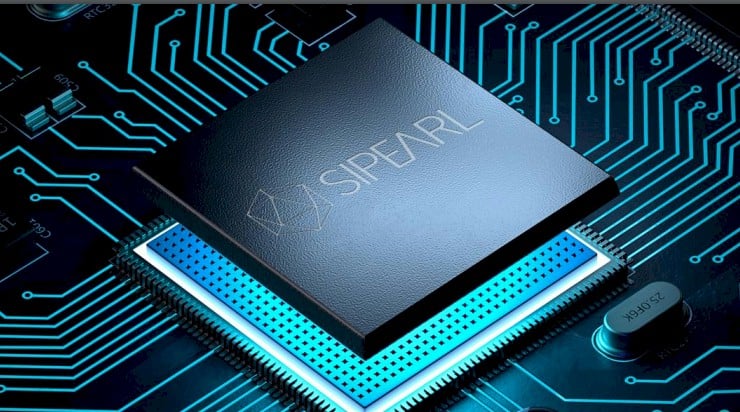
Euro chip designer SiPearl has released a reference server design featuring its Rhea1 processor, the chip that powers Jupiter, Europe's most powerful supercomputer.
The Seine Reference Server can be used for validation and testing, software development and porting, and demonstrations and customer evaluation, the company says.
According to SiPearl, this reference hardware makes up a vital component of several other European collaborative projects. These include Aero, which focuses on the development of an open source software ecosystem for Rhea1; OpenCUBE, which aims to deliver a full-stack validated European cloud computing blueprint; and Plasma-PEPSC, a EuroHPC project dedicated to plasma science.
The Seine Reference Server is available in two configurations. The first features a single CPU paired with up to two GPUs in a 2U chassis, for workloads such as AI inferencing and materials science. The second includes an additional CPU and targets other workloads, with defense and weather forecasting given as examples by SiPearl.
An animated video posted to YouTube by SiPearl shows that the first configuration uses a single main board alongside an enclosure for the two GPUs, which is replaced in the second instance with a duplicate main board.
The Rhea1 processor in this reference hardware is an Arm-based chip with 80 of Arm's Neoverse V1 cores, with each core including a pair of 256-bit Scalable Vector Extension (SVE) units to boost its vector processing capabilities. Each chip also incorporates four stacks of high-performance HBM2E memory.
- Euro techies call for sovereign fund to escape Uncle Sam's digital death grip
- SiPearl updates specs for Rhea1 processor set to power Europe's exascale dreams
- SiPearl works with AMD on GPU support for Arm HPC chip
- Home-grown Euro chipmaker SiPearl signs deal with HPE, Nvidia
SiPearl's processor was designed in response to the European Processor Initiative (EPI) to develop a power-efficient chip to drive European supercomputers, particularly the Jupiter project, which aims to be the region's first exascale system.
First announced in 2022, Jupiter, or the "Joint Undertaking Pioneer for Innovative and Transformative Exascale Research," was originally intended to come online last year. The contract to build the system was given to Atos subsidiary Eviden, using its BullSequana XH3000 direct liquid-cooled architecture, and it was constructed as a modular datacenter consisting of container units.
Just this week, the Jupiter supercomputer found its way into the number four spot on the Top500 list of the most powerful publicly ranked systems, as operators work to bring it up to full exaFLOPS capacity.
Funded by the European Union, SiPearl employs 200 people and says it works closely with other from the from EPI, the scientific community, and supercomputing centers. ®
From Chip War To Cloud War: The Next Frontier In Global Tech Competition
The global chip war, characterized by intense competition among nations and corporations for supremacy in semiconductor ... Read more
The High Stakes Of Tech Regulation: Security Risks And Market Dynamics
The influence of tech giants in the global economy continues to grow, raising crucial questions about how to balance sec... Read more
The Tyranny Of Instagram Interiors: Why It's Time To Break Free From Algorithm-Driven Aesthetics
Instagram has become a dominant force in shaping interior design trends, offering a seemingly endless stream of inspirat... Read more
The Data Crunch In AI: Strategies For Sustainability
Exploring solutions to the imminent exhaustion of internet data for AI training.As the artificial intelligence (AI) indu... Read more
Google Abandons Four-Year Effort To Remove Cookies From Chrome Browser
After four years of dedicated effort, Google has decided to abandon its plan to remove third-party cookies from its Chro... Read more
LinkedIn Embraces AI And Gamification To Drive User Engagement And Revenue
In an effort to tackle slowing revenue growth and enhance user engagement, LinkedIn is turning to artificial intelligenc... Read more