

Shanghai Covid: Oil Prices Fall After City Starts Lockdown
By Annabelle Liang
Business reporter
Image source, Reuters
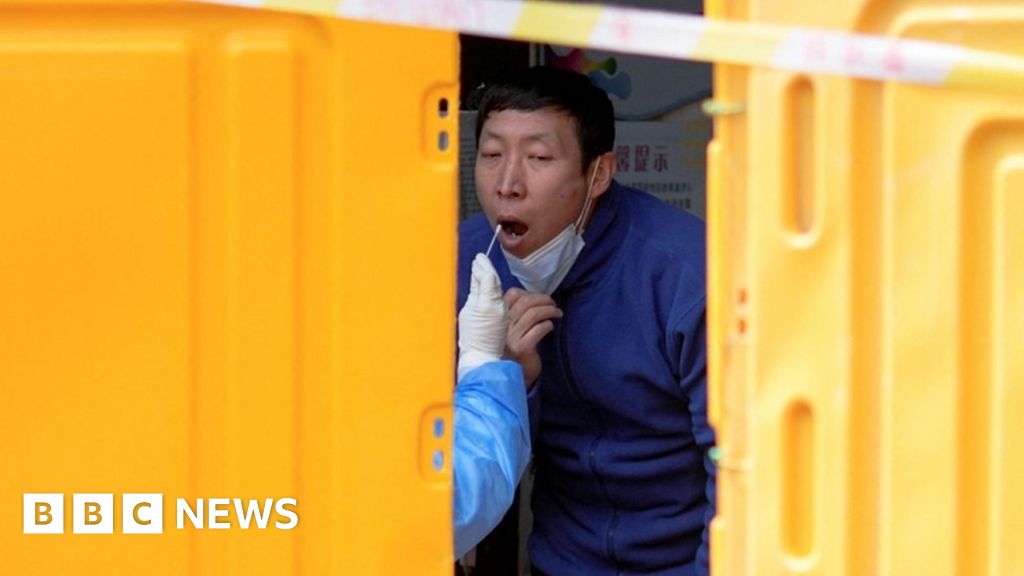
A man gets tested for Covid-19 at a makeshift testing site behind barriers of an area under lockdown in Shanghai
Global oil prices have fallen as China starts to implement a city-wide lockdown in Shanghai, an important financial and manufacturing hub.
Brent crude lost more than $4.50 a barrel on concerns that the move would mean that demand for oil will fall.
The Shanghai Composite stock index fell in early trade before regaining most of the losses later in the day.
The lockdown, which began on Monday, is China's largest since the coronavirus outbreak began more than two years ago.
The futures contract for Brent crude - an international benchmark for oil prices - was down by 4% at $115.80 a barrel.
Despite the fall, oil remains almost 80% higher than it was a year ago after the war in Ukraine helped to drive up prices.
Traders were concerned about the effectiveness of China's zero-tolerance policy towards Covid, said Stephen Innes, managing partner at SPI Asset Management.
'Tip of the iceberg'
Mr Innes also said in a note to investors that there were expectations of further supply chain disruptions as well as a fall in demand.
"We might be only dealing with the tip of the iceberg," he said.
However, Dan Wang, chief economist at Hang Seng Bank China, does not expect the lockdown to have a major impact on supply chains.
Most factories continue to operate as usual, and workers are either being confined on-site or given priority for testing, the Shanghai-based economist told the BBC.
"The suburbs are controlled quite well and quite tightly," she said. "Supply chain stability is a priority in this round."
She added that, given the spike in Covid cases, there were expectations of more government stimulus and interest rates could be lowered "quite significantly" in the coming days.
As long as they are passed on by banks, lower interest rates make it less costly for businesses and individuals to borrow money.
Meanwhile, the Shanghai Composite stock index opened lower on Monday before regaining those losses to close just 0.07% higher.
Until now, Chinese authorities had resisted locking down the city of almost 25 million people to avoid destabilising the world's second largest economy.
The city will be locked down in two stages over nine days while authorities carry out Covid-19 testing.
The key financial centre has battled a new wave of infections for nearly a month, although case numbers are not high by some international standards.
Shanghai's public transport has been suspended and firms and factories in the city have been ordered to halt operations or work remotely.
The lockdown will take place in two stages, starting on Monday with the eastern side of Shanghai, which includes the city's financial centre.
From Friday, the western side of Shanghai is scheduled to go into lockdown.
This staggered approach means that half of the city will be able to remain open.
Some businesses had already stopped operating in Shanghai, which has been battling a new wave of Covid infections for nearly a month.
Last week, the Shanghai Disney Resort said it would close until further notice, citing the "current pandemic situation".
"We will continue to monitor the pandemic situation and consult local authorities, and will notify guests as soon as we have a confirmed date to resume operations," it said.
China's financial capital, home to almost 25m people - Shanghai is now a divided city.
Everyone east of its main river is now locked down. Another round of mass testing has started.
By the week's end the western half of the city will be shut.
Public transport is being closed and the city sealed off. Anyone leaving needs to show a negative test.
It is all part of a huge effort to try to stop the spread of a resurgent virus that China's leaders thought they had banished.
Anyone testing positive here is sent to hospital or forced quarantine.
As the numbers continue to rise China's insistence on a zero-Covid strategy is being tested - but also subtly adapted.
You may also be interested in:
The BBC's Stephen McDonell visited Wuhan ahead of the anniversary of the world's first Covid-19 lockdown
From Chip War To Cloud War: The Next Frontier In Global Tech Competition
The global chip war, characterized by intense competition among nations and corporations for supremacy in semiconductor ... Read more
The High Stakes Of Tech Regulation: Security Risks And Market Dynamics
The influence of tech giants in the global economy continues to grow, raising crucial questions about how to balance sec... Read more
The Tyranny Of Instagram Interiors: Why It's Time To Break Free From Algorithm-Driven Aesthetics
Instagram has become a dominant force in shaping interior design trends, offering a seemingly endless stream of inspirat... Read more
The Data Crunch In AI: Strategies For Sustainability
Exploring solutions to the imminent exhaustion of internet data for AI training.As the artificial intelligence (AI) indu... Read more
Google Abandons Four-Year Effort To Remove Cookies From Chrome Browser
After four years of dedicated effort, Google has decided to abandon its plan to remove third-party cookies from its Chro... Read more
LinkedIn Embraces AI And Gamification To Drive User Engagement And Revenue
In an effort to tackle slowing revenue growth and enhance user engagement, LinkedIn is turning to artificial intelligenc... Read more