

Serbia Revokes Rio Tinto Lithium Mine Permits Following Protests
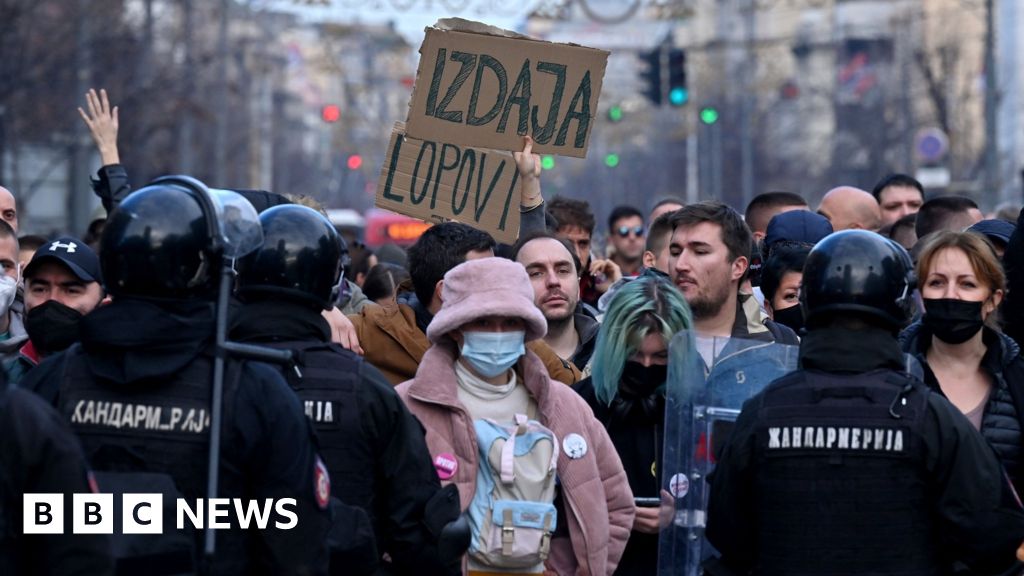
Image source, Getty Images
For months, thousands of people have been demonstrating against Rio Tinto's plan to mine lithium in the country
Serbia has withdrawn the exploration licences of Anglo-Australian mining company Rio Tinto following weeks of protests over plans for a lithium mine.
"All permits were annulled... we put an end to Rio Tinto in Serbia," Prime Minister Ana Brnabic said on Thursday.
The decision comes just weeks ahead of Serbia's general election in April.
Relations between Belgrade and Canberra have also soured recently over Australia's treatment and deportation of Serbian tennis star Novak Djokovic.
Djokovic, the world's number one men's tennis player who was unable to compete in the Australian Open, has supported the protests against the controversial mine.
In December, he posted images on social media of demonstrators and green landscapes along with comments written in Serbian such as "clean air and water are the keys to health" and "nature is our mother".
Thousands of demonstrators have been taking to the streets in recent months, blocking main roads in several cities, including the capital Belgrade and the country's second-largest city Novi Sad.
They say the development of a large mine near the town of Loznica in the western Jadar Valley could cause irreparable damage to the landscape and contaminate the region's water supplies.
Rio Tinto had previously said that any mining development in the country would meet both domestic and European Union environmental standards.
Speaking at a news conference in Belgrade on Thursday, Ms Brnabic - Serbia's first woman and first openly gay prime minister - said the decision to abandon the $2.4bn (£1.8bn; A$3.3bn) Jadar lithium mine was made in response to requests from environmental groups.
The project had been due to start production in 2027.
Rio Tinto's shares tumbled in Australia following the news, and were down more than 4% after markets opened in London.
It is undoubtedly tempting to look for a link between Australia's treatment of Novak Djokovic and Serbia's cancellation of Rio Tinto's mining project.
After all, it does have headquarters in Melbourne as well as London. And Serbia's prime minister, Ana Brnabic, announced the demise of the much-trumpeted lithium extraction operation just days after her counterpart in Australia cheered the deportation of Serbia's sporting icon.
The cancelled project is more likely a victim of Serbia's domestic politics, rather than a bizarre diplomatic tit-for-tat. Novak Djokovic is important to Serbia - but not as important as the $2.4bn which the mining giant had promised to invest.
In fact, pulling the plug is a reaction to months of protests. The movement has surprised Serbia's authorities with its organisation, unity and broad support going well beyond the usual coalition of opposition activists.
The government does not want to go into April's elections against a backdrop of blocked roads and accusations about favouring foreign investors over local interests.
But the environmentalists say they will continue protesting until the authorities issue a permanent ban on lithium mining.
In December, local authorities in western Serbia scrapped a plan to allocate land for a lithium mine in the region.
President Aleksandar Vucic had said that the opening of such a mine would require approval following an environmental study and a referendum.
In a statement to Reuters news agency, the Australian government said it regretted Serbia's decision: "We note the strong economic benefits of the significant investment by Rio Tinto in Serbia," it said.
Lithium is the main component of the batteries used in electric vehicles and demand for the element is increasing.
The World Bank estimates that globally the production of lithium will need to increase by 500% by 2050.
You may be interested to watch:
Serbian Prime Minister Ana Brnabic comments on the Djokovic vaccine row
From Chip War To Cloud War: The Next Frontier In Global Tech Competition
The global chip war, characterized by intense competition among nations and corporations for supremacy in semiconductor ... Read more
The High Stakes Of Tech Regulation: Security Risks And Market Dynamics
The influence of tech giants in the global economy continues to grow, raising crucial questions about how to balance sec... Read more
The Tyranny Of Instagram Interiors: Why It's Time To Break Free From Algorithm-Driven Aesthetics
Instagram has become a dominant force in shaping interior design trends, offering a seemingly endless stream of inspirat... Read more
The Data Crunch In AI: Strategies For Sustainability
Exploring solutions to the imminent exhaustion of internet data for AI training.As the artificial intelligence (AI) indu... Read more
Google Abandons Four-Year Effort To Remove Cookies From Chrome Browser
After four years of dedicated effort, Google has decided to abandon its plan to remove third-party cookies from its Chro... Read more
LinkedIn Embraces AI And Gamification To Drive User Engagement And Revenue
In an effort to tackle slowing revenue growth and enhance user engagement, LinkedIn is turning to artificial intelligenc... Read more