

Ryanair Afrikaans Test: Airline Drops Controversial South African Quiz
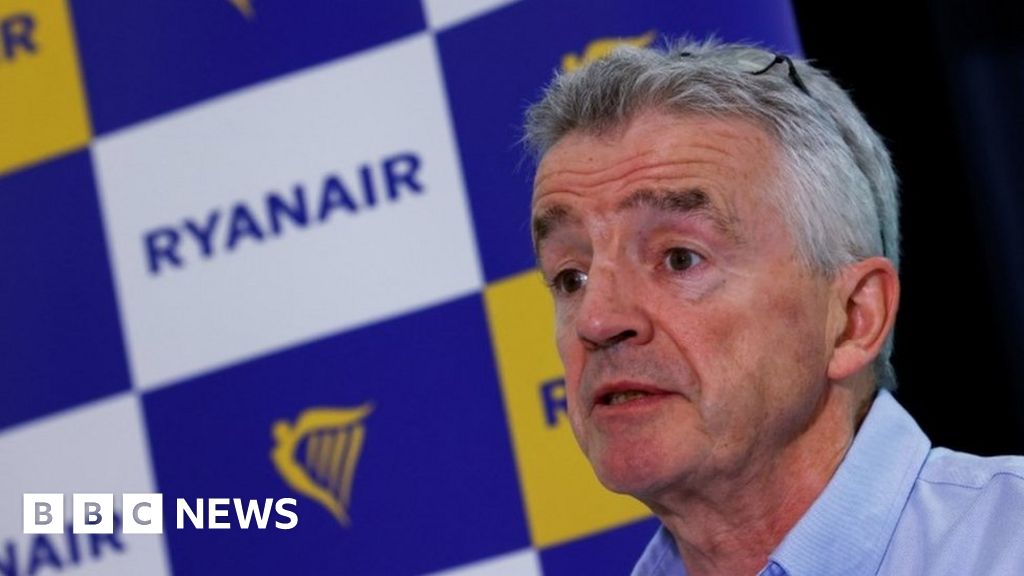
Ryanair CEO Michael O'Leary announced the change
Ryanair has dropped a controversial test in the Afrikaans language aimed at identifying passengers travelling on fake South African passports.
Boss Michael O'Leary said imposing the test "doesn't make any sense".
The policy caused outrage in South Africa, where many black people associate Afrikaans with the days of white-minority rule.
South Africa has 11 official languages and Ryanair never explained why it chose Afrikaans.
The budget airline runs flights across Europe.
The quiz contained questions such as what is South Africa's international dialling code, what is its capital city and who is the current president of the country.
Anyone who failed was refused travel and refunded the cost of their ticket. Ryanair originally defended the test saying it received a fine for every passenger found to have travelled on a fake passport.
In a statement sent to the BBC last week, Ryanair said it had to carry out the extra test because of "substantially increased cases of fraudulent South African passports being used to enter the UK".
But the imposition of the quiz was widely condemned.
More than a week after the controversy blew up, Mr O'Leary has said the airline has changed its policy.
"Our team issued a test in Afrikaans of 12 simple questions," he told journalists.
"They have no difficulty completing that. But we didn't think it was appropriate either. So we have ended the Afrikaans test, because it doesn't make any sense."
Last week, South African citizen Dinesh Joseph told the BBC how he was "seething" with anger when asked to take the test before flying to the UK from the Canary Islands.
"It was the language of apartheid," Mr Joseph said, saying it was a trigger for him.
"Being a person of colour, especially from South Africa, you've experienced a lot... of racism," he said.
Dinesh Joseph: 'Why I was so upset by Ryanair Afrikaans test'
The imposition of Afrikaans in schools was the main reason behind the 1976 Soweto uprising against the apartheid regime, in which at least 170 people were killed, mostly schoolchildren.
South Africa has 11 official languages: Zulu, isiXhosa, Afrikaans, Sepedi, Setswana, English, Sesotho, Xitsonga, Siswati, Tshivenda and Ndebele.
Why Afrikaans is so controversial:
- During apartheid, or white-minority rule, Afrikaans was made mandatory and an official language of education, alongside English, prompting nationwide protests by black South Africans
- It is no longer obligatory but is an option in schools
- It is the mother tongue of only 13% of South Africans, mainly mixed-race people, known as coloureds, and white South Africans - the descendants of Dutch, German and French settlers who arrived in the 17th Century
- More will be able to understand it but many cannot, and speak one of the 11 other official languages
- English is the language most commonly used officially and in business, according to South Africa's 2011 census.
You may also be interested in:
Around the BBC
From Chip War To Cloud War: The Next Frontier In Global Tech Competition
The global chip war, characterized by intense competition among nations and corporations for supremacy in semiconductor ... Read more
The High Stakes Of Tech Regulation: Security Risks And Market Dynamics
The influence of tech giants in the global economy continues to grow, raising crucial questions about how to balance sec... Read more
The Tyranny Of Instagram Interiors: Why It's Time To Break Free From Algorithm-Driven Aesthetics
Instagram has become a dominant force in shaping interior design trends, offering a seemingly endless stream of inspirat... Read more
The Data Crunch In AI: Strategies For Sustainability
Exploring solutions to the imminent exhaustion of internet data for AI training.As the artificial intelligence (AI) indu... Read more
Google Abandons Four-Year Effort To Remove Cookies From Chrome Browser
After four years of dedicated effort, Google has decided to abandon its plan to remove third-party cookies from its Chro... Read more
LinkedIn Embraces AI And Gamification To Drive User Engagement And Revenue
In an effort to tackle slowing revenue growth and enhance user engagement, LinkedIn is turning to artificial intelligenc... Read more