

Retail Sales Fall As Rising Cost Of Living Bites
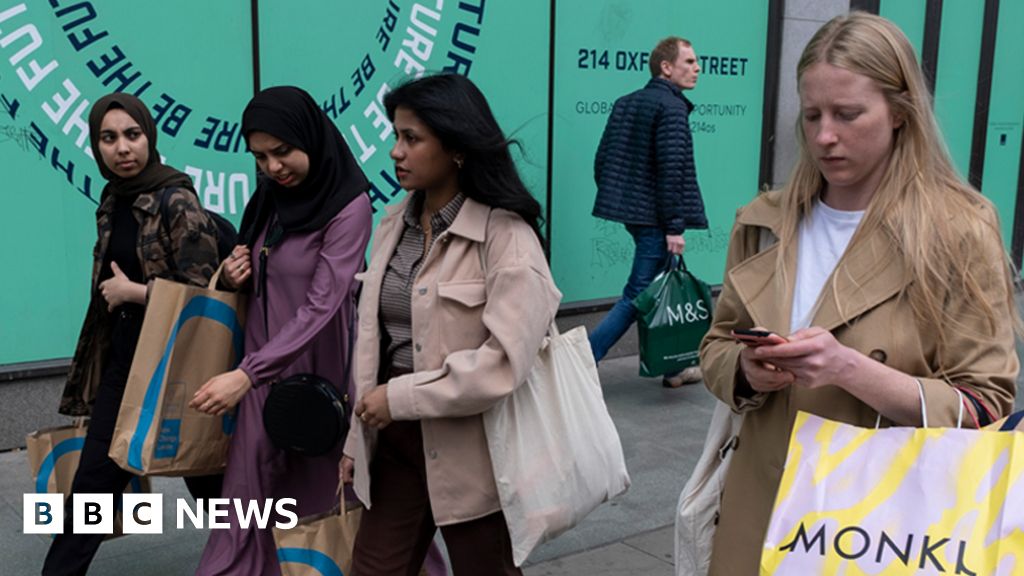
Image source, Getty Images
UK retail sales dropped in March as the rising cost of living hit consumer spending, according to official data.
Online sales fell sharply as people cut down on non-essential spending, the Office for National Statistics said.
Fuel sales also dropped as people cut travel amid record petrol and diesel prices.
However, overall retail sales were still above pre-Covid levels, the ONS said.
Retail sales fell by an unexpected 1.4% in the month, and February's sales figures were also revised down.
Darren Morgan, ONS director of economic statistics, said "Online sales were hit particularly hard due to lower levels of discretionary spending.
"Fuel sales also fell substantially, with evidence suggesting some people reduced non-essential journeys, following record high petrol prices, while food sales continued to fall, dropping for the fifth consecutive month."
The cost of living crisis is being driven by surges in fuel, energy and food prices, with inflation running at 7% - its highest rate for 30 years.
Energy and fuel prices had been rising even before Russia's invasion of Ukraine as economies started to recover from the coronavirus pandemic, and the conflict has pushed up prices further.
Bethany Beckett, UK economist for Capital Economics, said inflation was set to keep rising and "there's a real risk of an outright fall in consumer spending in the coming quarters".
The biggest contribution to the March retail sales slide came from the drop in online sales, which have been falling from pandemic highs after coronavirus restrictions eased.
"The sharp decline in sales in March suggests that households are already paring back spending to cope with higher costs for food and fuel," said Ms Beckett.
"That is only likely to worsen in the coming months as the cost of living crisis intensifies. After all, the March data predated April's huge 54% rise in utility bills which will have hit household budgets hard."
Separately, a survey by GfK suggested that UK consumer confidence in April dropped to its second-lowest level in 50 years due to people's weakening confidence in the economy and in their personal finances.
Consumer confidence was at its lowest ebb since July 2008, which was during the severe worldwide economic crisis, the market research firm said.
Analysis
by Ramzan Karmali, BBC business correspondent
The bigger-than-expected fall in retail sales last month was largely down to the current cost of living crisis - that's according to ONS officials.
Online sales of non-essential items fell again, and the data suggests that record high petrol prices are having a major impact with a cut in non-essential journeys.
More significantly perhaps is the fact food sales have been falling since last November, which is a sign that consumers are paring back their spending to cope with higher costs.
Economists believe the situation will only become more acute as March's data came before April's 54% hike in gas and electricity bills.
They also point to falling consumer confidence - the survey for this in April slumped to its lowest level in 14 years.
Meanwhile, a survey of businesses suggested a slowdown in private sector growth in April.
Although manufacturing growth picked up slightly after a five-month low in March, new manufacturing orders from abroad fell by the most since June 2020 as orders from Europe fell back.
Firms also said export orders were hit by Brexit, recent congestion in UK ports and sanctions on Russia, the survey found.
There was also a sharp rise in company insolvencies in March, according to official data. The number of firms going bust rose to 2,114 in March, more than double the number in March 2021, and a third higher than pre-pandemic figures.
'Stagflation risk'
The Bank of England has been raising interest rates to try to cool inflation, and its key rate currently stands at 0.75%.
Its governor, Andrew Bailey, said on Thursday that the Bank was walking a tight line between dealing with inflation and avoiding recession.
Bank of England monetary policymaker Catherine Mann said that interest rates would probably have to go up "a little bit" further.
Asked about the risk of so-called "stagflation", which is a combination of slow growth and high inflation, Ms Mann said "in some senses, we could say we're already there" because of the jump in energy prices and slowing retail sales.
"But I think that, you know, it's premature to kind of hearken back to the 1980s or the 1970s, in the US context in particular, and use that vocabulary," she said.
From Chip War To Cloud War: The Next Frontier In Global Tech Competition
The global chip war, characterized by intense competition among nations and corporations for supremacy in semiconductor ... Read more
The High Stakes Of Tech Regulation: Security Risks And Market Dynamics
The influence of tech giants in the global economy continues to grow, raising crucial questions about how to balance sec... Read more
The Tyranny Of Instagram Interiors: Why It's Time To Break Free From Algorithm-Driven Aesthetics
Instagram has become a dominant force in shaping interior design trends, offering a seemingly endless stream of inspirat... Read more
The Data Crunch In AI: Strategies For Sustainability
Exploring solutions to the imminent exhaustion of internet data for AI training.As the artificial intelligence (AI) indu... Read more
Google Abandons Four-Year Effort To Remove Cookies From Chrome Browser
After four years of dedicated effort, Google has decided to abandon its plan to remove third-party cookies from its Chro... Read more
LinkedIn Embraces AI And Gamification To Drive User Engagement And Revenue
In an effort to tackle slowing revenue growth and enhance user engagement, LinkedIn is turning to artificial intelligenc... Read more