

Polaris Supercomputer Boots Up, Paves Way For Aurora Exascale System
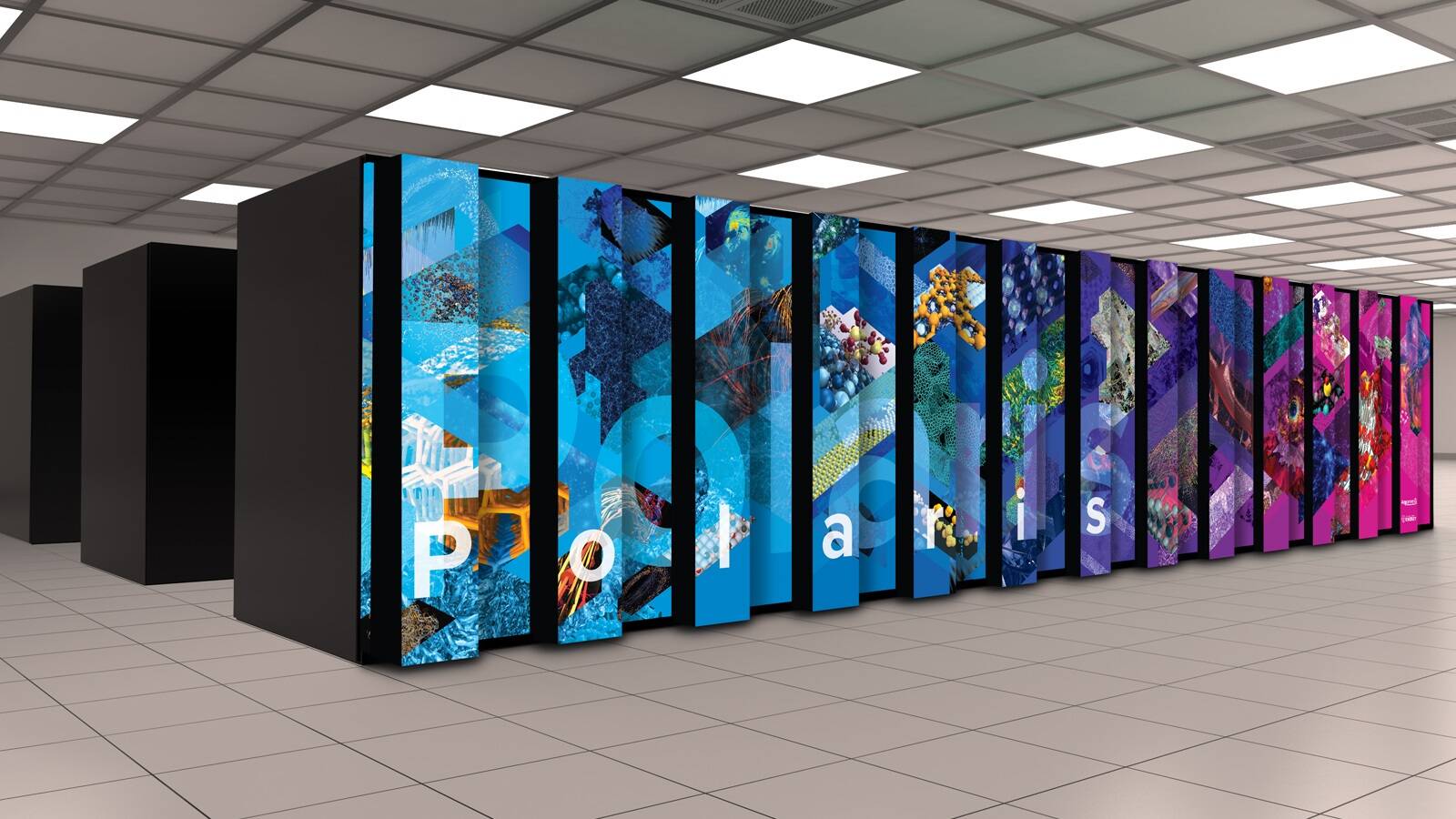
Argonne National Laboratory has declared its Polaris supercomputer operational, providing the scientific and engineering community with a powerful new research tool, but also serving as a testbed to prepare for the upcoming Aurora exascale system.
Polaris is a 44 petaflops machine, making it the most powerful system available to date at the US Department of Energy's (DoE) Argonne National Laboratory, with four times the power of its Theta supercomputer. It was built by HPE using AMD Epyc processors and Nvidia GPUs, making it similar to the Frontier exascale supercomputer at Oak Ridge National Laboratory.
This latest supercomputer to go live was first revealed almost a year ago, when it was described as a "testbed supercomputer," that had been ordered as a stepping stone to help Argonne "prepare critical workloads for future exascale systems."
In other words, it provides a platform for researchers to prepare codes and workloads for Argonne's upcoming Aurora exascale supercomputer, the latter of which was supposed to have been delivered last year, but was delayed, reportedly owing to issues that Intel has had with the "Ponte Vecchio" GPUs that will be paired with the "Sapphire Rapids" Xeon Scalable processors in that system.
Polaris will immediately begin supporting several research teams getting ready for the arrival of Aurora via DOE’s Exascale Computing Project (ECP) and the ALCF's Aurora Early Science Program (ESP), according to Argonne.
The new system will also be deployed to support projects focused on using artificial intelligence (AI) for science, as well as the integration of large-scale research instruments with high performance computing.
In fact, there is a diverse set of projects already lined up to use Polaris, according to Argonne Leadership Computing Facility (ALCF) Director of Science, Katherine Riley.
- Aurora exascale supercomputer lead leaves Intel for Samsung
- US to rev fastest supercomputer with powerful test system
- Cerebras brings wafer-size AI chips to medical data analysis
- America's Argonne lab buys AI super from HPE, AMD, Nvidia while waiting for Intel
"Some of the initial ECP and ESP research campaigns include using AI to accelerate cancer research, performing massive cosmological simulations to advance our understanding of the universe, and modeling turbulent flows to inform the design of more efficient aircraft," she said in a statement.
Although based on AMD Epyc processors, Polaris has a similar architecture to Aurora, in that both are hybrid systems that combine CPUs and GPU accelerators. This similarity, along with some other shared technologies, will help ease the transition to using Aurora for scientific research ahead of the exascale supercomputer's deployment, according to Argonne.
Polaris itself is built using HPE's Apollo Gen10 Plus architecture, where each node is based on one Epyc "Milan" processor plus Nvidia A100 GPUs. The entire Polaris cluster comprises 560 of these nodes, linked using a fabric based on HPE's high-performance Slingshot interconnect technology. ®
From Chip War To Cloud War: The Next Frontier In Global Tech Competition
The global chip war, characterized by intense competition among nations and corporations for supremacy in semiconductor ... Read more
The High Stakes Of Tech Regulation: Security Risks And Market Dynamics
The influence of tech giants in the global economy continues to grow, raising crucial questions about how to balance sec... Read more
The Tyranny Of Instagram Interiors: Why It's Time To Break Free From Algorithm-Driven Aesthetics
Instagram has become a dominant force in shaping interior design trends, offering a seemingly endless stream of inspirat... Read more
The Data Crunch In AI: Strategies For Sustainability
Exploring solutions to the imminent exhaustion of internet data for AI training.As the artificial intelligence (AI) indu... Read more
Google Abandons Four-Year Effort To Remove Cookies From Chrome Browser
After four years of dedicated effort, Google has decided to abandon its plan to remove third-party cookies from its Chro... Read more
LinkedIn Embraces AI And Gamification To Drive User Engagement And Revenue
In an effort to tackle slowing revenue growth and enhance user engagement, LinkedIn is turning to artificial intelligenc... Read more