

Oil And Gas Industry Pushes Back Over Windfall Tax
By Douglas Fraser
Business and economy editor, Scotland
Image source, Getty Images
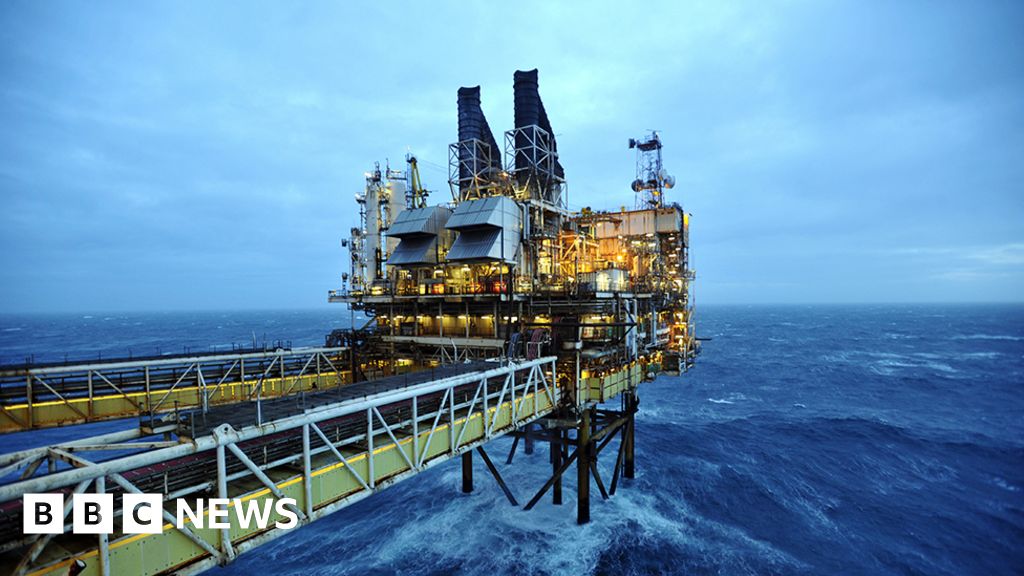
Oil and gas producers have hit back at calls for a windfall tax on their profits, saying they are already paying more tax as a result of price rises.
Offshore Energies UK (OEUK), which represents the sector, said producers are on course to pay £7.8bn in UK tax this year.
That is up from £3.1bn last year.
However political pressure is growing for a one-off additional tax to fund support for customers facing higher energy bills.
The independent Office for Budget Responsibility has calculated the tax UK fossil fuel energy producers are expected to pay this year to be nearly twenty times the £400m paid in 2020. That year, at the start of the pandemic, prices plummeted and producers sustained losses.
But profits have soared this year after sharp price increases in energy prices, prompting calls for those "exceptional" profits to be subject to a windfall levy.
The Labour opposition at Westminster has made that a key part of its attack on the government over Downing Street's handling of the cost of living crisis. Labour took the issue to a Commons vote on Wednesday, which the Opposition lost.
During Prime Minister's Questions earlier, Labour leader Sir Keir Starmer said a one-off tax on oil and gas profits "would raise billions of pounds, cutting energy bills across the country".
In response, Boris Johnson said he would "look at all sensible measures" to help families.
But he added that the Conservatives were "not in principle in favour of higher taxation".
Government ministers have been making the same case as the industry - that an unpredictable tax regime puts off future investment.
Companies are also countering the threat of a windfall tax by pointing to their plans to spend on further developments for oil and gas, if they are allowed to, and some are switching their emphasis to renewable energy.
Of the two British-based oil majors, BP is pledging £18bn in UK investment this decade, and Shell has between £20bn and £25bn to spend on UK energy production and systems such as vehicle charging networks.
Shell has produced a report into tax, which shows that in the most recent year unaffected by Covid the industry's effective tax rate was 35.5%, while the corporate tax rate in developed countries averages 23.5%.
Ministers have recently been pushing for further commitments from energy producers to invest, in response to the calls for a windfall tax. That has put more pressure on the industry to make its case.
Deirdre Michie, chief executive of OEUK, has written to Business Secretary Kwasi Kwarteng, warning that a windfall tax could put investment at risk.
She said the industry shares the "deep concern" about the impact of rising energy prices on consumers.
"We are proud that we are able to help by contributing a predicted £7.8bn in UK taxes this year alone.
"Those payments, equivalent to £279 per home, can help the government soften the pressure for households," she said.
"This year is not a one-off. Between 2021 and 2026-27 the OBR predicts our industry will pay around £23bn in UK tax."
The letter emphasised the employment created by the oil and gas industry, and its importance in the transition to renewable energy.
"Our industry puts a premium on stability and predictability in the ways it is taxed and regulated," Ms Michie said.
"Tax increases make it more expensive to borrow money for big projects - and that can make them unviable. It's why periods of fiscal stability are associated with increased investment, whereas sudden tax increases are often followed by decreased investment."
From Chip War To Cloud War: The Next Frontier In Global Tech Competition
The global chip war, characterized by intense competition among nations and corporations for supremacy in semiconductor ... Read more
The High Stakes Of Tech Regulation: Security Risks And Market Dynamics
The influence of tech giants in the global economy continues to grow, raising crucial questions about how to balance sec... Read more
The Tyranny Of Instagram Interiors: Why It's Time To Break Free From Algorithm-Driven Aesthetics
Instagram has become a dominant force in shaping interior design trends, offering a seemingly endless stream of inspirat... Read more
The Data Crunch In AI: Strategies For Sustainability
Exploring solutions to the imminent exhaustion of internet data for AI training.As the artificial intelligence (AI) indu... Read more
Google Abandons Four-Year Effort To Remove Cookies From Chrome Browser
After four years of dedicated effort, Google has decided to abandon its plan to remove third-party cookies from its Chro... Read more
LinkedIn Embraces AI And Gamification To Drive User Engagement And Revenue
In an effort to tackle slowing revenue growth and enhance user engagement, LinkedIn is turning to artificial intelligenc... Read more