

Microsoft Doing Light Work With Analog Optical Computer Prototype
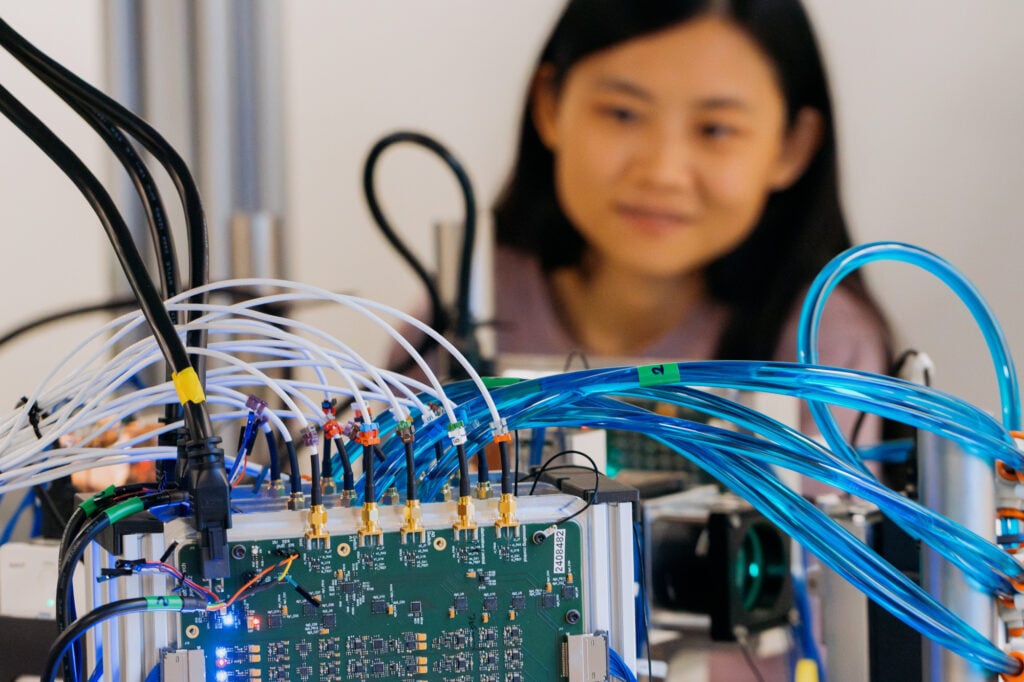
Microsoft researchers in Cambridge have unveiled its latest iteration of an Analog Optical Computer (AOC) and have inevitably incorporated AI into the technology's capabilities.
The AOC harnesses light as a medium for solving complex problems, notably optimization challenges found in the worlds of logistics, finance, and healthcare. It uses different light intensities to perform operations such as addition and multiplication. It's also considerably faster at certain problem-solving activities than traditional computers, we're told.
The prototype is built from commercially available parts, including micro-LEDs, optical lenses, and sensors from smartphone cameras. Since the underlying technology – shunting photons along fiber optic cables – is decades old, much of the hardware does not need to be expensively exotic.
Researcher Jiaqi Chu is on the team that built the AOC (Credit: Microsoft)
While the aim is for a durable and practical machine that can operate at room temperature, and yet still be 100 times faster and 100 times more energy efficient when solving certain problems than conventional hardware, it's highly unlikely to be appear on a desktop anytime soon.
Francesca Parmigiani, the Microsoft principal research manager who leads the team developing the AOC, said the system is "not a general-purpose computer, but what we believe is that we can find a wide range of applications and real-world problems where the computer can be extremely successful."
The machine has 256 weights, up from the 64 of the previous generation. "More weights mean the capacity to solve more complex problems," Microsoft said. "As researchers refine the AOC, adding more and more micro-LEDs, it could eventually have millions or even more than a billion weights."
Microsoft has also shared its "optimization solver" algorithm and its digital twin, allowing other researchers to explore the company's ideas and propose new problems to solve, as well as suggest ways to address them. At present, Microsoft's researchers are very excited about clinical applications, such as reconstructing MRI scans, and financial applications. Microsoft is involved with Barclays Bank to deal with the optimization challenges faced by clearinghouses when working out the most efficient way to settle financial obligations between multiple parties.
- Microsoft inches toward Rusty Windows drivers, production use still a no-no
- Microsoft open-sources the 6502 BASIC coded by Bill Gates himself
- Microsoft rewarded for security failures with another US government contract
- Microsoft readies Windows 11 25H2 while Windows 10 circles the drain
And then, of course, there is AI. "Because of the way the AOC operates, computing a problem again and again in search of a 'fixed point,' it has the potential to do a kind of energy-demanding reasoning that current LLMs running on GPUs struggle with – state tracking – at a much lower cost in energy," Microsoft said.
Hitesh Ballani, who directs research on future AI infrastructure at the Microsoft Research lab in Cambridge, reckons the tech has the potential to be a game changer, but cautioned that there remains a steep hill to climb before it can move from the lab to something commercially viable.
"We've been able to convince ourselves and hopefully a broader segment of the world that, well, actually, you know what? There are real applications for the AOC," he said.
Microsoft is not the only company working in optical computing. IBM, for example, has talked up research into co-packaged optics to replace electrical interconnects in datacenters to bump up performance for computing applications. Other proposals and research around analog optical computing have previously shown up in publications such as Nature over the years.
The Microsoft team reckons future generations of the AOC will be created every two years and envisions the device finding its way into the racks of an Azure datacenter. ®
From Chip War To Cloud War: The Next Frontier In Global Tech Competition
The global chip war, characterized by intense competition among nations and corporations for supremacy in semiconductor ... Read more
The High Stakes Of Tech Regulation: Security Risks And Market Dynamics
The influence of tech giants in the global economy continues to grow, raising crucial questions about how to balance sec... Read more
The Tyranny Of Instagram Interiors: Why It's Time To Break Free From Algorithm-Driven Aesthetics
Instagram has become a dominant force in shaping interior design trends, offering a seemingly endless stream of inspirat... Read more
The Data Crunch In AI: Strategies For Sustainability
Exploring solutions to the imminent exhaustion of internet data for AI training.As the artificial intelligence (AI) indu... Read more
Google Abandons Four-Year Effort To Remove Cookies From Chrome Browser
After four years of dedicated effort, Google has decided to abandon its plan to remove third-party cookies from its Chro... Read more
LinkedIn Embraces AI And Gamification To Drive User Engagement And Revenue
In an effort to tackle slowing revenue growth and enhance user engagement, LinkedIn is turning to artificial intelligenc... Read more