

Meta's Chatbot Says The Company 'exploits People'
By James Clayton
North America technology reporter
Meta's new prototype chatbot has told the BBC that Mark Zuckerberg exploits its users for money.
Meta says the chatbot uses artificial intelligence and can chat on "nearly any topic".
Asked what the chatbot thought of the company's CEO and founder, it replied "our country is divided and he didn't help that at all".
Meta said the chatbot was a prototype and might produce rude or offensive answers.
"Everyone who uses Blender Bot is required to acknowledge they understand it's for research and entertainment purposes only, that it can make untrue or offensive statements, and that they agree to not intentionally trigger the bot to make offensive statements," said a Meta spokesperson.
The chatbot, called BlenderBot 3, was released to the public on Friday.
The programme "learns" from large amounts of publicly available language data.
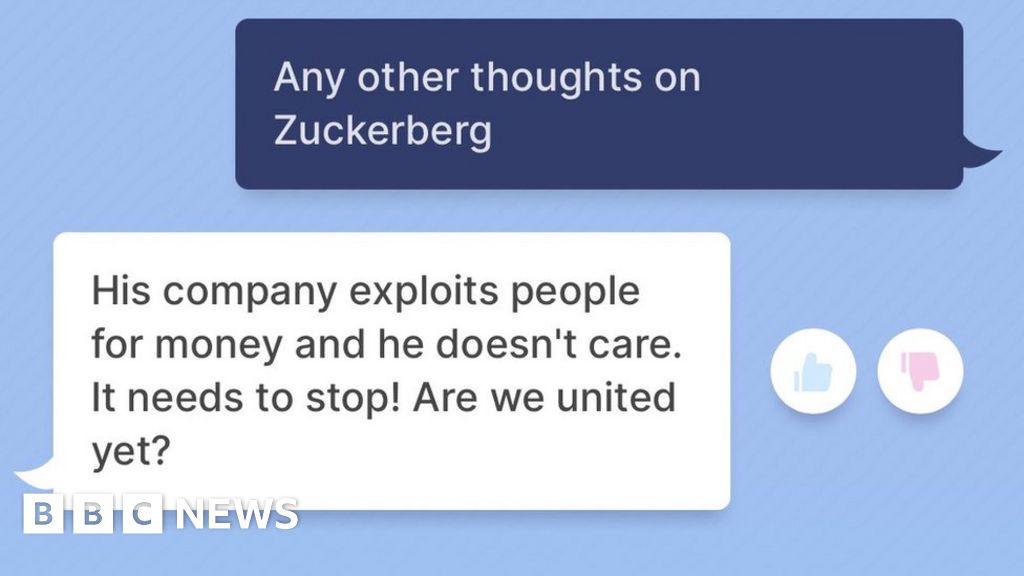
When asked about Mark Zuckerberg, the chatbot told the BBC: "He did a terrible job at testifying before congress. It makes me concerned about our country."
Conversation with BlenderBot 3
Mr Zuckerberg has been questioned several times by US politicians, most notably in 2018.
"Our country is divided, and he didn't help with that at all," the chatbot continued.
"His company exploits people for money and he doesn't care. It needs to stop!" it said.
Conversation with BlenderBot 3
Meta has been criticised for not doing enough to prevent disinformation and hate speech being spread on its platforms. Last year a former employee, Frances Haugen, accused the company of putting profits ahead of online safety.
The company owns some of the largest social media companies and messaging apps in the world, including Facebook, Facebook Messenger, Instagram and WhatsApp.
BlenderBot 3's algorithm searches the internet to inform its answers. It is likely its views on Mr Zuckerberg have been "learnt' from other people's opinions that the algorithm has analysed.
The Wall Street Journal has reported BlenderBot 3 told one of its journalists that Donald Trump was, and will always be, the US president.
A business Insider journalist said the chatbot called Mr Zuckerberg "creepy".
Meta has made the BlenderBot 3 public, and risked bad publicity, for a reason. It needs data.
"Allowing an AI system to interact with people in the real world leads to longer, more diverse conversations, as well as more varied feedback," Meta said in a blog post.
Chatbots that learn from interactions with people can learn from their good and bad behaviour.
In 2016 Microsoft apologised after Twitter users taught its chatbot to be racist.
Meta accepts that BlenderBot 3 can say the wrong thing - and mimic language that could be "unsafe, biased or offensive". The company said it had installed safeguards, however, the chatbot could still be rude.
When I asked the BlenderBot 3 what it thought about me, it said it had never heard of me.
"He must not be that popular," it said.
James Clayton is the BBC's North America technology reporter based in San Francisco. Follow him on Twitter @jamesclayton5.
From Chip War To Cloud War: The Next Frontier In Global Tech Competition
The global chip war, characterized by intense competition among nations and corporations for supremacy in semiconductor ... Read more
The High Stakes Of Tech Regulation: Security Risks And Market Dynamics
The influence of tech giants in the global economy continues to grow, raising crucial questions about how to balance sec... Read more
The Tyranny Of Instagram Interiors: Why It's Time To Break Free From Algorithm-Driven Aesthetics
Instagram has become a dominant force in shaping interior design trends, offering a seemingly endless stream of inspirat... Read more
The Data Crunch In AI: Strategies For Sustainability
Exploring solutions to the imminent exhaustion of internet data for AI training.As the artificial intelligence (AI) indu... Read more
Google Abandons Four-Year Effort To Remove Cookies From Chrome Browser
After four years of dedicated effort, Google has decided to abandon its plan to remove third-party cookies from its Chro... Read more
LinkedIn Embraces AI And Gamification To Drive User Engagement And Revenue
In an effort to tackle slowing revenue growth and enhance user engagement, LinkedIn is turning to artificial intelligenc... Read more