

Mark Carney: Climate Crisis Deaths 'will Be Worse Than Covid'
By Sharanjit Leyl
BBC News
image copyrightGetty Images
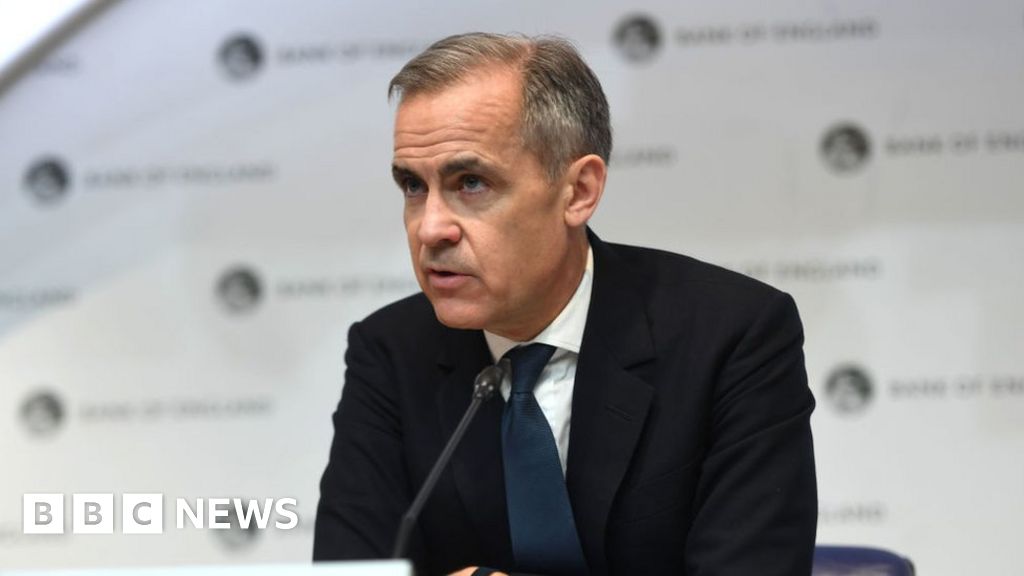
The world is heading for mortality rates equivalent to the Covid crisis every year by mid-century unless action is taken, according to Mark Carney.
The former central banker said the investment needed to avert millions of deaths was double current rates.
But with governments ploughing billions into keeping economies afloat, a question mark hangs over whether the recovery will be green enough.
The answer lies in smarter investment, Mr Carney said.
'We cannot retreat'
Mr Carney, who was the Bank of England governor up until last year, and the head of the Bank of Canada before that, is now the United Nations envoy for climate action and finance.
He told the BBC that while there were parallels between the Covid-19 pandemic and climate change, damage to the environment and ecosystems has the potential to cause many more deaths.
"One of the biggest issues is you cannot self-isolate from climate," he said. "That is not an option. We cannot retreat in and wait out climate change, it will just get worse," he told Talking Business Asia: The Climate Change Challenge.
"When you look at climate change from a human mortality perspective, it will be the equivalent of a coronavirus crisis every year from the middle of this century, and every year, not just a one-off event. So it is an issue that needs to be addressed now."
But governments pouring trillions of dollars into stimulus plans to rescue their ailing economies are mainly addressing job losses and the economic damage inflicted from lockdowns.
Very little of that cash is heading towards reducing carbon emissions, although emissions have fallen in the past year because people aren't travelling as much.
Mr Carney, who is tasked with persuading policymakers, chief executives, bankers and investors to focus on the environment, said: "The scale of investment in energy, sustainable energy and sustainable infrastructure needs to double.
"Every year, for the course of the next three decades, $3.5 trillion (£2.5tn) a year, for 30 years. It is an enormous investment opportunity."
'Put money to work'
He said the answer lies in a global pot of $170tn of private capital which, he says, "is looking for disclosure".
Banks, investment funds and individuals increasingly want to know how their money will be used.
It is not just about disclosing the carbon position of companies, he says, but "where it's going to go tomorrow in order to make these kinds of investment and lending decisions".
That pot is bigger than the total economic output of the world for a year, he said. "The issue is about putting that money to work."
image copyrightGetty Images
Mr Carney said that as the US returns to the world stage in the battle against climate change, there's renewed momentum to the issue, especially as last year China, the world's largest polluter, aimed to become carbon neutral by 2060.
Although China continues to build coal-fired power plants, and draws about 70% of its power from fossil fuel, the country is a crucial part of the solution.
"There clearly are issues in terms of coal in China, and the sooner China moves on that, the better for them and for the world.
"But China also produces 60% of the global solar photovoltaic panels. It is also the largest producer of electric vehicles. So China has many sides to this."
The US has the "largest and most sophisticated financial sector" along with the "engineering and technological expertise" to get to net zero emissions, he said.
Part of his role at the UN is to tap into this financial sector.
It is the "power of money" that will ultimately play the biggest role in combating climate change, he said.
"We're getting the system in a position where, whether it's a bank, or somebody who's investing a small amount of savings in the market, or your pension, they can choose [how it is invested].
"They have the information and they can choose to be part of the solution, transitioning to net zero, or be part of the problem."
You can watch the full interview with Mark Carney on Talking Business Asia on BBC World News this weekend.
From Chip War To Cloud War: The Next Frontier In Global Tech Competition
The global chip war, characterized by intense competition among nations and corporations for supremacy in semiconductor ... Read more
The High Stakes Of Tech Regulation: Security Risks And Market Dynamics
The influence of tech giants in the global economy continues to grow, raising crucial questions about how to balance sec... Read more
The Tyranny Of Instagram Interiors: Why It's Time To Break Free From Algorithm-Driven Aesthetics
Instagram has become a dominant force in shaping interior design trends, offering a seemingly endless stream of inspirat... Read more
The Data Crunch In AI: Strategies For Sustainability
Exploring solutions to the imminent exhaustion of internet data for AI training.As the artificial intelligence (AI) indu... Read more
Google Abandons Four-Year Effort To Remove Cookies From Chrome Browser
After four years of dedicated effort, Google has decided to abandon its plan to remove third-party cookies from its Chro... Read more
LinkedIn Embraces AI And Gamification To Drive User Engagement And Revenue
In an effort to tackle slowing revenue growth and enhance user engagement, LinkedIn is turning to artificial intelligenc... Read more