

Let's Talk: 'Therapy Is Not Weak Or Unnecessary'
By Suzanne Bearne
Business reporter
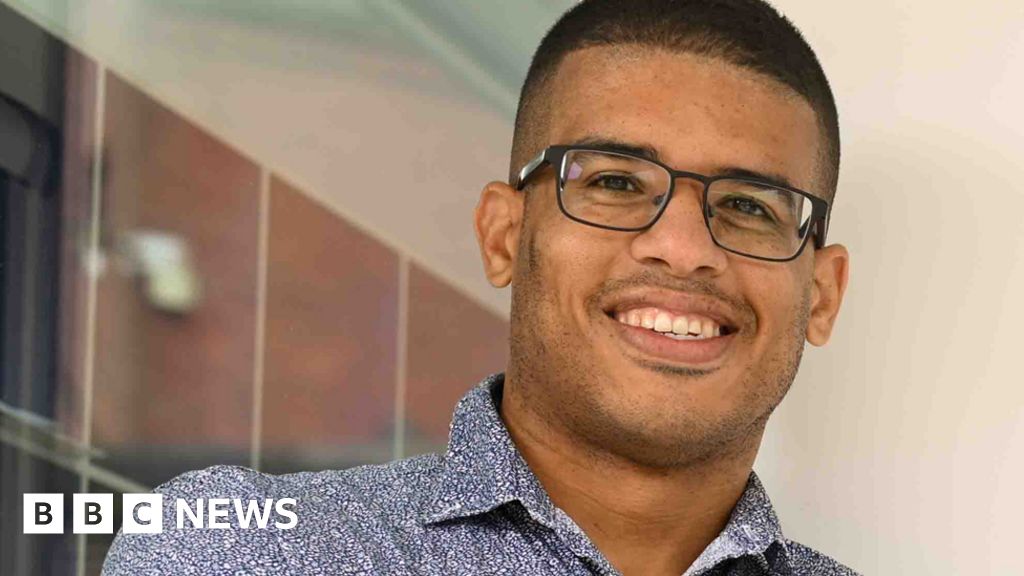
Lee Chambers says he was "in a dark place" when he sought help from a therapist
Like millions of people worldwide, Lee Chambers turned to therapy for the first time, prompted by the impact of the Covid pandemic on his mental health.
"I'd just started a new business at the beginning of the pandemic and suddenly I was home-schooling my children while my wife was working virtually from home as a teacher," says Mr Chambers.
Six years ago, the 36-year-old business psychologist, lost the ability to walk and it took him almost a year to recover. "I was in a dark place and felt chronically anxious," he says.
The "constant uncertainty" of Covid "took me back to a time when I didn't know if I would be back on my feet."
He says he realised he needed to swallow his pride and seek therapy to help him deal with some of the challenges he faced after Covid hit his business and he was forced to slow down.
Starting in late 2020, Mr Chambers had eight sessions with a psychologist. The results were instant, he says.
"I started to feel liberated and felt I had a space to fully express myself.
"She gave me specific things to work on. It was beneficial to have a third-party perspective. It's really given me an increased understanding of how important therapy can be and how it's not something we should look at as weak or unnecessary."
Image source, Mike Sewell Photography/BACP
BACP's Fiona Ballantine Dykes says therapists are still seeing people who are dealing with the consequences of Covid
Living through a global pandemic and dealing with the impact on all areas of our lives, including family, friendships and work, led to a huge spike in demand for all kinds of counsellors.
The British Association for Counselling and Psychotherapy (BACP) says last year it saw a 58% increase in monthly enquiries to therapists listed in its directory, compared with 2019.
In 2021, 33% of people said they had consulted a counsellor or psychotherapist, according to a BACP survey with YouGov, up from 21% in 2010.
Far from declining BACP says demand for therapy now "appears to be greater than it's ever been".
"Therapists are still seeing people who are dealing with the consequences of Covid-19 and coming to terms with the impact the pandemic has had on their lives, such as bereavement, isolation, and anxiety, but also a range of other issues in society at the moment including the rising cost of living, war, and climate change," says BACP's deputy chief executive, Fiona Ballantine Dykes.
BACP's own membership has increased from about 33,000 in 2010 to 60,000 in January 2022.
Image source, Kendall Platt
Kendall Platt says attending therapy sessions was "one of the best things" she has ever done
Kendall Platt, 35, describes herself as a "horticultural therapist". She runs online gardening and floristry courses designed to help women with their mental wellbeing.
To help her stay mentally well she says she does a small amount of gardening every day.
However, in the summer of 2020 she realised she "needed more help... and to offload to somebody else".
"During the pandemic so many were struggling and I didn't feel I could talk to my friends as they were going through their own problems."
She found a local therapist and had eight sessions at £55 each. "It was quite expensive but I just thought I've got to do it,"says Ms Platt.
"It was one of the best things I have ever done. I'd gone through a difficult time in my job and it was really nice to have my experience validated."
She makes a crucial point that the sheer cost of therapy makes it inaccessible to many people.
The NHS talking therapies programme - known as Improving Access to Psychological Therapies or IAPT - offers free treatment of conditions such as anxiety, depression and post-traumatic stress disorder.
In the last financial year the NHS England target was for 1.6 million people to be referred to talking therapies, however, only 1.2 million were referred.
"There's limited access through the NHS, which is valuable but not sufficient," says BACP's Ms Ballantine Dykes. "Long waiting lists mean people are seeking private therapists. It's crucial that we see investment now in life-changing counselling and psychotherapy services so that everyone can access therapy when they need it."
Some counsellors do offer a reduced fee to people on lower incomes.
Image source, Anthony Davis
Psychotherapist Anthony Davis says his caseload has risen by 30% in the last couple of years
One of those who offer concessionary fees is Anthony Davis, a BACP-registered integrative counsellor and psychotherapist. He says he noticed a change in the demographic of his clients during the pandemic, with an uptick in men choosing to have therapy for the first time.
"A lot of men were living alone and seeking out therapy to reflect on past relationships and past trauma and wanted to explore how to stop suppressing their emotions," says Mr Davis, whose caseload has jumped by 30% since the start of pandemic.
"From the summer of 2020 onwards there was particularly more black men due to the murder of George Floyd and the rise of Black Lives Matter. There was also a surge in couples who were working from home together in close proximity all the time and experienced a lot of difficulty in communicating."
Online therapy has also gained traction since Covid-19, with people using video chat messaging or Zoom to contact professionals on platforms such as E-therapy, My Therapist Online and My Online Therapy.
"Being able to access online sessions from the comfort of your own home will make therapy more appealing for some people," says Ms Ballantine Dykes, who points out that it's more accessible for people with physical limitations, or those who live in rural or remote areas.
But it is not for everyone, she adds. "Not everyone has access to technology and home is not always a safe space. There are also issues of confidentiality. For some people, it may be that family members or a partner is part of the reason for going to therapy."
New Economy is a new series exploring how businesses, trade, economies and working life are changing fast.
Image source, Kendall Platt
Darcey Croft says she was left feeling "re-traumatised" after one particular session with a therapist
However, not everyone speaks glowingly about their therapy sessions. Darcey Croft, 46, a specialist midwife for the NHS and clinical hypnotherapist, says she was left feeling "re-traumatised" following a session exploring an incident 12 years ago.
"My therapist burst into tears which reinforced how traumatic everything had been for me," says Ms Croft, who lives in Beaconsfield.
"She was so distressed that I spent the rest of the session putting her back together again. She was newly qualified and probably wasn't expecting that level of incident but I came away feeling so re-traumatised, almost like all the good work I'd done on myself had been undone."
Although it did put her off counselling for some time, Ms Croft has recently had two sessions with a different therapist which she says have been "really helpful", so far.
For a good therapist, BACP's Fiona Ballantine Dykes recommends checking that your therapist is registered with an accredited body.
"This means that your therapist is highly qualified, works to high ethical and practice standards, fulfils continuing professional development requirements, and if you're unhappy with your therapy there's a complaints procedure available."
You should be able to feel safe and trusting of your therapist so you can open up and explore the things you need to talk about, she says.
Back in Preston, Lee Chambers says turning to therapy enabled him to find "acceptance in the things I have been through".
"I've found that I'm more vulnerable and open in the way I approach everything I do. It's helped unlock a part of me that was being suppressed."
From Chip War To Cloud War: The Next Frontier In Global Tech Competition
The global chip war, characterized by intense competition among nations and corporations for supremacy in semiconductor ... Read more
The High Stakes Of Tech Regulation: Security Risks And Market Dynamics
The influence of tech giants in the global economy continues to grow, raising crucial questions about how to balance sec... Read more
The Tyranny Of Instagram Interiors: Why It's Time To Break Free From Algorithm-Driven Aesthetics
Instagram has become a dominant force in shaping interior design trends, offering a seemingly endless stream of inspirat... Read more
The Data Crunch In AI: Strategies For Sustainability
Exploring solutions to the imminent exhaustion of internet data for AI training.As the artificial intelligence (AI) indu... Read more
Google Abandons Four-Year Effort To Remove Cookies From Chrome Browser
After four years of dedicated effort, Google has decided to abandon its plan to remove third-party cookies from its Chro... Read more
LinkedIn Embraces AI And Gamification To Drive User Engagement And Revenue
In an effort to tackle slowing revenue growth and enhance user engagement, LinkedIn is turning to artificial intelligenc... Read more