

'Interns Helped Save My Firm'
By Jeremy Howell
Business reporter, BBC News
- Published
For generations, publishers have employed book editors to decide which works are published. Inkitt is an online publishing company that gives that choice to readers.
But its own story could have been cut short when key members of the firm walked away.
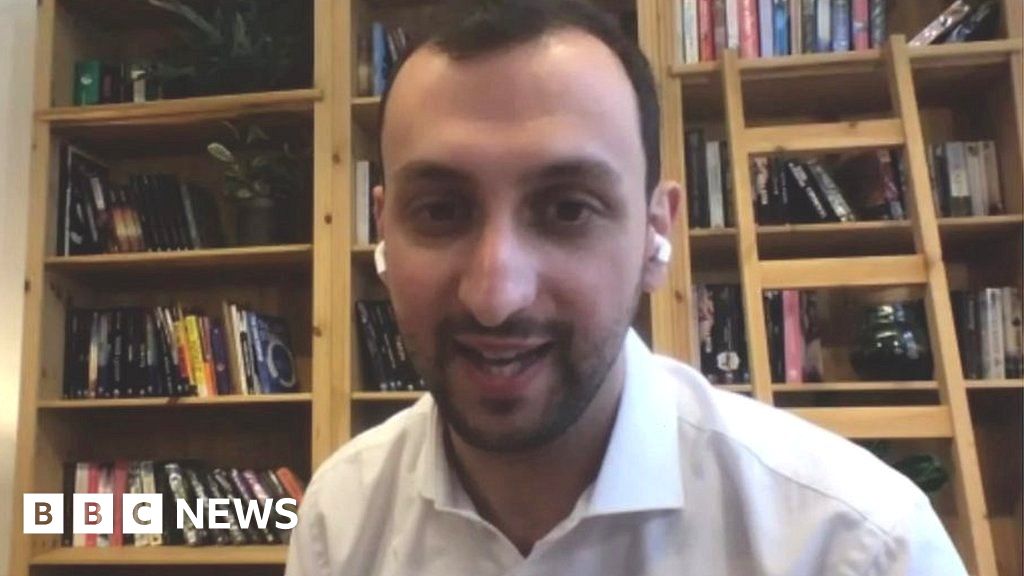
Ali Albazaz founded Inkitt in Berlin in 2013 because he believed the industry had been overlooking talented authors like JK Rowling, whose first Harry Potter book was famously turned down by 12 different publishers.
So he decided to give readers more of a say.
"Inkitt has a social reading platform which writers can upload their stories on," he says. "Readers can read the books completely for free. In the background, we analyse their reading behaviour."
Inkitt uses computer algorithms to tell which works people read through to the end and how quickly they read them. There is also a comments section for readers and a star system by which they can rate different works.
"Based on these data points, we can predict which stories have the potential to become bestsellers," says Ali.
image copyrightInkitt
Having a revolutionary idea is one thing; selling it is another. Ali spent three years trying to persuade publishers to use Inkitt's analytics to select promising titles and proposed a tie-up with Amazon to sell books on its website using his system. He was rejected by all of them.
It was at this low point that Ali was faced with another, unforeseen knockback. Two out of Inkitt's four founding directors suddenly announced they were quitting.
"It was three years into running the company, with limited success, when half of the management team lost faith and quit. It was a very, very tough time for us. There was a lot of uncertainty. Investors were questioning the business, staff morale was at an all-time low and we had only six months of cash in the bank."
At this point, most chief executives would have advertised for new managers. However, Ali doubted he could recruit anyone from outside the company who would understand its ethos. Instead, he promoted two young people who were working at Inkitt as interns at the time.
"The solution was promoting two junior staff and rallying them around finding a new business model," says Ali. "That was extremely tough. We had a war room, I remember, and I would spend hours and hours working with them every single day to find a new path for the business."
Ali and his new directors decided to make Inkitt a publisher in its own right, producing e-books. It has also developed its own reading app, Galatea, which adds vibrations and sound effects to the experience of reading the e-books.
image copyrightInkitt
"Galatea is an immersive reading experience," says Ali. "It means when you are reading, you can feel the heartbeat of the protagonist with vibrations on your phone. You hear sound effects. It is something between reading and watching a TV series."
Inkitt gives the reader one episode of a published book for free every day, which equates to about 15 minutes worth of reading. In theory, you can read books on Galatea without paying anything, but typically people buy credits to continue reading more than the free amount each day and on average pay about £10 per book.
Today, Inkitt publishes about 300 books a year and employs more than 70 people at its headquarters in Berlin.
"Working with this junior talent who stepped up really, really worked out," says Ali. "Looking back on it, the crisis we went through is one of the reasons we were actually able to turn the company around.
"Keep in mind that when one door closes, another door opens. There is always a way to make things work. Even if things look really, really horrible you can always turn situations around."
Read more CEO Secrets here.
From Chip War To Cloud War: The Next Frontier In Global Tech Competition
The global chip war, characterized by intense competition among nations and corporations for supremacy in semiconductor ... Read more
The High Stakes Of Tech Regulation: Security Risks And Market Dynamics
The influence of tech giants in the global economy continues to grow, raising crucial questions about how to balance sec... Read more
The Tyranny Of Instagram Interiors: Why It's Time To Break Free From Algorithm-Driven Aesthetics
Instagram has become a dominant force in shaping interior design trends, offering a seemingly endless stream of inspirat... Read more
The Data Crunch In AI: Strategies For Sustainability
Exploring solutions to the imminent exhaustion of internet data for AI training.As the artificial intelligence (AI) indu... Read more
Google Abandons Four-Year Effort To Remove Cookies From Chrome Browser
After four years of dedicated effort, Google has decided to abandon its plan to remove third-party cookies from its Chro... Read more
LinkedIn Embraces AI And Gamification To Drive User Engagement And Revenue
In an effort to tackle slowing revenue growth and enhance user engagement, LinkedIn is turning to artificial intelligenc... Read more