

Intel Adds A New Device – The IPU – To Its Must-have Modern Data Centre Stack
Intel has added “infrastructure processing units” (IPUs) to its list of must-have data centre infrastructure, and promised it’ll build more of them and offer software to put them to work.
IPUs also go by the name “SmartNICs” or “data processing units” (DPUs). As The Register tried to explain in September 2020, DPUs/IPUs/SmartNICs are network cards with enough processing power and storage to relieve a server’s CPU of boring background work.
Hyperscale cloud operators cottoned on to DPUs/IPUs/SmartNICs early because they make money renting out CPU cores to their clients, but some of those cores are kept busy running a cloud’s plumbing. Shifting necessary workloads like chatting to storage devices or running a firewall onto a DPU/IPU/SmartNIC means clouds have more cores they can rent for profit. DPUs/IPUs/SmartNICs are also pleasingly isolated from servers themselves, so the big clouds use the devices to run their own cloud plumbing and as a side benefit get to point out that their own workloads are helpfully separated from the data and applications you run on their servers.
Intel on Monday re-iterated that back story at an event called “Six Five Summit”, claimed it is the “volume leader” in the category thanks to work with Microsoft, Baidu, JD.com and VMware, and said that in a modern and efficient data centre IPUs will sit alongside CPUs and the many-core-and-multi-technology “XPUs” that Chipzilla advances as necessary for finicky workloads.
The company also pledged it would soon offer more IPUs based on its FPGA tech, custom ASICs, and the Xeon D it already bakes into such products, plus a “powerful software foundation that allows customers to build leading-edge cloud orchestration software” that eases users’ path to software-defined networks and virtual storage.
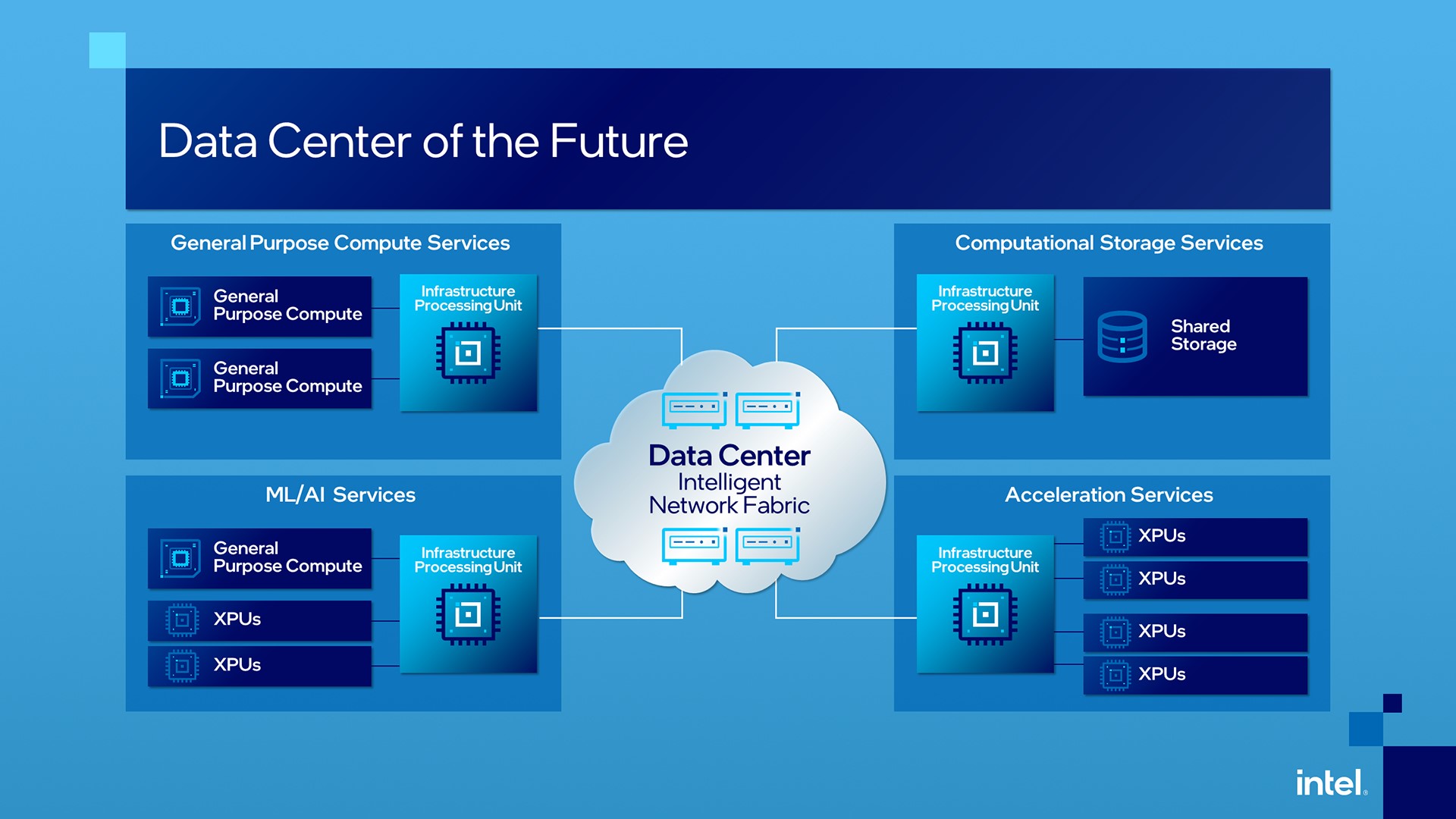
Intels's IPU architecture vision.
Click to enlarge
That software may be more interesting than Intel’s hardware, because today hyperscalers tend to develop their own software infrastructure and mostly keep it all-but-secret. If Intel delivers an IPU-at-scale orchestration platform, it strides into competition with the likes of OpenStack and VMware.
Intel said its intention is to sell this stuff to cloud customers. Doing so would certainly give those customers good reasons to stick with Xeons, or at least keep Intel inside any Arm servers they deploy because there’ll be Chipzilla tech on an IPU hanging off every motherboard.
- VMware adds support for 80-core Ampere Altra chips to its experimental Arm hypervisor
- Nvidia says microservices will drive a SmartNIC into every server
- Baidu cloud catches up by offloading cloudy networking and storage to SmartNICs
And the rest of us? For now, it’s hard to find a workload to run on a DPU/IPU/SmartNIC. VMware thinks you might fancy a firewall on the devices and NVIDIA sees them as essential to make AI sing, but other major players are yet to signal mainstream applications for the devices. ®
From Chip War To Cloud War: The Next Frontier In Global Tech Competition
The global chip war, characterized by intense competition among nations and corporations for supremacy in semiconductor ... Read more
The High Stakes Of Tech Regulation: Security Risks And Market Dynamics
The influence of tech giants in the global economy continues to grow, raising crucial questions about how to balance sec... Read more
The Tyranny Of Instagram Interiors: Why It's Time To Break Free From Algorithm-Driven Aesthetics
Instagram has become a dominant force in shaping interior design trends, offering a seemingly endless stream of inspirat... Read more
The Data Crunch In AI: Strategies For Sustainability
Exploring solutions to the imminent exhaustion of internet data for AI training.As the artificial intelligence (AI) indu... Read more
Google Abandons Four-Year Effort To Remove Cookies From Chrome Browser
After four years of dedicated effort, Google has decided to abandon its plan to remove third-party cookies from its Chro... Read more
LinkedIn Embraces AI And Gamification To Drive User Engagement And Revenue
In an effort to tackle slowing revenue growth and enhance user engagement, LinkedIn is turning to artificial intelligenc... Read more