

How This Country Became Europe's Cargo Bike Hub
By Janek Schmidt
Technology of Business reporter
Image source, Jasmin Minne
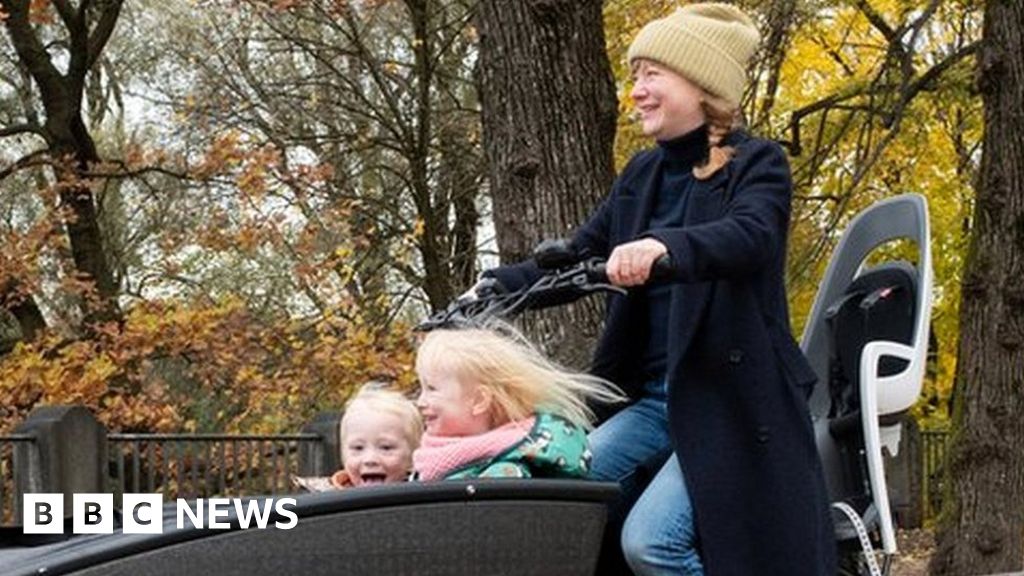
Riding the cargo bike is pure bliss, says Grit Paulussen
When Grit Paulussen and her partner Matthias Bogus wanted to treat themselves to a rare evening out recently, they worked out a plan.
The couple booked a babysitter for their two young children, reserved a table at a trendy new restaurant in their hometown, Munich, and took their version of luxury transport: a joint ride in their electric cargo bike.
"Of course, we could have opted for the tube, a cab, or, our normal bikes," Ms Paulussen explains. "But that evening we just wanted to celebrate our freedom, so it was clear to us that Matthias would ride the cargo bike and I would sit on the passenger seat - for us, that is pure bliss."
In their love of cargo bikes, the couple are part of a growing trend. Cargo bike sales in Europe grew by 38% in 2020 and are projected to grow by another 66% this year, according to a European cargo bike industry survey of 38 specialised producers.
Image source, cargobike.jetz
Germany is easily the biggest market for cargo bikes in Europe
By far the largest European market is Germany, where the national Bike Association (ZIV) registered 103,000 cargo bikes sold in 2020.
Germany ranks ahead of Denmark with 25,000, the Netherlands with 16,000 and France with 12,000 sold last year, says the European Bike Association (Conebi).
Ms Paulussen explains that there are several things that she loves about her cargo bike. "It's a green and swift way of getting around, I can comfortably chat to my kids who usually sit in the front, and thanks to the electric motor, I don't even break a sweat."
The rising demand for green transport and the technological advances in e-bikes are widely seen as two crucial factors driving the trend. In the survey, cargo bike manufacturers report that last year 92% of their models sold were electric.
That comes at a price, explains Philipp Runge, a sales adviser at Ahoi Velo, one of Germany's largest cargo bike shops, based in Hamburg. The cheapest electric model in his shop starts at €3,800 ($4,280; £3,210) .
"But as cargo bikes become a life-style choice for some people, producers race to build the Rolls-Royce of the market," he explains.
One example is the recently released Ca Go, featuring an electronic gearbox, a crash cushioned box, cable steering for tighter turning and folding seats with vibration absorption and adjustable headrests. With all optional extras it costs more than €10,000.
"Of course, our bike wasn't cheap", concedes Mr Paulussen. "But it allows us to do without a car, which would be a lot more expensive, and luckily, it was subsidised with a €1,000 by the city of Munich."
Several other countries, such as Austria, Switzerland, France, Italy and Belgium, now also offer subsidies, say advocacy group European Cyclists' Federation.
Image source, Arne Behrensen
Incentives schemes for cargo bikes are too fragmented, says Arne Behrensen
Yet, the subsidy schemes are often organised in a confusing way. In Germany and Austria alone, there are more than 100 communal and regional schemes, says Arne Behrensen of German pressure group cargobike.jetzt.
"Some, like that in Munich, are longstanding and well-run," he says. "But all in all, the local fragmentation is extremely inefficient, as every city, or region, has to design, calculate and administer its own framework - which often run out after a few months."
Last year, when Hamburg dedicated €700,000 to subsidise 33% of any newly purchased cargo bike in the city, the money was used up in less than 30 minutes.
"The same thing had previously happened in Berlin", says Mr Behrensen. "At worst, such short-lived chaos throws the industry into disarray, by creating demand spikes and inducing disappointed applicants to put off their bike purchase till the start of a later scheme."
Image source, Ca Go Bike
Cargo bikes are getting more features and becoming more expensive
Mr Behrensen wants to see more efficient national programmes, as recently introduced in France.
But things are improving, when Germany expanded a scheme for commercially used cargo bikes in March, in little over six months, more than 2,000 applications for subsidies had been approved - almost five times more than in the whole of 2020.
Bike dealer Philip Runge says that, up until a few years ago, commercial customers made up only about 10% of his clients. Today they make up about 35%. "We're even opening a second shop in Hamburg, focusing on heavy-duty bikes for commercial clients such plumbers, dry cleaners, nursing homes or bars and restaurants."
Commercial and private cargo bikes are evolving really, says Mr Runge. Manufacturers are starting to produce tailored components - such as the first cargo-specific tyre, by Schwalbe, which combines shock absorption and sturdiness; engines with more torque by Bosch, Shimano or Brose; more robust brakes and wheels, inspired by the automotive industry.
Image source, Ahoi Velo
Bike dealer Philip Runge is opening a second shop, focusing on bikes for the commercial market
"More and more expertise, know-how and design elements from the car industry are now moving into cargo-bikes", explains Arne Behrensen of cargobike.jetzt, Volkswagen and BMW among them.
The Ono, one of the most advanced heavy-duty cargo bikes available for commercial use, has a weather protected driver's cabin, radio frequency identification device (RFID) locks for the vehicle, plus batteries that can be replaced within seconds at exchange stations. It also has a freight-carrying capacity of 200kg (440lb).
It is hoped this type of vehicle - combining van comforts with the ecological flexibility of a bike - might induce the same feeling in delivery drivers, that Grit Paulussen has on her own cargo-bike: a sense of unusual freedom and pure bliss.
Image source, Janine Graubaum/ONOMOTION GmbH
Onomotion's ONO e-cargo bike
From Chip War To Cloud War: The Next Frontier In Global Tech Competition
The global chip war, characterized by intense competition among nations and corporations for supremacy in semiconductor ... Read more
The High Stakes Of Tech Regulation: Security Risks And Market Dynamics
The influence of tech giants in the global economy continues to grow, raising crucial questions about how to balance sec... Read more
The Tyranny Of Instagram Interiors: Why It's Time To Break Free From Algorithm-Driven Aesthetics
Instagram has become a dominant force in shaping interior design trends, offering a seemingly endless stream of inspirat... Read more
The Data Crunch In AI: Strategies For Sustainability
Exploring solutions to the imminent exhaustion of internet data for AI training.As the artificial intelligence (AI) indu... Read more
Google Abandons Four-Year Effort To Remove Cookies From Chrome Browser
After four years of dedicated effort, Google has decided to abandon its plan to remove third-party cookies from its Chro... Read more
LinkedIn Embraces AI And Gamification To Drive User Engagement And Revenue
In an effort to tackle slowing revenue growth and enhance user engagement, LinkedIn is turning to artificial intelligenc... Read more