

H&M: Fashion Giant Sees China Sales Slump After Xinjiang Boycott
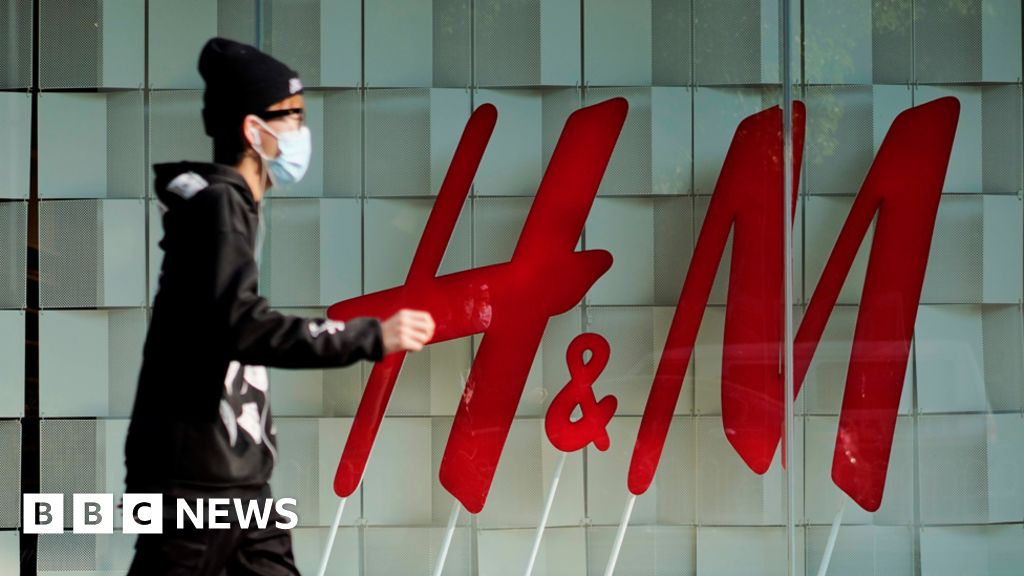
image copyrightGetty Images
Swedish fashion giant H&M saw its sales slump in China, months after it became the target of a Chinese boycott.
H&M was among several brands that raised concerns over alleged human rights abuses against Uyghur Muslims in China's Xinjiang province.
Its statement led celebrities to cut ties with the brand and e-commerce platforms to drop H&M.
The sales slide came even as H&M's global business returned to profit as the impact of the pandemic eased.
China accounted for around 5% of the retail group's sales last year and is one of its biggest suppliers.
H&M's sales in China were down 23% in the local currency for the second quarter of 2021, compared to the same time last year.
"With regards to China the situation remains complex. Beyond that we refer to what we have said before," Chief Executive Helena Helmersson said as H&M quantified for the first time the impact of the boycott.
That came as the world's second-largest fashion retailer reported a stronger-than-expected $420m (£305m) pre-tax profit for the quarter, after a loss in the same period in 2020.
Why was H&M boycotted in China?
Several Western brands, including H&M and Nike, recently faced a backlash from Chinese shoppers after the firms expressed concerns about the alleged use of Uyghur forced labour in cotton production.
In March, H&M was removed from the Chinese online retail platform Tmall and domestic phone makers' app stores after it expressed concerns about the alleged use of Uyghur forced labour in cotton production.
But later in March, H&M said it was dedicated to regaining the trust of customers and partners China and that its commitment to the country remained strong.
Last week, the boss of Nike, which also faced a boycott in China, made a robust defence of the sportswear giant's business in the country.
Chief executive John Donahoe said "Nike is a brand that is of China and for China" in response to a question about competition from Chinese brands.
Mr Donahoe made the comments during a discussion on Nike's fourth quarter earnings, which showed revenues had doubled to a better-than-expected $12.3bn (£8.8bn) for the three months to the end of March.
What is Xinjiang and who are the Uyghurs?
- Xinjiang, China's biggest region, produces about a fifth of the world's cotton. An autonomous region in theory, in reality it faces restrictions which have only increased in recent years
- Millions of China's Uyghurs, a Muslim minority that sees itself as culturally and ethnically close to Central Asian nations, live in Xinjiang
- In recent decades, mass migration of Han Chinese (China's ethnic majority) to Xinjiang has fuelled tensions with Uyghurs which has at points flared into deadly violence
- This has resulted in a massive security crackdown and an extensive state surveillance programme, which critics say violate Uyghur human rights. China says such measures are necessary to combat separatism and terrorism
- Uyghurs have been detained at camps where allegations of torture, forced labour and sexual abuse have emerged. China has denied these claims saying the camps are "re-education" facilities aimed at lifting Uyghurs out of poverty
In March, a group of Western countries imposed sanctions on officials in China over rights abuses against the Uyghurs.
The sanctions were introduced as a coordinated effort by the European Union, UK, US and Canada.
From Chip War To Cloud War: The Next Frontier In Global Tech Competition
The global chip war, characterized by intense competition among nations and corporations for supremacy in semiconductor ... Read more
The High Stakes Of Tech Regulation: Security Risks And Market Dynamics
The influence of tech giants in the global economy continues to grow, raising crucial questions about how to balance sec... Read more
The Tyranny Of Instagram Interiors: Why It's Time To Break Free From Algorithm-Driven Aesthetics
Instagram has become a dominant force in shaping interior design trends, offering a seemingly endless stream of inspirat... Read more
The Data Crunch In AI: Strategies For Sustainability
Exploring solutions to the imminent exhaustion of internet data for AI training.As the artificial intelligence (AI) indu... Read more
Google Abandons Four-Year Effort To Remove Cookies From Chrome Browser
After four years of dedicated effort, Google has decided to abandon its plan to remove third-party cookies from its Chro... Read more
LinkedIn Embraces AI And Gamification To Drive User Engagement And Revenue
In an effort to tackle slowing revenue growth and enhance user engagement, LinkedIn is turning to artificial intelligenc... Read more