

Even A Humble Keyboard Is Now Political In Taiwan

Computex Every time I attend Taiwan's Computex exhibition I'm bewildered by the dozens of vendors selling unremarkable keyboards and mice.
This year, a Chinese vendor stood out from the rest because its stand included not only some lovely input devices but a large sign that reads "FACTORY IN VIETNAM."
I asked why that mattered enough to point out and was told: "To avoid tariffs." And to ensure that Computex visitors would understand that while this vendor is Chinese, its wares would not be made unduly expensive by import duties.
Intrigued, I started trying to identify more Chinese vendors to ask how the US's new trade policy has impacted their operations. A couple told me they have operated outside China for a while, and swung production and export operations to whichever jurisdiction emerged with the lowest tariffs after Donald Trump's "Liberation Day" announcements.
One shifted production to Vietnam and then shifted it back to China after Beijing and Washington agreed a mutual 90-day tariff easing pact earlier this month. The company rep I spoke to then shrugged in exasperation at the prospect of having to move production again if tariffs rebound to higher levels.
A manufacturer of mini-PCs offered a different take: Smugness at having long ago chosen to target Asian and European markets rather than customers in the US, thereby avoiding the trade war.
- AMD puts Intel in rear view mirror with Threadripper Pro 9000 high-end desktop chips
- Nvidia builds a server to run x86 workloads alongside agentic AI
- Nvidia sets up shop in Taiwan with AI supers and a factory full of ambition
- Qualcomm confirms it's dipping into datacenter world again, probably for AI
Another Chinese company I looked into for The Reg's traditional "weird stuff from Computex" roundup also has a tariff story: Its website includes a notice that states it is able to satisfy about half of US demand from a warehouse in California, and therefore without tariffs. The site has also been tweaked so that quoted prices include tariffs.
Developers are now factory workers
Tariffs aren't the only geopolitical concern at Computex.
Speaking on a panel ahead of Nvidia CEO Jensen Huang's keynote address, Trend Micro CEO Eva Chen noted that as the industry currently refers to GPU-dominated datacenters as "AI factories," perhaps software developers can be considered manufacturing workers.
"If Jensen can convince Trump," she said, "then Trump's dream of moving manufacturing back to the US is already done."
Chen is clearly aware of the current political climate.
So is Foxconn chair Young Lui, who used his Computex keynote to warn world leaders that AI is going to shrink the manufacturing workforce and they should revisit policy accordingly.
Jensen Huang also waded into political waters by offering both criticsm and praise for evolving US trade policy.
The politics of tech even reached street level at Computex, in the form of the sticker depicted below that I spotted on a lamppost near the exhibition halls that house the event.
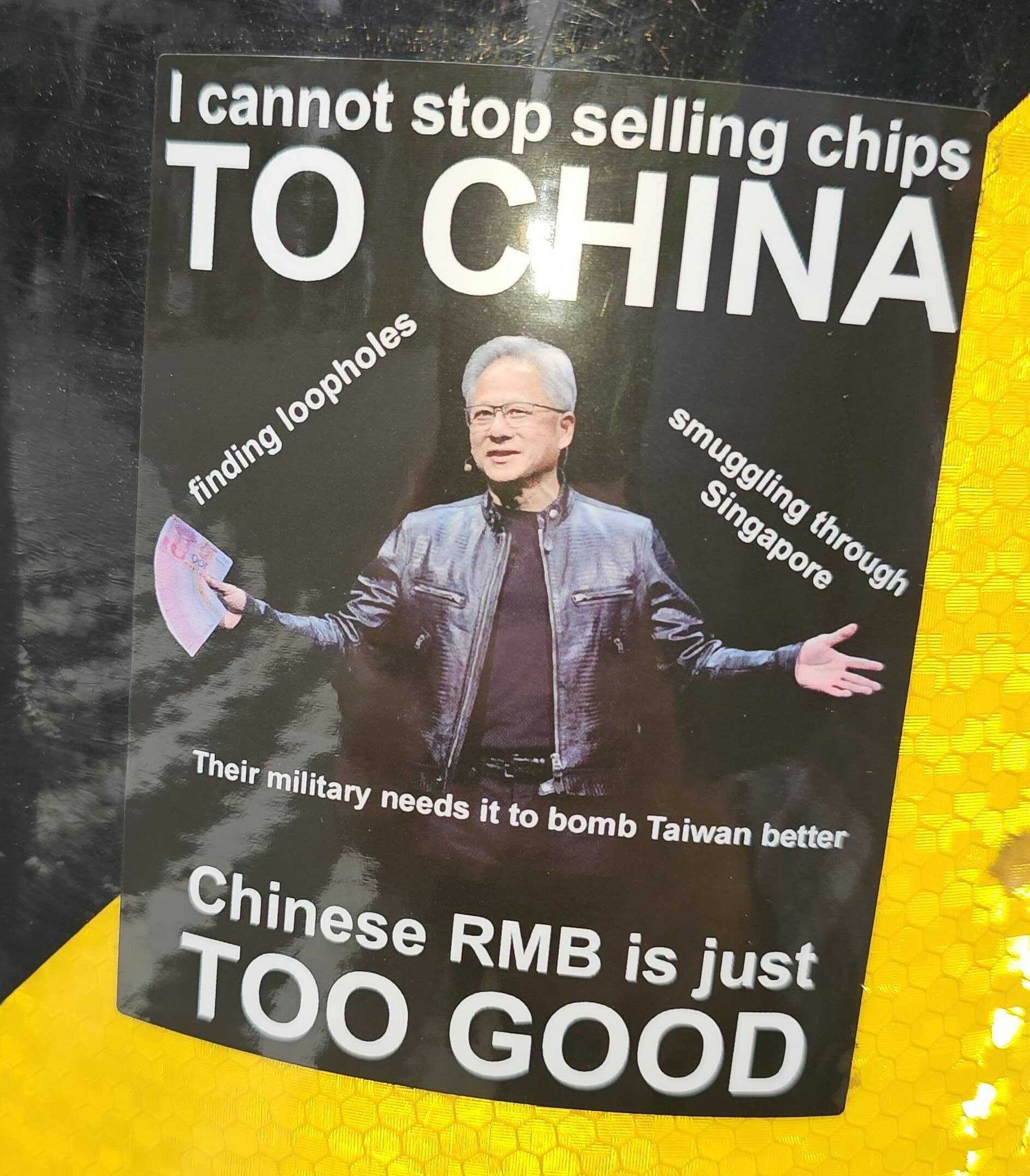
Sticker protesting Nvidia's sales to China spotted at Computex 2025 – click to enlarge
Whoever created and posted that sticker is clearly aware that Nvidia wins a curiously large percentage of its revenue in Singapore and that US lawmakers worry GPUs sold there could make their way to China.
The sticker's creator also knows that Chinese president Xi Jinping has an ambition to re-unify with Taiwan – perhaps by force.
And that ambition means Computex, whose purpose is to promote the Taiwanese tech industry upon which the world has become utterly reliant, will remain an event at which politics and tech must mix. Even on a humble keyboard. ®
From Chip War To Cloud War: The Next Frontier In Global Tech Competition
The global chip war, characterized by intense competition among nations and corporations for supremacy in semiconductor ... Read more
The High Stakes Of Tech Regulation: Security Risks And Market Dynamics
The influence of tech giants in the global economy continues to grow, raising crucial questions about how to balance sec... Read more
The Tyranny Of Instagram Interiors: Why It's Time To Break Free From Algorithm-Driven Aesthetics
Instagram has become a dominant force in shaping interior design trends, offering a seemingly endless stream of inspirat... Read more
The Data Crunch In AI: Strategies For Sustainability
Exploring solutions to the imminent exhaustion of internet data for AI training.As the artificial intelligence (AI) indu... Read more
Google Abandons Four-Year Effort To Remove Cookies From Chrome Browser
After four years of dedicated effort, Google has decided to abandon its plan to remove third-party cookies from its Chro... Read more
LinkedIn Embraces AI And Gamification To Drive User Engagement And Revenue
In an effort to tackle slowing revenue growth and enhance user engagement, LinkedIn is turning to artificial intelligenc... Read more