

EuroHPC Lines Up AI Upgrade For Leonardo Supercomputer
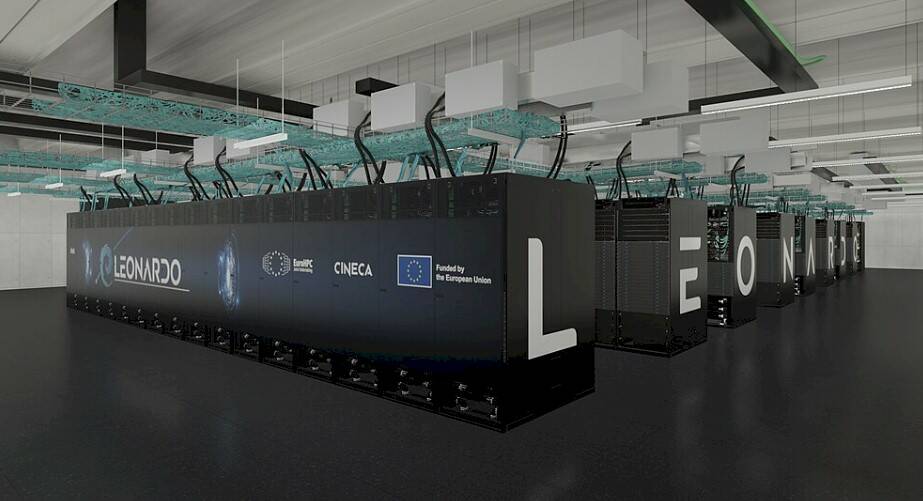
Updated Italy's Leonardo supercomputer is to get an AI upgrade to beef up support for the development of Large Language Models (LLMs) and multi-modal generative AI, in addition to the 13 AI factories now being procured around the EU.
Europe's supercomputing body the European High-Performance Computing Joint Undertaking (EuroHPC JU) says it has signed the contract for the Leonardo Improved Supercomputing Architecture (LISA), valued at about €28.2 million ($31.4 million). Yet the org will not divulge the specs, despite a contract price seemingly at odds with requirements.
The lucky winner that gets to build the LISA upgrade is Eviden, the HPC subsidiary of troubled multinational technology biz Atos, which in a startling coincidence, just happens to be the same company that built Leonardo in the first place.
According to the EuroHPC JU, the LISA extension will comprise 166 server nodes, each configured with 8 GPU accelerators, all fully interconnected through a high-performance non-blocking network. Each server will also feature high-bandwidth memory (HBM) to boost the system's performance with AI-intensive tasks.
If that sounds a little bit vague, you're not wrong. We asked for more detailed information on the specifications of this AI partition, but an Eviden spokesperson told us they were not at liberty to divulge anything further, while the EuroHPC JU had yet to respond at the time of publishing.
This may have something to do with the fact that the contract price is simply not enough to cover a cluster of 166 servers crammed with the latest and greatest Nvidia GPU accelerators, as was discussed by our colleagues at The Next Platform last year, when the procurement call went out to tender. Their analysis at the time was that Nvidia DGX A100 systems with 8 of the older (and less powerful) A100 GPUs might just about fit the budget.
LISA is the first EuroHPC computing partition designed specifically for AI workloads, according to the agency, and its deployment is scheduled for later this year.
However, this upgrade coincides with the deployment of IT4LIA, one of the 13 planned EuroHPC AI Factories that is, we're told, to be centered around the Leonardo supercomputer.
- Nvidia GPU roadmap confirms it: Moore’s Law is dead and buried
- Atos denies Space Bears' ransomware claims – with a 'but'
- French state waves up to €625M for Atos's Advanced Computing assets
- Nvidia's dominance on the Green500 faces challenges from AMD – and itself
The AI Factories project was announced last year after the EuroHPC JU's mandate was expanded to include the operation of AI-optimized supercomputers to serve a diverse range of European users including startups, small-to-medium enterprises (SMEs), industry, academia, and the public sector.
Despite being debt-ridden and undergoing a traumatic restructuring process over the past several years, Atos also secured the EuroHPC contract to build Jupiter, expected to be Europe's first exascale system, and a number of other European supercomputer projects, including a Finnish national supercomputer called Roihu. ®
Updated to add at 1015 UTC, May 14
Cineca, which hosts and manages Leonardo, got in touch with us after publication to respond to our budget mismatch concerns, saying "the solution offered [will] comply with all the mandatory technical requirements of the procurement, publicly available in the EuroHPC website."
It added: "In particular 166 8-way A100 nodes would not comply with the required minimum HPL of 45.000 TFlops reported in the specifications. The system will be featuring NVIDIA H100 GPUs."
Updated to add on May 15
EuroHPC responded at last, having spent over 24 hours hunting for the specs: "The cost of this upgrade is 28,167,942.00 EUR. The type of GPU and servers are NVIDIA H100 (8 per node, 1328 in total) installed in BullSequana AI 600 family servers and the non-blocking networking technology being used is Infiniband."
From Chip War To Cloud War: The Next Frontier In Global Tech Competition
The global chip war, characterized by intense competition among nations and corporations for supremacy in semiconductor ... Read more
The High Stakes Of Tech Regulation: Security Risks And Market Dynamics
The influence of tech giants in the global economy continues to grow, raising crucial questions about how to balance sec... Read more
The Tyranny Of Instagram Interiors: Why It's Time To Break Free From Algorithm-Driven Aesthetics
Instagram has become a dominant force in shaping interior design trends, offering a seemingly endless stream of inspirat... Read more
The Data Crunch In AI: Strategies For Sustainability
Exploring solutions to the imminent exhaustion of internet data for AI training.As the artificial intelligence (AI) indu... Read more
Google Abandons Four-Year Effort To Remove Cookies From Chrome Browser
After four years of dedicated effort, Google has decided to abandon its plan to remove third-party cookies from its Chro... Read more
LinkedIn Embraces AI And Gamification To Drive User Engagement And Revenue
In an effort to tackle slowing revenue growth and enhance user engagement, LinkedIn is turning to artificial intelligenc... Read more