

El Salvador Bitcoin City Planned At Base Of Conchagua Volcano
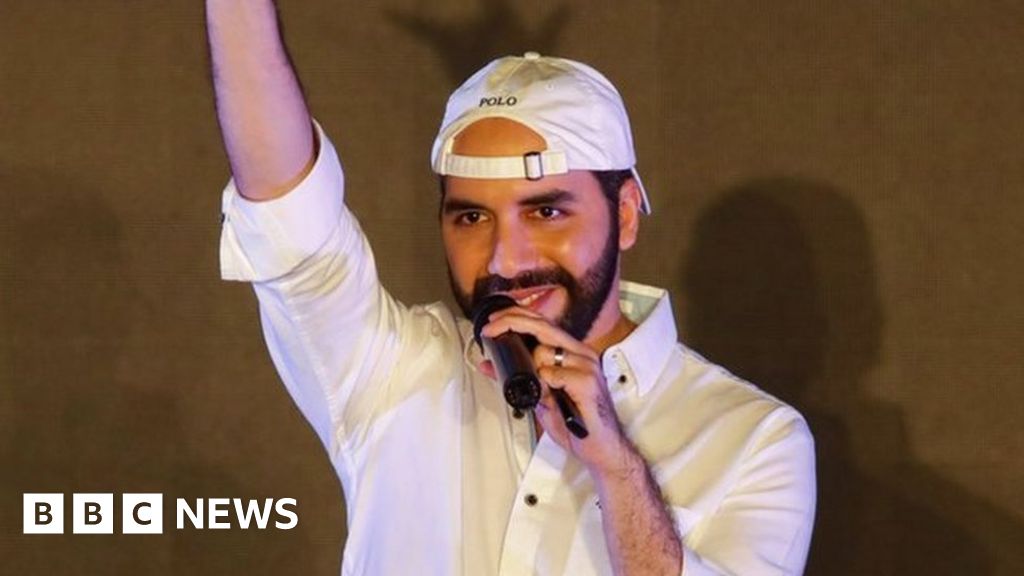
Image source, Reuters
President Nayib Bukele announced the plans to a raucous crowd
El Salvador plans to build a Bitcoin city at the base of a volcano, with the cryptocurrency used to fund the project, its president has announced.
The city will be circular to represent the shape of a large coin and will be built in the south-eastern region of La Unión, President Nayib Bukele said.
The site would take advantage of the Conchagua volcano's geothermal energy to power Bitcoin mining, he added.
El Salvador recently became the first country to use Bitcoin as legal tender.
The move led to large-scale protests over fears the cryptocurrency would bring instability and inflation to the impoverished Latin American country.
Addressing a raucous crowd at a promotional Bitcoin event in the coastal town of Mizata late on Saturday, Mr Bukele said the planned new city would "include everything".
"Residential areas, commercial areas, services, museums, entertainment, bars, restaurants, airport, port, rail - everything devoted to Bitcoin," the 40-year-old said.
The president, who appeared on stage wearing a baseball cap backwards, said that no income taxes would be levied in the city, only value added tax (VAT).
He said that half of the revenue gained from this would be used to "to build up the city", while the rest would be used to keep the streets "neat and clean".
Mining Bitcoin and other cryptocurrencies is done using sophisticated computers to solve complex mathematical problems. It is costly, difficult and takes up large amounts of energy.
Mr Bukele did not provide dates for construction or completion of the city, but said he estimated that much of the public infrastructure would cost around 300,000 Bitcoins.
One Bitcoin is currently trading at just under $60,000 (£45,000).
In September, El Salvador introduced the virtual currency as a legal tender, alongside the US dollar.
At the time, the government released a new digital wallet app, giving away $30 (£22) in Bitcoin to every citizen. More than 200 new cash machines were also installed across the country.
It presented the measure as a way to boost economic development and jobs, but El Salvador has been divided by the move.
It means that businesses, wherever possible, are now obliged to accept the digital coins as payment.
Bitcoin is a controversial currency in part because its value can fluctuate significantly - it has risen and fallen dramatically over the past year.
Bitcoin explained: How do crypto-currencies work?
From Chip War To Cloud War: The Next Frontier In Global Tech Competition
The global chip war, characterized by intense competition among nations and corporations for supremacy in semiconductor ... Read more
The High Stakes Of Tech Regulation: Security Risks And Market Dynamics
The influence of tech giants in the global economy continues to grow, raising crucial questions about how to balance sec... Read more
The Tyranny Of Instagram Interiors: Why It's Time To Break Free From Algorithm-Driven Aesthetics
Instagram has become a dominant force in shaping interior design trends, offering a seemingly endless stream of inspirat... Read more
The Data Crunch In AI: Strategies For Sustainability
Exploring solutions to the imminent exhaustion of internet data for AI training.As the artificial intelligence (AI) indu... Read more
Google Abandons Four-Year Effort To Remove Cookies From Chrome Browser
After four years of dedicated effort, Google has decided to abandon its plan to remove third-party cookies from its Chro... Read more
LinkedIn Embraces AI And Gamification To Drive User Engagement And Revenue
In an effort to tackle slowing revenue growth and enhance user engagement, LinkedIn is turning to artificial intelligenc... Read more