

Delta Boss Says Climate Change Means Flying Will Cost More
By Jonathan Josephs
Business reporter, BBC News
Image source, Getty Images
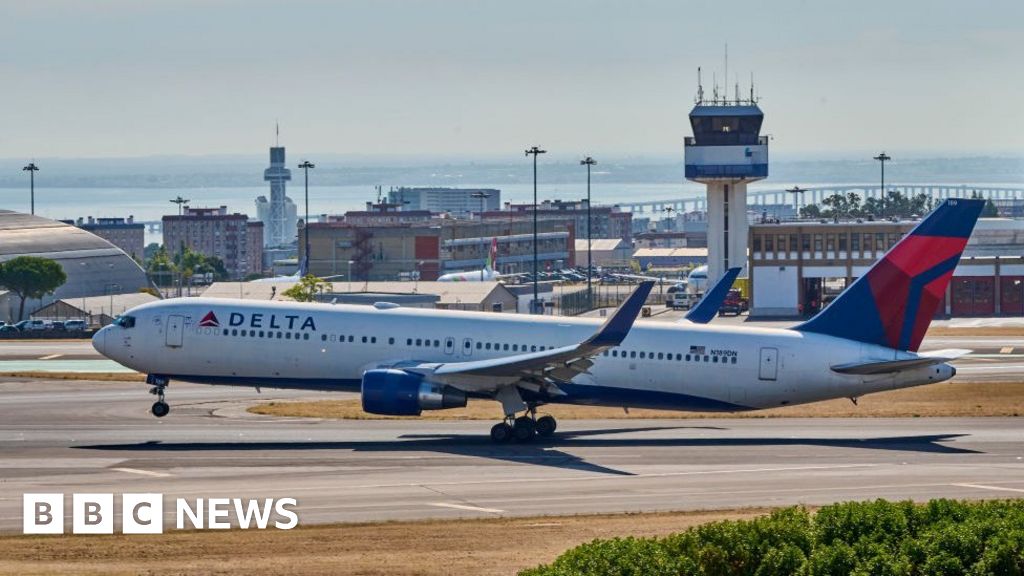
The boss of the world's second biggest airline has said that tackling climate change will make flying more expensive.
"Over time, it's going to cost us all more, but it's the right approach that we must take," Delta Air Lines chief executive Ed Bastian told the BBC.
Aviation is responsible for about 2.5% of the carbon emissions that are warming the planet, according to the International Energy Agency.
Critics argue the best way to reduce them is by flying less.
Atlanta-based Delta says that after spending $30m (£22.4m) a year on carbon-offsetting it has been carbon neutral since March 2020.
It has also pledged to spend $1bn over the next decade to cancel out all the emissions it creates.
More fuel-efficient planes, sustainable aviation fuels and removing carbon from the atmosphere are some of the ways it hopes to achieve this.
Ambitious goal
Reducing carbon emissions is crucial if the world is to limit global warming to 1.5C above pre-industrial levels as agreed in Paris in 2015, and has been the focus of the COP26 climate change summit in Glasgow.
Andreas Schafer, professor of energy and transport at University College London, says it will "cost trillions rather than billions of dollars" to move the global aviation sector to net zero carbon emissions.
Preliminary results from his team's research suggest airfares would need to increase by 10%-20% to cover the costs.
"In the short-term, government support will be needed with those costs as decarbonising aviation will be extremely challenging, and current efforts will need to be scaled up dramatically", says Prof Schafer.
Moving aviation to net zero carbon emissions is the right approach, says Ed Bastian
Mr Bastian concedes it is an ambitious goal that his airline won't be able to achieve alone.
"It's the biggest long-term challenge this industry faces," he said. "We're in an industry that's classified as hard to decarbonise because we don't have the bio-fuels or the sustainable aviation fuels (SAFs) en masse yet that we're going to need."
Delta aims to be using 10% sustainable aviation fuel by the end of 2030.
Many airlines and fuel companies are investing in SAFs. Other technologies being developed involve turning food waste into jet fuel and using carbon dioxide pulled out of the air.
However, these still cost more than traditional jet fuels and the quantities needed are also seen as problematic.
According to the US government, global demand for jet fuel is set to more than double by 2050 .
The number of passenger flights is set to jump from a pre-pandemic 4.5 billion to 10 billion by 2050, according to the International Air Transport Association (IATA).
IATA director general Willie Walsh told the BBC that while creating the levels of SAF production needed was a big challenge, "it is perfectly possible if industry and governments work together".
"Production increases will bring the cost down to competitive levels. We've seen similar increases in the development of solar and wind power in recent decades."
Image source, Getty Images
Aviation accounts for 2.5% of global carbon emissions but demand is set to grow
At the UN climate change summit in Glasgow, 23 countries have pledged to work together to get the aviation industry to net zero carbon emissions by 2050. More efficient energy use, sustainable aviation fuels and electric aeroplanes are all part of their ambitions.
However, environmental campaign group Greenpeace says the agreement is "brazen greenwashing".
"This announcement is full of scams like offsetting, and excessive optimism on so-called 'sustainable aviation fuels' and future aircraft designs," says Greenpeace's Klara Maria Schenk.
"But it lacks the one thing that's needed to deliver the goal of limiting temperature rise to 1.5C which is tangible action to prioritise green travel and reduce flights."
World's largest all-electric plane takes flight
Whilst many businesses and individuals have used the pandemic as a chance to re-evaluate their carbon footprints, Mr Bastian thinks the number of flights will return to pre-pandemic levels.
"All forms of travel are on the way back. Families are the part of the travelling public that we're most happy to see, because there's been some really difficult stories over time of families not being able to connect for long [periods]".
Business travel is also returning because video meetings can't replace everything, says Mr Bastian.
"There's a real unity and sense of purpose that we have when people get back together in person".
That desire to travel helped Delta to report a $194m profit in the three months to the end of September, its first profit since the pandemic began.
Image source, AFP
Demand for domestic air travel has helped Delta Air Lines return to profitability
Before the pandemic Delta was the world's second biggest airline, flying 200 million passengers in 2019. As of September it was operating at 71% of its pre-pandemic capacity.
The recovery in its domestic US market has been fastest, with long-haul routes to Asia the slowest. That echoes the pattern seen in a recent forecast from planemaker Boeing, which forecast a full recovery of global aviation would take until 2024.
Like other airlines, Delta has received billions in government support to get through the pandemic, but is hopeful of a brighter future now the US has reopened its borders to international travellers.
Watch: Emotional families reunite as US lifts travel ban
Mr Bastian says this may take some adjusting to and there may be long queues at airports as Covid vaccines and paperwork are checked.
However, he is confident in the airline's outlook and says the pandemic was "an opportunity to invest in our future".
Now the airline is making money again he says: "We hope to be able to maintain that and go into the new year as a profitable carrier."
You can watch Ed Bastian's full interview on "Talking Business with Aaron Heslehurst" this weekend on BBC World News at Saturday 23:30 GMT, Sunday 05:30 and 16:30 GMT and Monday at 08:30 GMT
From Chip War To Cloud War: The Next Frontier In Global Tech Competition
The global chip war, characterized by intense competition among nations and corporations for supremacy in semiconductor ... Read more
The High Stakes Of Tech Regulation: Security Risks And Market Dynamics
The influence of tech giants in the global economy continues to grow, raising crucial questions about how to balance sec... Read more
The Tyranny Of Instagram Interiors: Why It's Time To Break Free From Algorithm-Driven Aesthetics
Instagram has become a dominant force in shaping interior design trends, offering a seemingly endless stream of inspirat... Read more
The Data Crunch In AI: Strategies For Sustainability
Exploring solutions to the imminent exhaustion of internet data for AI training.As the artificial intelligence (AI) indu... Read more
Google Abandons Four-Year Effort To Remove Cookies From Chrome Browser
After four years of dedicated effort, Google has decided to abandon its plan to remove third-party cookies from its Chro... Read more
LinkedIn Embraces AI And Gamification To Drive User Engagement And Revenue
In an effort to tackle slowing revenue growth and enhance user engagement, LinkedIn is turning to artificial intelligenc... Read more