

Datacenter Biz Wants To Turn Heat And Carbon Waste Into Biomass For Sale
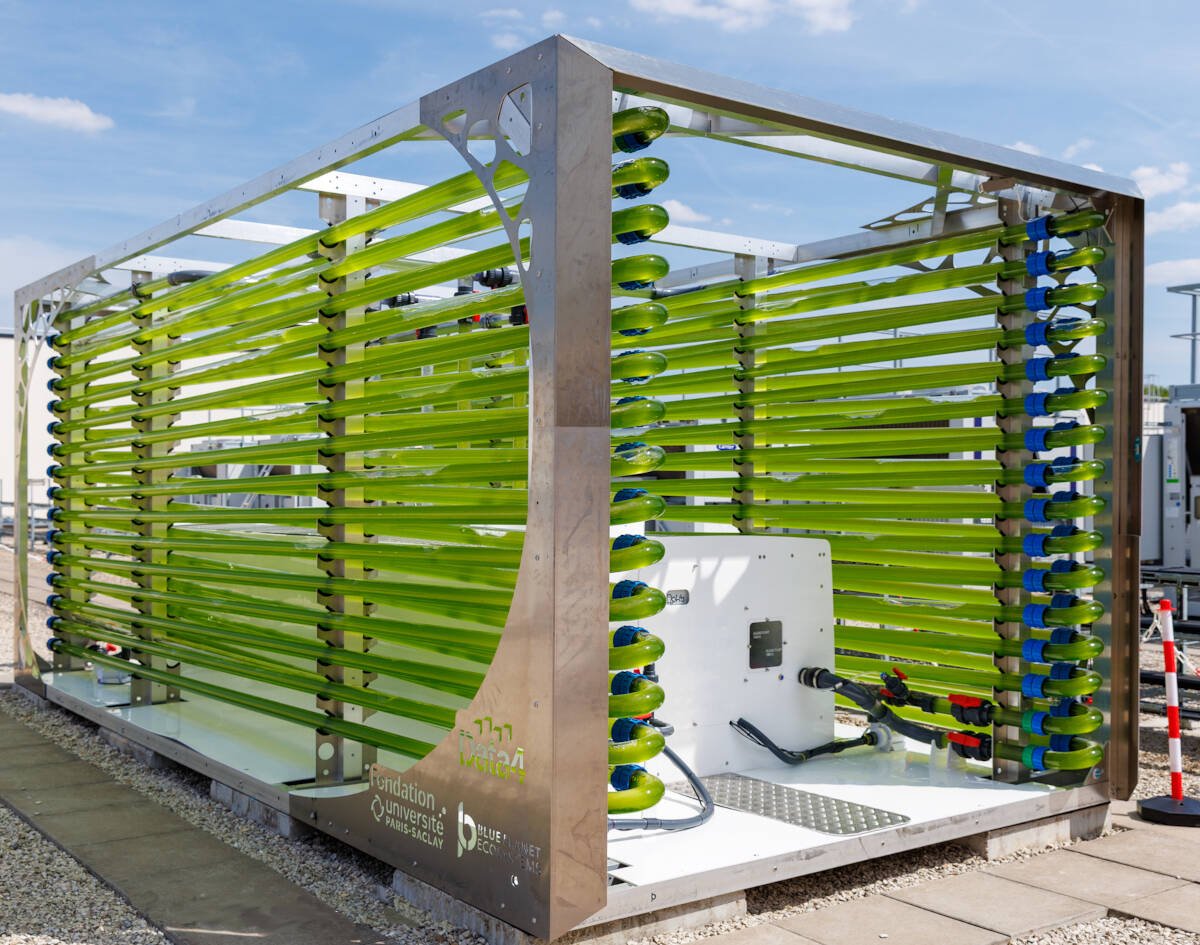
Euro datacenter operator Data4 is trialling a project to reuse heat from its servers and captured carbon dioxide to grow algae that can then be used in the agri-food or pharmacology sectors.
The Paris-based biz says it has a proof-of-concept installation now operating on the roof of its facility in that city. The heat recovery and biomass production system consists of an algae production module claimed to have an absorption capacity 20 times greater than that of trees for the equivalent surface area.
The Data4 heat reuse unit - Pic (c): DirCom91 / T. Cochet-Peduzzi
Data4 says a second stage of the project is under development, which aims to install algal modules on datacenter facades as well as the roof, with the goal of scaling up to produce 20 kg of algae and capture 36 kg of CO2 daily.
The scheme has been in the works for at least a year, in partnership with the University of Paris-Saclay, startup Blue Planet Ecosystems, and the Conseil Départemental de l'Essonne, the administrative body for the Île-de-France region centred on Paris.
Data4 claims the R&D project is a response to the challenge of reusing the heat produced by data facilities. Several schemes were considered, including using the excess heat to warm nearby homes. However, it found this solution only exploits 20 percent of the heat energy produced.
Instead, it looked for new ways of reusing the heat, including reproducing a natural photosynthesis mechanism by using captured CO2 to grow algae, recycling it as biomass and reusing it in the manufacture of bioproducts for other industries such as cosmetics.
"Nearly 18 terawatt-hours of energy are available in our datacenters in France, but are currently unused," Data4 group Head of Innovation Linda Lescuyer said in statement.
- Microsoft burnishes green cred by paying Swedes to burn biomass and bury CO2
- Google's €1B Finnish datacenter expansion to heat the local community
- Laser-cooled chips: Maybe coming soon-ish to a datacenter near you
- More than a third of enterprise datacenters expect to deploy liquid cooling by 2026
"Through this project, we aim to transform this heat into energy. Thanks to the biocircular datacenter module, we have the opportunity to create a new ecological and economic resource for the region, and therefore jobs, that can develop with the datacenters."
Other bit barns owned by Data4 are based in Milan, Madrid, Frankfurt, Athens, and Warsaw. A spokesperson told The Reg its objective is to expand this project to other sites if phases 1 and 2 of the pilot are successful.
Data4 and its partners are in contact with several potential customers for the end product within the agri-food and pharmacology industries, the spokesperson confirmed. As discussions are ongoing, Data4 declined to name any of them.
Tackling greenhouse gas emissions has risen up the corporate agenda due to increasing government regulations, plus pressure from customers who may have to report supplier emissions as part of their own emissions accounting processes.
Recent growth in compute demand because of the AI industry hasn't helped, of course, and a report from financial services biz Morgan Stanley last year estimated that bit barns are set to emit three times more greenhouse gas by the end of the decade than if generative AI had not been developed.
Even worse, emissions from datacenters are likely to be much higher than currently estimated, perhaps more than seven times higher, according to some experts, due to the emissions accounting practices used by some operators.
Every little bit helps, then, and Data4 claims that in its scheme CO₂ is actually captured from other industrial sites and injected into the tubes to boost algae growth.
"Currently, the module captures 900g of CO2 per day, but the objective for phase 2 (2027) is to capture 36kg per day," the spokesperson told us. ®
From Chip War To Cloud War: The Next Frontier In Global Tech Competition
The global chip war, characterized by intense competition among nations and corporations for supremacy in semiconductor ... Read more
The High Stakes Of Tech Regulation: Security Risks And Market Dynamics
The influence of tech giants in the global economy continues to grow, raising crucial questions about how to balance sec... Read more
The Tyranny Of Instagram Interiors: Why It's Time To Break Free From Algorithm-Driven Aesthetics
Instagram has become a dominant force in shaping interior design trends, offering a seemingly endless stream of inspirat... Read more
The Data Crunch In AI: Strategies For Sustainability
Exploring solutions to the imminent exhaustion of internet data for AI training.As the artificial intelligence (AI) indu... Read more
Google Abandons Four-Year Effort To Remove Cookies From Chrome Browser
After four years of dedicated effort, Google has decided to abandon its plan to remove third-party cookies from its Chro... Read more
LinkedIn Embraces AI And Gamification To Drive User Engagement And Revenue
In an effort to tackle slowing revenue growth and enhance user engagement, LinkedIn is turning to artificial intelligenc... Read more