

D-Wave To Go Public After $1.2 Billion Merger Deal With SPAC
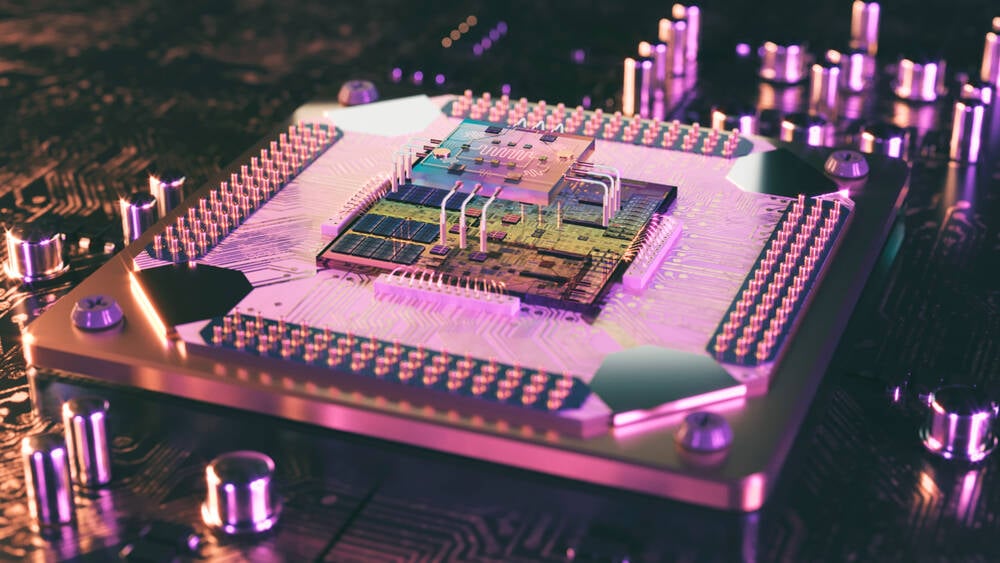
Quantum computer company D-Wave will go public after reaching a deal to merge with the SPAC (special purpose acquisition company) DPCM Capital, in a deal that values the advanced-computing firm at $1.2bn.
The private biz will change its name to D-Wave Quantum Inc. and will receive about $340m in funding. The newly formed company will be listed on the New York Stock Exchange under ticker symbol QBTS, and the deal will close in the second quarter this year, as SPAC deals typically offer a faster route to market than the traditional IPO method.
Quantum computers are still under development, but are being hyped for the ability to do things like drug discovery substantially faster than today's computers and possibly break current encryption systems. But IT leaders in Fortune 500 companies are approaching it with caution, and experimenting with the systems without making significant financial commitments.
Quantum computers encode information in qubits, and store exponentially more information in the form of 1s, 0s or a superposition of both, and evaluate data simultaneously, while classical computers evaluate data sequentially.
D-Wave has been around for a decade selling its quantum annealing system, which is designed to solve specific computing problems. The system delivers a set of possible outcomes after a magnetic field is applied to perform qubit operations.
The company last year announced it was also building a gate-model system to solve substantially larger problems like differential equations, which weren't designed to be handled by the annealing systems.
D-Wave's gate-model will be based on flux qubits, the same as used in the annealing system. The error-corrected system will put the company in competition with IBM and Google, which use transmon qubits in their quantum computers.
The delivery of the gate-model system is expected by 2023 or 2024. D-Wave has so far raised nearly $300m capital through various rounds, and the SPAC deal gives it more financial armor to chase after loftier goals.
- Quantum computing startups pull in millions as VCs rush to get ahead of the game
- D-Wave claims it can build a gate-model quantum computer
- A diverse range of processing units linked via interconnects. Sounds familiar? Yes, it's IBM's quantum computing
- 'Quantum computer algorithms are linear algebra, probabilities. This is not something that we do a good job of teaching our kids'
D-Wave already has customers in the finance, pharmaceutical and logistics market, DPCM Capital said in a filing with the US Securities and Exchange Commission. It also asserted that the quantum computing market is worth up to $5bn in the short term, and up to $50bn in the mid-tier term.
The D-Wave SPAC deal follows the footsteps of another quantum hardware company Rigetti, which announced a $1.5bn merger with Supernova Partners Acquisition Company II, a finance house focusing on strategic acquisitions.
Investment deals from SPAC firms tend to be highly speculative, so DPCM will be in for a big-time reward if D-Wave emerges successful. Quantum computers are also still viewed with a healthy level of skepticism by some.
Last year was a funding bonanza for quantum computing startups, which raked in $1.02bn in venture capital investments without factoring in the Rigetti deal, according to data provided to The Register by Pitchbook. That was a significant increase from $684m invested by VC firms in 2020, and $188m in 2019. ®
From Chip War To Cloud War: The Next Frontier In Global Tech Competition
The global chip war, characterized by intense competition among nations and corporations for supremacy in semiconductor ... Read more
The High Stakes Of Tech Regulation: Security Risks And Market Dynamics
The influence of tech giants in the global economy continues to grow, raising crucial questions about how to balance sec... Read more
The Tyranny Of Instagram Interiors: Why It's Time To Break Free From Algorithm-Driven Aesthetics
Instagram has become a dominant force in shaping interior design trends, offering a seemingly endless stream of inspirat... Read more
The Data Crunch In AI: Strategies For Sustainability
Exploring solutions to the imminent exhaustion of internet data for AI training.As the artificial intelligence (AI) indu... Read more
Google Abandons Four-Year Effort To Remove Cookies From Chrome Browser
After four years of dedicated effort, Google has decided to abandon its plan to remove third-party cookies from its Chro... Read more
LinkedIn Embraces AI And Gamification To Drive User Engagement And Revenue
In an effort to tackle slowing revenue growth and enhance user engagement, LinkedIn is turning to artificial intelligenc... Read more