

Coronavirus: Boom Time For Bikes As Virus Changes Lifestyles
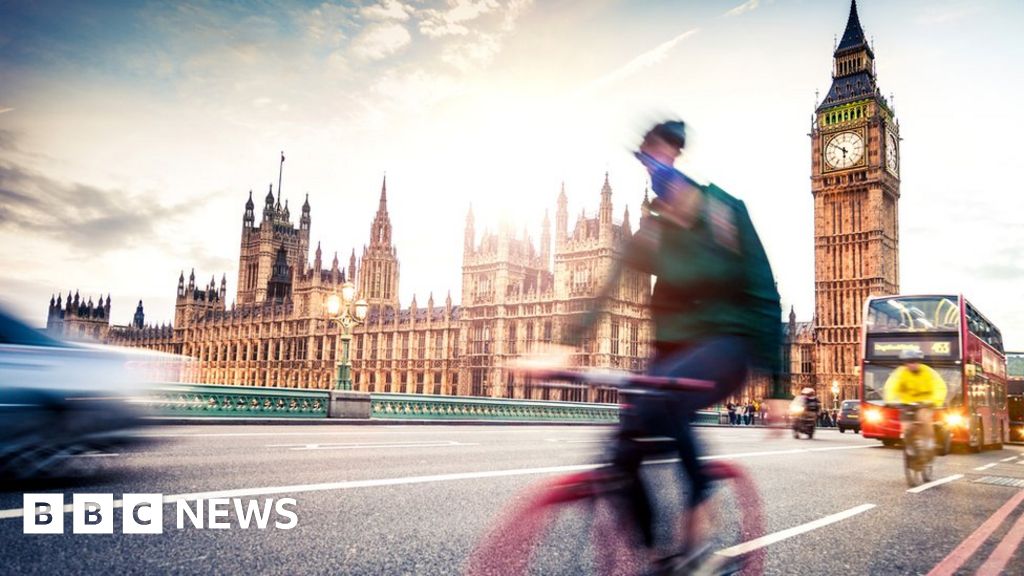
 Image copyright
Getty Images
Image copyright
Getty Images
Fear of catching coronavirus on public transport has helped lead to a boom in cycle-to-work schemes.
The schemes saw a 200% increase in bicycle orders from people working for emergency services.
Demand for more mobility and exercise amid lifestyle changes imposed by the lockdown has also boosted bike sales across the UK.
"Very strong" bicycle sales at bike and car parts chain Halfords this week saw its shares soar by 23%.
Some bike stores are battling to meet demand. Broadribb Cycles in Bicester normally despatches 20-30 bikes a week, but manager Stuart Taylor says the shop is currently selling 50 bikes every day - and seeing a commensurate rise in demand for servicing.
"It's just gone crazy," he told the BBC. "People are dragging bikes out of sheds and garages and finding they need new tyres and cables.
"We normally take in bikes for repair and servicing and deal with them for next day [pick-up]. Now we're booking services for two weeks [ahead]."
At Lunar Cycles repair shop in north London, the mechanic says trade was booming, then ended the call to avoid upsetting the socially-distanced queue outside.
Andrew Hassard from Mango Bikes in Ballyclare, Northern Ireland, said: "The bicycle industry is having a boom. People are saying 'I'm getting back on a bike after 15-20 years - I'm going to use it during lockdown - then commute on it as well,' to avoid public transport."
A recent poll for the consultants SYSTRA suggested 61% of Britons are nervous of taking public transport post-lockdown.
Adrian Warren who runs an alliance of cycle schemes, told the BBC: "This past six weeks, we have seen the biggest experiment in transport policy this country has even known. It's clear the default option is cycling."
Cycle schemes allow employees to claim a tax credit on bikes they buy at work.
But rusty cyclists may be nervous on busy roads, so the pressure group Cycling UK has commissioned research showing how 100 "pop-up" lanes in 10 English cities could make cycling and walking easier.
It maps UK cities which have created extra cycle lines during the crisis, in many cases taking over one car lane on a dual carriageway.
The Cycling UK research from Leeds looks at English cities with a high cycling potential and has identified 99.2 miles of streets and roads in London, Birmingham, Manchester, Leeds, Liverpool, Bristol, Leicester, Sheffield, Newcastle and Cambridge which could benefit from temporary walking and cycling infrastructure.
Cities round the world have been freeing space for people on foot and bikes, in response to the coronavirus lockdown.
In Germany, expanded cycle lanes have been marked by removable tape and mobile signs.
Paris is rolling out 650 kilometres of cycleways, including a number of pop-up "corona cycleways".
Some cities, like Milan, are making the changes permanent.
The Scottish government has announced £10m of funding for councils to provide temporary space on the roads this way, and Cycling UK is urging ministers in Westminster to follow suit.
In London, the walking and cycling commissioner, Will Norman, told the Online magazine BikeBiz that the capital's public transport capacity is running at a fifth of pre-crisis levels, meaning post-lockdown up to eight million journeys a day will need to be made by other means.
UK Transport Secretary Grant Shapps has in fact said that he favours getting people out of their cars, overall.
Mr Shapps told Sky News that he sees cycling and walking as part of the solution.
"Active transport can keep people off public transport and get people to work under their own steam - and that can be a very important part of this [the nation's post-lockdown] recovery as well," he said.
Not everyone is in favour: The libertarian group the Alliance of British Drivers has strongly opposed removing road space from motorists. But Edmund King, president of the AA, said he didn't oppose the transfer of road space to cycles "where appropriate".
Follow Roger on Twitter.
From Chip War To Cloud War: The Next Frontier In Global Tech Competition
The global chip war, characterized by intense competition among nations and corporations for supremacy in semiconductor ... Read more
The High Stakes Of Tech Regulation: Security Risks And Market Dynamics
The influence of tech giants in the global economy continues to grow, raising crucial questions about how to balance sec... Read more
The Tyranny Of Instagram Interiors: Why It's Time To Break Free From Algorithm-Driven Aesthetics
Instagram has become a dominant force in shaping interior design trends, offering a seemingly endless stream of inspirat... Read more
The Data Crunch In AI: Strategies For Sustainability
Exploring solutions to the imminent exhaustion of internet data for AI training.As the artificial intelligence (AI) indu... Read more
Google Abandons Four-Year Effort To Remove Cookies From Chrome Browser
After four years of dedicated effort, Google has decided to abandon its plan to remove third-party cookies from its Chro... Read more
LinkedIn Embraces AI And Gamification To Drive User Engagement And Revenue
In an effort to tackle slowing revenue growth and enhance user engagement, LinkedIn is turning to artificial intelligenc... Read more