

Chinese Yuan: Currency Hits Record Lows Against US Dollar
By Suranjana Tewari & Peter Hoskins
BBC News
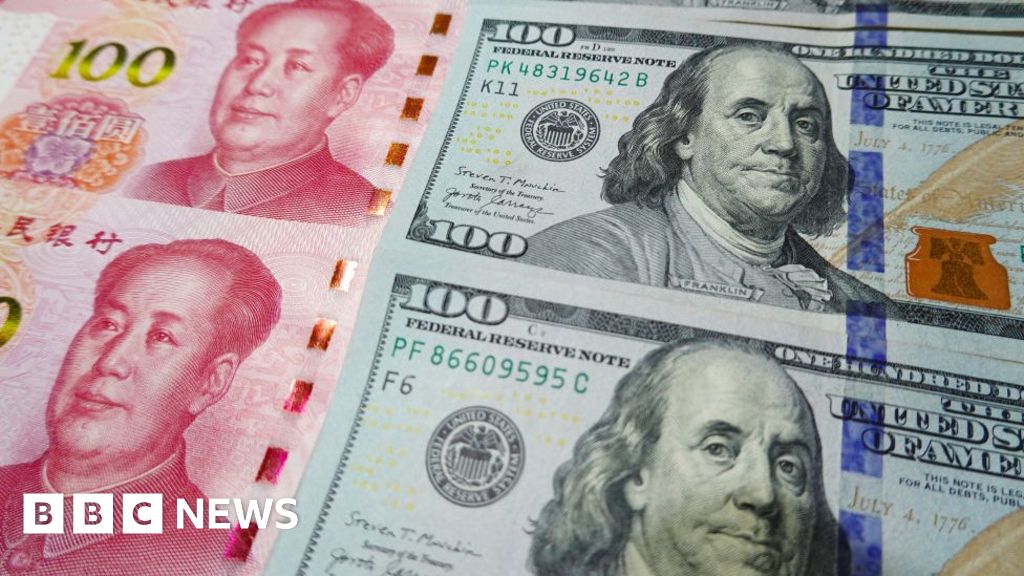
China's yuan has hit fresh record lows against the surging US dollar.
The internationally-traded yuan fell to its lowest level since data first became available in 2011.
China's domestic currency also reached its weakest point since the 2008 global financial crisis.
It comes as the dollar continues to rise in value against other major currencies, after the US central bank raised interest rates again earlier this month.
Meanwhile on Wednesday, other major stock market indexes across Asia fell sharply.
Japan's benchmark Nikkei index, Hong Kong's Hang Seng and the Kospi in South Korea were down by more than 2% in morning trade.
China's central bank has been trying to slow the yuan's slide by making it more expensive to bet against the currency. The People's Bank of China (PBOC) also cut how much foreign currency banks have to hold.
Many investors see the dollar as a safe place to put their money in times of trouble.
That has helped to drive up its value against other currencies, including the British pound - which hit an all-time low against the dollar on Monday.
Also on Wednesday, the dollar reached a fresh 20-year high against a closely-watched group of leading global currencies.
The yuan's slide is yet another example of a currency weakening as a result of the strong dollar.
It is also about the very different paths China and the United States are taking in response to economic issues at home.
The PBOC has been easing interest rates to revive growth in an economy ravaged by Covid lockdowns, while the US Federal Reserve is moving aggressively in the opposite direction as it tries to control inflation.
Such a divergence is not wholly problematic, Joseph Capurso, head of international and sustainable economics at the Commonwealth Bank of Australia told the BBC.
The fall in the currency's value can actually be helpful for exporters within China, he said, because it would make their goods cheaper and so could increase demand.
That said, exports only make up 20% of the Chinese economy these days, so a weak yuan will not turn around fundamental weakness domestically largely caused by Beijing's zero-Covid strategy and a property crisis, said Mr Capurso.
A weaker currency can also lead to investors pulling their money out of the country and uncertainty in financial markets - something Chinese officials will want to avoid with the Communist Party Congress coming up next month, when its president Xi Jinping is expected to secure an unprecedented third term in office.
The yuan's fall has caused weakness in other currencies of developed economies in the region, including the Australian and Singapore dollar as well as the South Korean won.
Last week, the Bank of Japan intervened to support the yen for the first time since 1998, after the currency weakened against the dollar.
Asia's emerging markets are vulnerable too - as they sell raw materials and components to China's factories and so have increasingly become dependent on the yuan.
Washington has in the past accused China of intentionally devaluing its currency to keep exports cheap and imports from the US expensive.
While the strong dollar has rattled world markets, it is unlikely to deter the Fed from continuing to raise rates.
"The strong dollar is working for the US market," Dimitri Zabelin at the London School of Economics' foreign policy think-tank said.
"It will be a consideration but it will not weigh as heavy as domestic concern about inflation."
You may also be interested in:
Watch: Ros Atkins On… How this year’s biggest stories connect
From Chip War To Cloud War: The Next Frontier In Global Tech Competition
The global chip war, characterized by intense competition among nations and corporations for supremacy in semiconductor ... Read more
The High Stakes Of Tech Regulation: Security Risks And Market Dynamics
The influence of tech giants in the global economy continues to grow, raising crucial questions about how to balance sec... Read more
The Tyranny Of Instagram Interiors: Why It's Time To Break Free From Algorithm-Driven Aesthetics
Instagram has become a dominant force in shaping interior design trends, offering a seemingly endless stream of inspirat... Read more
The Data Crunch In AI: Strategies For Sustainability
Exploring solutions to the imminent exhaustion of internet data for AI training.As the artificial intelligence (AI) indu... Read more
Google Abandons Four-Year Effort To Remove Cookies From Chrome Browser
After four years of dedicated effort, Google has decided to abandon its plan to remove third-party cookies from its Chro... Read more
LinkedIn Embraces AI And Gamification To Drive User Engagement And Revenue
In an effort to tackle slowing revenue growth and enhance user engagement, LinkedIn is turning to artificial intelligenc... Read more