

China Launches Test Satellites For Orbiting Broadband Service
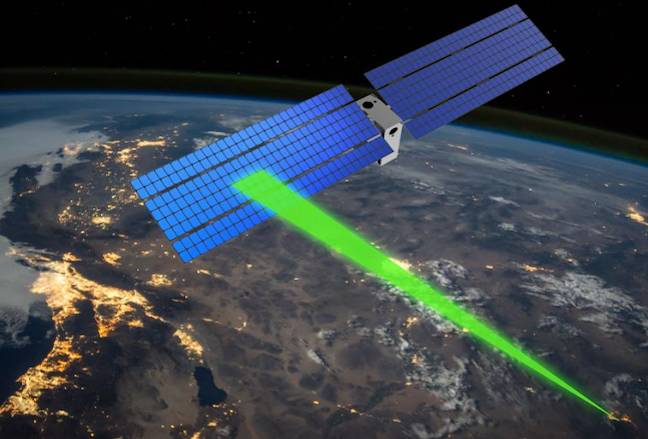
Chinese satellite broadband outfit GalaxySpace has launched the first satellites in a planned low Earth orbit constellation that will eventually offer a wireless internet service.
The sats went aloft over the weekend atop a Long March 2-C rocket that also hauled an Earth observation sat into the heavens.
GalaxySpace aims to provide 5G internet at speeds of 40Gbit/sec.
Last January, GalaxySpace named the test network, nicknamed "little spider web", and promised it would provide low orbit broadband for more than 30 minutes at a time and inform development of a planned 144-satellite constellation.
The company said that the price of creating such a satellite has halved since its first one was built, and it has managed to keep the weight of each unit to 190kg.
"The successful mission proved that China has built up the low cost, batch development, and networking operation capabilities of satellites – all factors that are necessary to build a satellite internet mega-constellation," said state sponsored media, Global Times.
The future megaconstellation will be overseen by Beijing.
- IT blamed after HR forgets to install sockets in new office
- Russia acknowledges sanctions could hurt its tech companies
- PayPal, Visa, Mastercard suspend Russian services
- DBAs massively over-provision Oracle to protect themselves: Microsoft
- Deere & Co won't give out software and data needed for repairs, FTC told
The elephant in the room is that 144 satellites is not very many, compared to rivals like SpaceX's 2,000-birds-and-growing Starlink constellation or planned constellations from Amazon. Starlink has more than 2,000 satellites already in orbit and Amazon's planned fleet calls for 7,774 units – up from an original 3,236.
GalaxySpace's planned fleet is also on the low side compared to local rivals. The Hongyan and Hongyun projects – owned by the state-owned China Aerospace Science and Technology Corporation and China Aerospace Science and Industry Corporation, respectively – have been launching test satellites since 2018. Hongyan plans 324 total satellites, while Hongyun will have 157.
Smaller constellation networks aren't unheard of elsewhere. Boeing's been approved for 147 that will provide services to the US, Puerto Rico and the US Virgin Islands, and the UK government-backed OneWeb has planned 648.
If Beijing sticks to a nice low number like 144 the service won't be useful beyond the Middle Kingdom – and GalaxySpace specifically said the satellites will "accelerate the construction of China's satellite internet." In the end, that might just suit the increasingly insular country just fine. ®
From Chip War To Cloud War: The Next Frontier In Global Tech Competition
The global chip war, characterized by intense competition among nations and corporations for supremacy in semiconductor ... Read more
The High Stakes Of Tech Regulation: Security Risks And Market Dynamics
The influence of tech giants in the global economy continues to grow, raising crucial questions about how to balance sec... Read more
The Tyranny Of Instagram Interiors: Why It's Time To Break Free From Algorithm-Driven Aesthetics
Instagram has become a dominant force in shaping interior design trends, offering a seemingly endless stream of inspirat... Read more
The Data Crunch In AI: Strategies For Sustainability
Exploring solutions to the imminent exhaustion of internet data for AI training.As the artificial intelligence (AI) indu... Read more
Google Abandons Four-Year Effort To Remove Cookies From Chrome Browser
After four years of dedicated effort, Google has decided to abandon its plan to remove third-party cookies from its Chro... Read more
LinkedIn Embraces AI And Gamification To Drive User Engagement And Revenue
In an effort to tackle slowing revenue growth and enhance user engagement, LinkedIn is turning to artificial intelligenc... Read more