

Canada Pledges To Help Countries Stop Using Russian Oil
By Jonathan Josephs
Business Reporter, BBC News, Paris
Canada's Natural Resources Minister Jonathan Wilkinson says there is agreement about moving away from Russian oil and gas
Canada says it can provide more oil, gas and uranium to help solve the global energy crisis.
Prices have soared as a result of Russian supplies being squeezed because of its invasion of Ukraine.
Canada's natural resources minister said many countries are committed "to help as much as we can in terms of displacing Russian oil and gas".
The world's fourth biggest oil producer has committed to exporting an extra 200,000 barrels of oil.
Its Natural Resources Minister Jonathan Wilkinson told BBC News it would also export an additional 100,000 barrels of natural gas.
It follows requests from its allies at a meeting of the world's energy ministers at the International Energy Agency (IEA) in Paris, which pledged to accelerate the move to clean energy.
"We expect that by the end of the year we will be fully up to the 300,000 barrels," said Mr Wilkinson.
However, that is only a fraction of the three million barrels a day that the IEA says will be removed from global markets by next month because of sanctions against Russia.
Image source, NurPhoto/Getty
Canada will export 200,000 more barrels of oil per day by the end of the year
Canada is limited in how much oil it can export because its pipelines are running near full capacity, but Mr Wilkinson says sending it via the United States is an option.
Canada's biggest pipeline company Enbridge told the BBC it is "prepared to do what we can to increase energy security for both North America and Europe".
The impact of Canada's extra supplies "will be relatively limited given the regionality of Canadian crude, which will likely stay in the North American market", according to Louise Dickson, who is a senior oil analyst at the consultancy Rystad Energy.
"The main energy crisis is playing out in Europe due to supply shortages, and Asia where demand is on the cusp of recovering if Covid-19 lockdowns can be kept at bay," added Ms Dickson.
Tackling rising prices
Canada has joined the US and UK in introducing a ban on Russian oil. That has seen prices pushed up as high as almost $130 (£98.56) a barrel since the war in Ukraine began.
Mr Wilkinson believes "there is a consensus" among the other energy ministers at the meeting that the world needs to cope without Russian oil and gas, adding: "I think the only differences are around how fast can you actually get away from it."
However, the investment bank JP Morgan says it thinks the "current extreme aversion to Russian oil will subside" and that the price of a barrel of oil will fall back to about $100 in the second half of this year.
The International Monetary Fund is among those who have raised concerns that higher oil prices are causing costs of goods and energy bills to rise and that inflation is harming the global economy.
Mr Wilkinson said leaders must ensure that people "are able to heat their homes and that industries are able to produce the goods that we all need."
Image source, NurPhoto/Getty
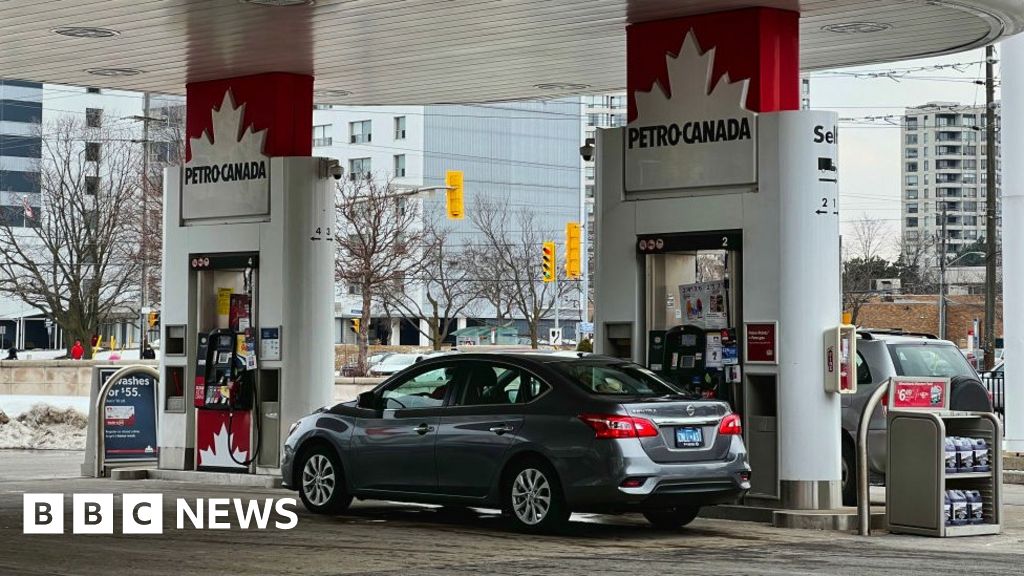
Motorists, including these in Toronto, have seen the price of filling up their car go up as a result of the war in Ukraine
In the longer term, Mr Wilkinson said he recognised that "energy security and fighting climate change are intimately linked".
Addressing immediate concerns, he argued: "Canadian oil displacing Russian oil doesn't cause more climate change. There's no more CO2 emissions."
Having previously run a "clean energy" company, Mr Wilkinson said he was a big believer in using hydrogen and other renewable sources to create more energy going forward.
Growth of nuclear
The variable nature of solar and wind power means "there is a role for nuclear in many jurisdictions in terms of providing baseload rather than intermittent power", Mr Wilkinson said.
Russia plays a key role in the global nuclear power industry. As well as mining uranium, it does a lot of the processing to make it useable in power stations.
Image source, International Energy Agency
Energy ministers meeting at the IEA in Paris agreed to maintain a focus on cutting carbon emissions as they seek to move away from Russian oil and gas
Canada is "absolutely" prepared to export more uranium, said Mr Wilkinson. He explained "our uranium producers actually do have excess capacity and certainly could ramp up to to help to fill the gap that Russian supplies will provide".
The UN Secretary General didn't mention a role for nuclear power when he said a few days ago that the rush to use fossil fuels because of the war in Ukraine is "madness" and threatens the ability to limit the rise in global temperatures to 1.5C.
Mr Wilkinson said: "I think where the secretary general and I would agree very much... is the need to accelerate the work that we're doing on climate change.
"We are we are running out of time. There is no question about that - we need to make significant progress by 2030."
He suggested that the war in Ukraine is underlining "how important it is not just from a climate perspective, although that's enough, it's from an energy security perspective that we actually do this now. We don't wait."
You can watch Jonathan Wilkinson's full interview on "Talking Business with Aaron Heslehurst" this weekend.
Viewers in the UK can watch the show on Sunday at 15:30 on the BBC News Channel.
In other countries, it will be on BBC World News at Saturday at 12:30 & 23:30 GMT and Sunday 06:30 & 18:30 GMT.
From Chip War To Cloud War: The Next Frontier In Global Tech Competition
The global chip war, characterized by intense competition among nations and corporations for supremacy in semiconductor ... Read more
The High Stakes Of Tech Regulation: Security Risks And Market Dynamics
The influence of tech giants in the global economy continues to grow, raising crucial questions about how to balance sec... Read more
The Tyranny Of Instagram Interiors: Why It's Time To Break Free From Algorithm-Driven Aesthetics
Instagram has become a dominant force in shaping interior design trends, offering a seemingly endless stream of inspirat... Read more
The Data Crunch In AI: Strategies For Sustainability
Exploring solutions to the imminent exhaustion of internet data for AI training.As the artificial intelligence (AI) indu... Read more
Google Abandons Four-Year Effort To Remove Cookies From Chrome Browser
After four years of dedicated effort, Google has decided to abandon its plan to remove third-party cookies from its Chro... Read more
LinkedIn Embraces AI And Gamification To Drive User Engagement And Revenue
In an effort to tackle slowing revenue growth and enhance user engagement, LinkedIn is turning to artificial intelligenc... Read more