

Burberry And Tencent Team Up For Concept Stores

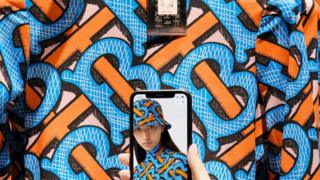 Image copyright
Burberry
Image copyright
Burberry
Burberry has partnered with China's tech giant Tencent to launch a luxury concept store using social media interactions.
The British retailer opened its first "social retail store" on Friday in Shenzhen, China's technology hub.
The companies want to roll the concept out across Burberry's network in China.
The tie-up comes as tensions rise between the two countries, with China's UK ambassador saying relations have been "seriously poisoned".
The Shenzhen social store is the first stage of the partnership, aimed at positioning Burberry as an innovator among Chinese shoppers, who account for around 40% of its sales.
"It marks a shift in how we engage with our customers," Burberry's chief executive Marco Gobbetti said. "When it came to innovating around social and retail, China was the obvious place to go as home to some of the most digitally savvy luxury customers."
Tencent's WeChat social messaging platform, China's equivalent of WhatsApp, plays a big role in this new customer experience. The app has more than 1bn users in China.
A WeChat programme allows shoppers to unlock exclusive content and personalised experiences which they can share on their social media networks.
All the clothes are labelled with QR codes which show product information on the customer's phone when scanned.
"It is a unique space to test and learn, and to trial innovation that can be expanded to the rest of the Burberry network in China," Mr Gobbetti added.
Retail analysts praised Burberry for the hybrid store which combines online shopping with traditional bricks-and-mortar retailing.
"Burberry has been savvy and ahead of the curve in understanding the importance of social media and e-commerce in targeting Chinese consumers," said Shaun Rein, founder of the China Market Research Group.
"Too many luxury brands focus on bricks and mortar and the in-store experience only while Chinese want to shop online."
Luxury brands have been selling strongly in China as residents can't travel overseas on expensive foreign shopping sprees due to coronavirus travel restrictions.
"China is the best bet with the most digital and social savvy consumers, and a large market for luxury retail," said Siddharth Pathak, a partner at management consulting firm Kearney.
"The usage of digital in stores has been prevalent in China for a few years now but this definitely takes it to a whole new level."
However, Burberry could face headwinds given the growing political tensions between the UK and China.
On Thursday Beijing's ambassador to London Liu Xiaoming said the relationship between the UK and China has been "seriously poisoned".
The two countries have clashed over a number of issues recently including the banning of Chinese technology firm Huawei from the UK's 5G mobile network and China's new security law imposed in Hong Kong.
"Burberry could get caught up in UK-China tension. Chinese might boycott the brand if the UK continues to be seen supporting the Hong Kong riots," warned Mr Rein.
The luxury British brand has 61 stores in China.
From Chip War To Cloud War: The Next Frontier In Global Tech Competition
The global chip war, characterized by intense competition among nations and corporations for supremacy in semiconductor ... Read more
The High Stakes Of Tech Regulation: Security Risks And Market Dynamics
The influence of tech giants in the global economy continues to grow, raising crucial questions about how to balance sec... Read more
The Tyranny Of Instagram Interiors: Why It's Time To Break Free From Algorithm-Driven Aesthetics
Instagram has become a dominant force in shaping interior design trends, offering a seemingly endless stream of inspirat... Read more
The Data Crunch In AI: Strategies For Sustainability
Exploring solutions to the imminent exhaustion of internet data for AI training.As the artificial intelligence (AI) indu... Read more
Google Abandons Four-Year Effort To Remove Cookies From Chrome Browser
After four years of dedicated effort, Google has decided to abandon its plan to remove third-party cookies from its Chro... Read more
LinkedIn Embraces AI And Gamification To Drive User Engagement And Revenue
In an effort to tackle slowing revenue growth and enhance user engagement, LinkedIn is turning to artificial intelligenc... Read more