

Brexit: Barnier Arrives In UK For Face-to-face Talks
- Published
image copyrightPA Media
The UK and EU will resume face-to-face Brexit trade talks in London this weekend, as negotiators race to reach a deal before a looming deadline.
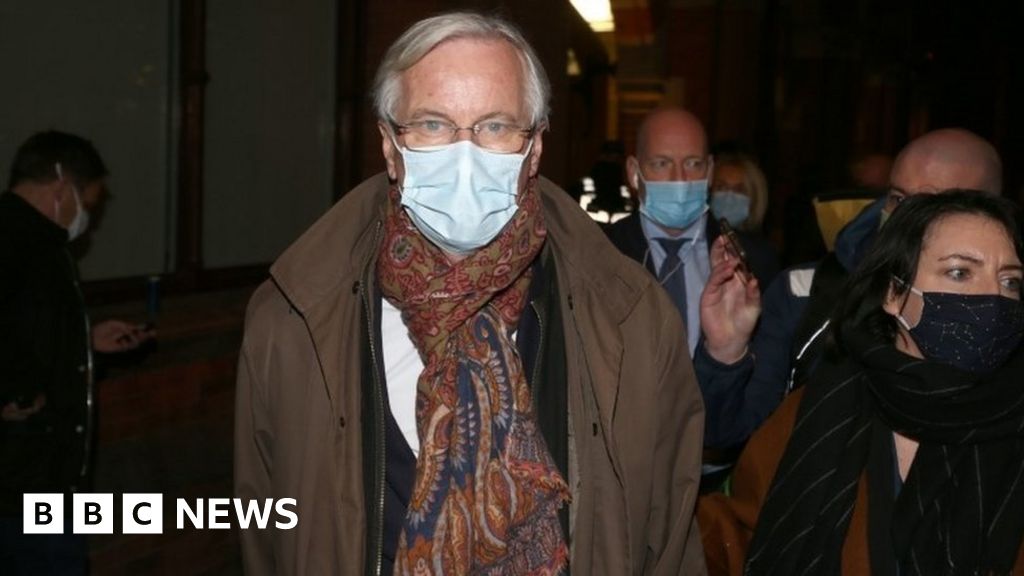
It comes after EU chief negotiator Michel Barnier left a period of self-isolation after a colleague tested positive for Covid last week.
Ahead of travelling to the UK, he said the "same significant divergences persist" in negotiations.
After arriving, he said he would work with "patience and determination".
Earlier, Boris Johnson insisted the likelihood of a deal depended on the EU.
Speaking on Friday, the prime minister told reporters that "there's a deal there to be done if they want to do it".
But he added "substantial and important differences" remained between the two sides, with just over a month left before a December deadline.
Negotiators are striving to strike a deal to govern their trading relationship once the UK's post-Brexit transition period ends in January 2021.
Talks have been continuing via video link for the past week or so, after the positive Covid-19 test in a member of Mr Barnier's team.
Mr Barnier travelled to London after briefing EU ambassadors and members of the European Parliament on talks.
"In line with Belgian rules, my team and I are no longer in quarantine. Physical negotiations can continue," he wrote on Twitter.
Ahead of in-person talks getting back under way, his UK counterpart Lord David Frost pledged to "do my utmost" see if a deal is possible.
"It is late, but a deal is still possible, and I will continue to talk until it's clear that it isn't," he tweeted on Friday.
He added that any deal would have to "fully respect UK sovereignty," including over fishing waters and a regime for subsidising businesses.
"An agreement on any other basis is not possible," he added.
If the UK is holding off making compromises, in the hope of squeezing more last-minute concessions out of Brussels, it might be successful when it comes to fish.
On Friday, we heard talk of Michel Barnier being about to propose that between 15% and 18% of the fish quota caught in UK waters by EU fleets would be restored to the UK under a free trade agreement.
That was later dismissed by a number of European diplomats, as merely one of "many proposals doing the rounds".
But whatever happens on the fish front - and Brussels knows it has some big compromises to make - as much as the EU wants a deal with the UK, it's unlikely to let go of its insistence on two other issues: common competition regulations and a tough means of policing them.
Asked about the chances of an agreement, Mr Johnson said the "likelihood of a deal is very much determined by our friends and partners in the EU".
He added that a trade agreement would "benefit people on both sides of the Channel," but insisted the UK could "prosper mightily" without one.
"Everybody's working very hard - but clearly there are substantial and important differences to be bridged, but we're getting on with it."
Sticking points
The UK left the EU on 31 January, but it is continuing to follow the bloc's rules until the end of the year as part of an 11-month transition period.
If a trade deal is not agreed by then, trading between the two will default to World Trade Organization (WTO) rules.
The EU and UK can keep negotiating if they want to after this, but the two sides would face import taxes on goods traded between them.
The UK would have no access to the EU's energy market, and no agreement on police and judicial co-operation.
Fishing has been a major flashpoint in the talks, along with post-Brexit competition rules and how any deal would be enforced.
The two sides are also at odds over how closely the UK should have to follow the EU's social, labour, and environmental standards after the transition.
They are also haggling over how any rules in this area - including on "state aid" support for businesses - would be enforced as part of the agreement.
From Chip War To Cloud War: The Next Frontier In Global Tech Competition
The global chip war, characterized by intense competition among nations and corporations for supremacy in semiconductor ... Read more
The High Stakes Of Tech Regulation: Security Risks And Market Dynamics
The influence of tech giants in the global economy continues to grow, raising crucial questions about how to balance sec... Read more
The Tyranny Of Instagram Interiors: Why It's Time To Break Free From Algorithm-Driven Aesthetics
Instagram has become a dominant force in shaping interior design trends, offering a seemingly endless stream of inspirat... Read more
The Data Crunch In AI: Strategies For Sustainability
Exploring solutions to the imminent exhaustion of internet data for AI training.As the artificial intelligence (AI) indu... Read more
Google Abandons Four-Year Effort To Remove Cookies From Chrome Browser
After four years of dedicated effort, Google has decided to abandon its plan to remove third-party cookies from its Chro... Read more
LinkedIn Embraces AI And Gamification To Drive User Engagement And Revenue
In an effort to tackle slowing revenue growth and enhance user engagement, LinkedIn is turning to artificial intelligenc... Read more