

Breathe Easy: Apple Watch Can Read Your Oxygen Levels Again
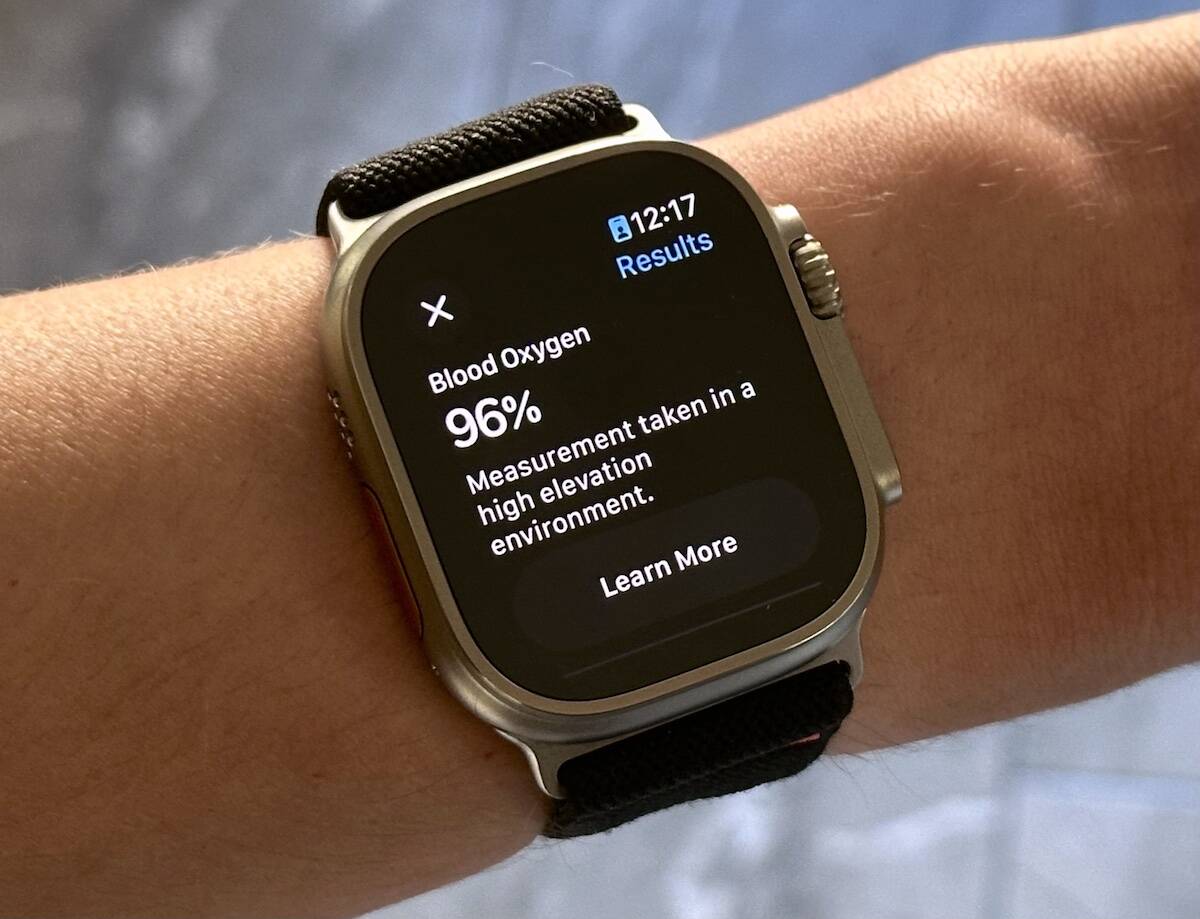
Apple will deliver a software update for recent US Apple Watch models to reimplement the ability to measure blood oxygen levels, a process known as pulse oximetry.
Pulse oximetry can be helpful when assessing the health of a people who experience conditions that affect the level of oxygen in the blood, according to Johns Hopkins, including various heart and lung conditions like heart attacks and asthma. Sales of the devices boomed during the COVID pandemic.
But unlike the Apple Watch's EKG feature, the device's pulse oximetry functions have not been approved by the US Food and Drug Association (FDA). Consequently, it is not intended to assess medical conditions. It's intended for "wellness" – data entertainment – rather than medical diagnostics.
The iBiz had to remove the feature in January 2024 after the International Trade Commission determined that Apple's blood oxygen measurement technology violated patents held by California-based medical device maker Masimo. The ITC issued an import ban that prevented Apple Watch from being sold in the US with the patenting infringing pulse oximetry capability.
But on Thursday, Apple said an software update will deliver "a redesigned Blood Oxygen feature for some Apple Watch Series 9, Series 10, and Apple Watch Ultra 2 users" in the US today. It arrives via iOS 18.6.1 and watchOS 11.6.1.
Apple Watch models that were purchased with the original blood oxygen measurement feature (before the feature was deactivated to comply with the ITC ruling) and those purchased outside the US are not affected by these updates.
The design change involves not presenting the blood oxygen measurement on the Watch, as initially implemented and shown in the photo above.
"For models of Apple Watch purchased in the United States on or after January 18, 2024 with part numbers ending in LW/A, the Blood Oxygen data analysis is performed on iPhone, and results can be viewed in the [iPhone's] Health app," Apple's documentation explains. "This experience is available on the latest version of iOS and watchOS."
Masimo did not immediately respond to a request for comment.
- Epic Games has another win over Apple and Google, this time in Australia
- Apple piles another $100B on top of previous US manufacturing pledge
- Not big in Japan: Apple's WebKit browser requirement may break new law
- Caught between China and Trump, Apple spends $500M on rare earth recycling
A 2023 meta analysis of Apple Watch blood oxygen saturation studies in the medical journal Cureus found Apple's device roughly comparable to medical-grade pulse oximeters, with occasional outlier results. The authors also said more analysis needs to be done to assess whether skin color affects measurement accuracy – a concern subsequently echoed by the FDA.
The authors also questioned whether providing blood oxygen measurements to inform wellness decisions is of any value. It is unclear, they said, whether an Apple Watch customer with an underlying condition will be motivated to seek medical attention based on a data display before being alerted by physical symptoms like shortness of breath.
"For the vast majority of individuals using the watch as a wellness tracker, it will likely not provide a meaningful benefit in terms of health guidance and might even cause psychological distress to those who worry about outliers that the watch occasionally produces," the authors observed.
"Since the normal range for oxygen saturation is 95 - 100 percent, and the limits of agreement of the reviewed studies are in the +/- 2.7 to 5.9 percent range, it is to be expected that users will eventually be shown measurements outside of the normal range which, if occurring in isolation, should be no cause for concern."
Nonetheless, there are reports of people who claim Apple Watch health notifications saved their life. ®
From Chip War To Cloud War: The Next Frontier In Global Tech Competition
The global chip war, characterized by intense competition among nations and corporations for supremacy in semiconductor ... Read more
The High Stakes Of Tech Regulation: Security Risks And Market Dynamics
The influence of tech giants in the global economy continues to grow, raising crucial questions about how to balance sec... Read more
The Tyranny Of Instagram Interiors: Why It's Time To Break Free From Algorithm-Driven Aesthetics
Instagram has become a dominant force in shaping interior design trends, offering a seemingly endless stream of inspirat... Read more
The Data Crunch In AI: Strategies For Sustainability
Exploring solutions to the imminent exhaustion of internet data for AI training.As the artificial intelligence (AI) indu... Read more
Google Abandons Four-Year Effort To Remove Cookies From Chrome Browser
After four years of dedicated effort, Google has decided to abandon its plan to remove third-party cookies from its Chro... Read more
LinkedIn Embraces AI And Gamification To Drive User Engagement And Revenue
In an effort to tackle slowing revenue growth and enhance user engagement, LinkedIn is turning to artificial intelligenc... Read more