

Bosch To Pour $3 Billion Into European Chip Fabs And Research
Bosch is set to invest €3 billion in its semiconductor business by 2026 as part of a broader push to boost the European chip manufacturing industry.

The Bosch parking lot over the A8 outside Stuttgart, Germany
At its Bosch Tech Day 2022, the German engineering and technology company said it plans to build two new development centers in Reutlingen and Dresden, and expand its manufacturing capacity by adding an extra 3,000 square meters of clean-room space to its wafer fab in Dresden.
According to Bosch, the €3 billion (just over $3 billion or about £2.5 billion) funding is coming from the EU and German federal governments within the framework of the European Chips Act, through a newly launched IPCEI (Important Project of Common European Interest) on Microelectronics and Communication Technology that aims to promote research and innovation.
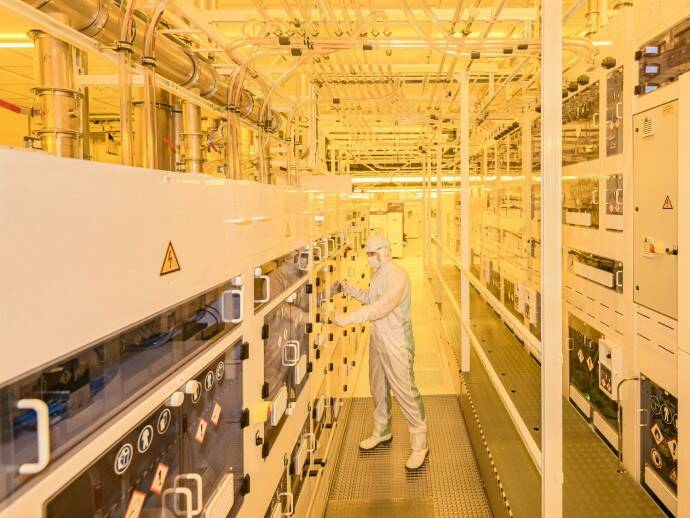
Between now and 2025, Bosch said it will spend around €400 million of its investment pot to the expansion of manufacturing capacity and the conversion of existing factory space into new clean-room space. This includes construction of a new extension in Reutlingen, which will create an additional 3,600 square meters of capacity. The total clean-room space at the facility is set to grow from the current 35,000 square meters to over 44,000 square meters.
View into the clean room production at the Bosch semiconductor plant in Dresden
But far from installing cutting edge fabrication processes, it appears that Bosch intends to invest in semiconductors targeting the automotive industry, with production process sizes of between 40 and 200 nanometers rather than the 5nm and 3nm that are now coming on-stream for components like next-gen microprocessors. Given the company’s background, this is hardly surprising, however.
- Big Tech begs Congress to pass $52bn chip subsidies bill
- EU directs €11bn toward European Chips Act to build homegrown semiconductor industry
- GlobalFoundries, STMicroelectronics said to mull French fab
- Intel to get $7.3b for Germany fab site as TSMC dismisses Europe plans
- Intel selects German city for EU semiconductor plant
“Europe can and must capitalize on its own strengths in the semiconductor industry,” said Dr Stefan Hartung, chairman of the Bosch board of management. “More than ever, the goal must be to produce chips for the specific needs of European industry. And that means not only chips at the bottom end of the nanoscale.”
This is likely justified because the share of a car’s total value represented by semiconductor components is set to quadruple over the course of this decade, from just under €200 to more than €800, according to Hartung, and Bosch wants its share of this.
Despite this, Bosch says that the investment will also open up new areas of innovation, such as systems-on-a-chip, with an example given being the radar sensors that will be used by autonomous vehicles to scan their surroundings. Bosch said it aims to make these smaller and cheaper to produce.
Consumer research
One area of research is microelectromechanical systems (MEMS) – miniaturized machines with both mechanical and electronic components fabricated using modified semiconductor process technologies – targeting the consumer market. The example given here is a projection module so small that it can be embedded into the frame of a pair of smart glasses, which Bosch said its researchers are developing.
Hartung said Bosch plans to manufacture MEMS sensors on 300mm wafers, with production scheduled to start in 2026.
Another focus for Bosch is the production of new types of semiconductors. The company already has experience in manufacturing components from silicon carbide (SiC), the properties of which make it suitable for the power electronics circuitry required for electric and hybrid vehicles. The demand for these is growing at annual rates of 30 percent or more, according to Bosch, and so it will be exploring the potential of other materials such as gallium nitride. ®
From Chip War To Cloud War: The Next Frontier In Global Tech Competition
The global chip war, characterized by intense competition among nations and corporations for supremacy in semiconductor ... Read more
The High Stakes Of Tech Regulation: Security Risks And Market Dynamics
The influence of tech giants in the global economy continues to grow, raising crucial questions about how to balance sec... Read more
The Tyranny Of Instagram Interiors: Why It's Time To Break Free From Algorithm-Driven Aesthetics
Instagram has become a dominant force in shaping interior design trends, offering a seemingly endless stream of inspirat... Read more
The Data Crunch In AI: Strategies For Sustainability
Exploring solutions to the imminent exhaustion of internet data for AI training.As the artificial intelligence (AI) indu... Read more
Google Abandons Four-Year Effort To Remove Cookies From Chrome Browser
After four years of dedicated effort, Google has decided to abandon its plan to remove third-party cookies from its Chro... Read more
LinkedIn Embraces AI And Gamification To Drive User Engagement And Revenue
In an effort to tackle slowing revenue growth and enhance user engagement, LinkedIn is turning to artificial intelligenc... Read more