

Bonus Features: Sony Uses Blu-ray Tech To Simulate 466Mbps Laser Link From The Stratosphere To Space

Sony Computer Science Laboratories (CSL) and the Japanese space agency have conducted an experiment to transmit data from the stratosphere to space and declared the results promising as a complete file was delivered at 446 megabits per second.
Data networking is hard in space, because distances and latency are substantial and radiation can impact transmissions. Those challenges have led to efforts like the Interplanetary networking SIG and its delay-tolerant networking (DTN) tech that makes internet standards work despite the challenges of space.
DTN also addresses the problem of network nodes disappearing over the horizon – and therefore beyond the reach of radio or optical signals – by (as its name implies) not getting grumpy if packets take a while to reach their intended destinations.
Jaxa and Sony took up the task of simulating DTN at work on a transmission from the stratosphere to low-Earth orbit, over an optical connection.
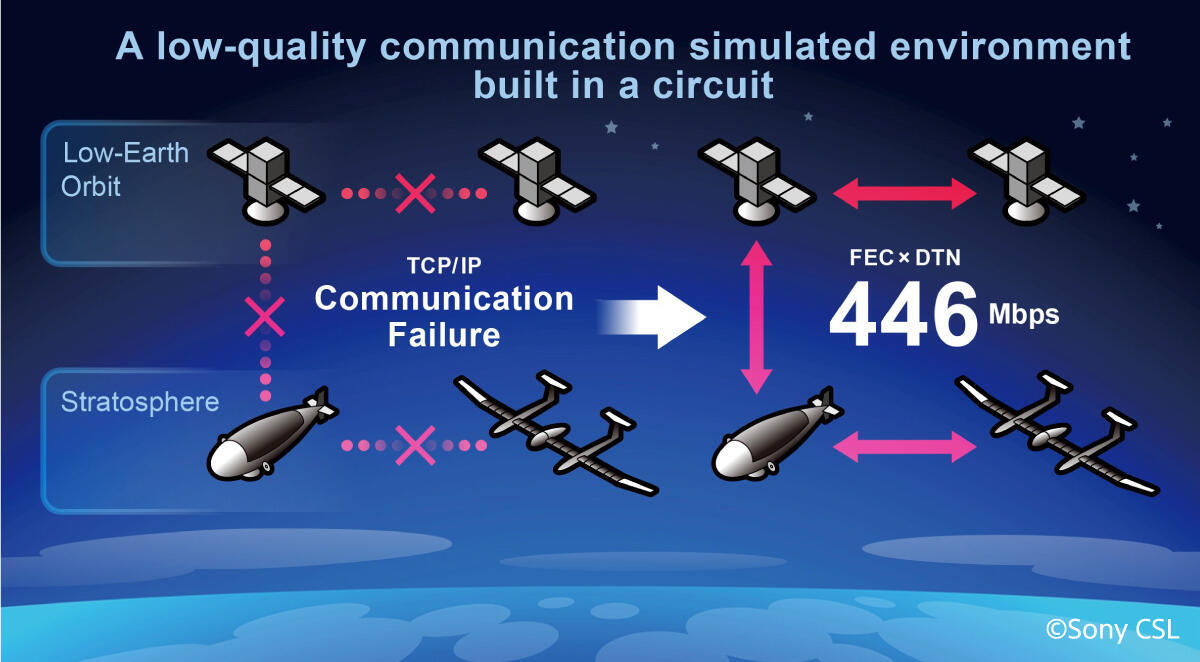
Sony and JAXA's simulated network.
Click to enlarge
The two entities haven't offered a lot of detail about their experiment, but did state that DTN was used alongside a Sony IP called CSL Forward Error Correction (FEC) – a laser-reading technique derived from the Japanese giant's Blu-ray optical disk technology.
FEC has already been used in space, in an experiment called the Small Optical Link for International Space Station (SOLISS). That effort established a 100Mbit/sec link from the ground to the ISS in March 2020.
- NASA confirms International Space Station is to keep orbiting through 2030
- You wood not believe what a Japanese logging company and university want to use to build a small satellite
- Boffins' first take on asteroid dust from Japanese probe: Carbon rich, less lumpy than expected
- Fancy being an astronaut but didn't go to uni? Your time may have finally come
By hitting 466Mbit/sec, this latest test went rather faster than SOLISS. Jaxa and Sony CSL therefore reckon "a solution is in sight to the high speed, high bandwidth, and low energy consumption requirements of point-to-point optical internet service in the stratosphere or low-Earth orbit." The two have started to imagine "small optical communication terminals installed on low-Earth orbit satellite constellations, or unmanned aircraft for stratospheric telecommunications."
The Register wonders if it could also deliver the ultimate in cold storage: an orbiting Blu-ray archive. ®
From Chip War To Cloud War: The Next Frontier In Global Tech Competition
The global chip war, characterized by intense competition among nations and corporations for supremacy in semiconductor ... Read more
The High Stakes Of Tech Regulation: Security Risks And Market Dynamics
The influence of tech giants in the global economy continues to grow, raising crucial questions about how to balance sec... Read more
The Tyranny Of Instagram Interiors: Why It's Time To Break Free From Algorithm-Driven Aesthetics
Instagram has become a dominant force in shaping interior design trends, offering a seemingly endless stream of inspirat... Read more
The Data Crunch In AI: Strategies For Sustainability
Exploring solutions to the imminent exhaustion of internet data for AI training.As the artificial intelligence (AI) indu... Read more
Google Abandons Four-Year Effort To Remove Cookies From Chrome Browser
After four years of dedicated effort, Google has decided to abandon its plan to remove third-party cookies from its Chro... Read more
LinkedIn Embraces AI And Gamification To Drive User Engagement And Revenue
In an effort to tackle slowing revenue growth and enhance user engagement, LinkedIn is turning to artificial intelligenc... Read more