

Argos Axes 'book Of Dreams' Catalogue After 48 Years
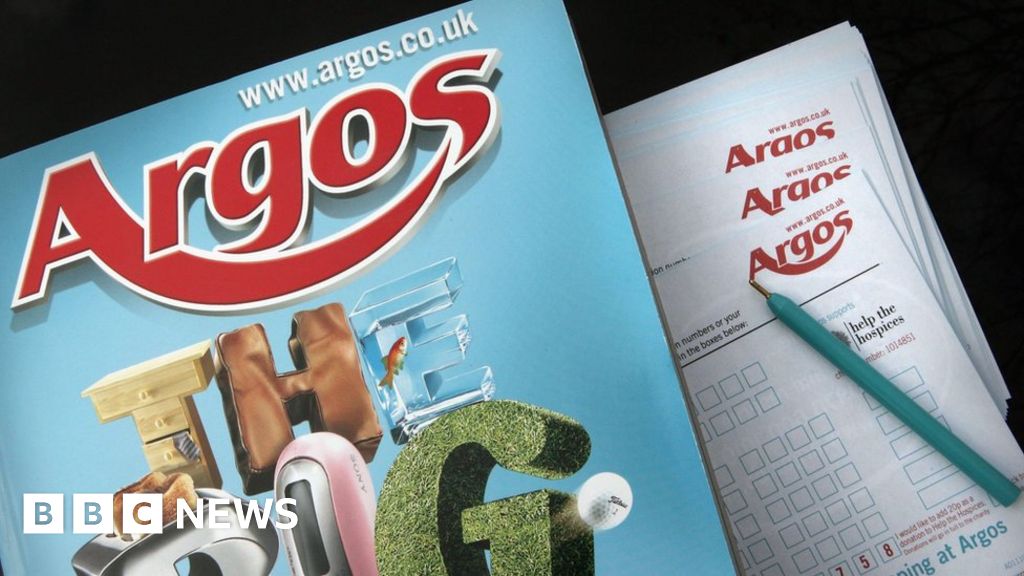
 Image copyright
Getty Images
Image copyright
Getty Images
"The laminated book of dreams," was how comedian Bill Bailey jokingly described the plastic-coated Argos catalogue.
But 48 years on from its launch, the catalogue is finally coming to an end.
The encyclopedia-like catalogues, the basis of many a child's Christmas wishlist, will no longer be regularly printed by the end of January 2021.
The catalogue was first launched in 1972 and at its peak was Europe's most widely-printed publication, with only the Bible in more homes across the UK.
Read more: Life lessons from the Argos catalogue
Comedian Alan Carr famously picked the Argos catalogue as his book choice on Radio 4's programme Desert Island Discs.
"At least there's pictures," he said at the time. "I feel it would help me through."
But now Argos says that online shopping offers "greater convenience" than flicking through its print catalogue and no further take-home editions of the catalogue will be produced. Instead, its products will be only listed and displayed online.
The retailer has produced more than one billion copies of its bi-annual catalogue during its 48-year run, which quickly became synonymous with the brand.
'Childhood ruined'
During its heyday, its pages featured the likes of Emma Bunton and Arnold Schwarzenegger.
In fact, some of the UK's best known celebrities once graced the laminated pages of the retail bible.
Strictly Come Dancing presenter Tess Daly modelled clothes for the company before she went on to become a household name in television.
This Morning host Holly Willoughby also made an appearance in the late 90s while she was still working as a lingerie model.
Other stars who began their career within its pages included actress Michelle Collins, supermodel Lisa Snowdon and presenter Emma Willis.
The catalogue became so popular that at one stage more than 10 million copies were printed.
However, that dipped to around three million copies when the now-final version was released in January this year.
As word of the catalogue's demise spread across social media there was an outpouring of grief.
Many declared childhood had been "ruined" by the news and decrying that children will never know the joys of circling potential birthday and Christmas gifts.
'RIP Argos' wrote one person, while another said it was another "horror" for 2020.
However, others suggested the catalogue had become outdated in recent years, and said Argos had made the right decision to go digital.
'Changing tastes'
Mark Given, chief marketing officer at Sainsbury's - which owns Argos, said the move was in response to a shift in customers' shopping habits.
"Over the decades the Argos catalogue has charted the nation's changing tastes and trends in everything from must-have toys to the latest gadgets and devices," he said.
"Just as our customers' tastes have changed over the years, so have their shopping habits. We're seeing an increasing shift towards digital shopping, using our mobile app, website and in-store browsers."
Customers shopping on smartphones and tablets now account for more than 70% of all Argos online sales.
The retailer said it would still produce a print version of its annual Christmas gift guide.
'March of technology'
Steve Dresser, director at Grocery Insight, told the BBC that it had only been a matter of time before the retailer made the shift to digital-only.
"Everyone uses the internet for ordering nowadays, and e-commerce is experiencing a stratospheric rise again," he explained.
"Post-Covid 19 there is even less of a call for a catalogue.
"The reality is the march of technology and progression doesn't spare anything, not even the beloved Argos catalogue."
Last year, Argos made all its back catalogues available to browse online, letting consumers reminisce over everything from the 1974 hostess trolley (then priced at £43) to the 1987 personal stereo (£19.95).
From Chip War To Cloud War: The Next Frontier In Global Tech Competition
The global chip war, characterized by intense competition among nations and corporations for supremacy in semiconductor ... Read more
The High Stakes Of Tech Regulation: Security Risks And Market Dynamics
The influence of tech giants in the global economy continues to grow, raising crucial questions about how to balance sec... Read more
The Tyranny Of Instagram Interiors: Why It's Time To Break Free From Algorithm-Driven Aesthetics
Instagram has become a dominant force in shaping interior design trends, offering a seemingly endless stream of inspirat... Read more
The Data Crunch In AI: Strategies For Sustainability
Exploring solutions to the imminent exhaustion of internet data for AI training.As the artificial intelligence (AI) indu... Read more
Google Abandons Four-Year Effort To Remove Cookies From Chrome Browser
After four years of dedicated effort, Google has decided to abandon its plan to remove third-party cookies from its Chro... Read more
LinkedIn Embraces AI And Gamification To Drive User Engagement And Revenue
In an effort to tackle slowing revenue growth and enhance user engagement, LinkedIn is turning to artificial intelligenc... Read more